

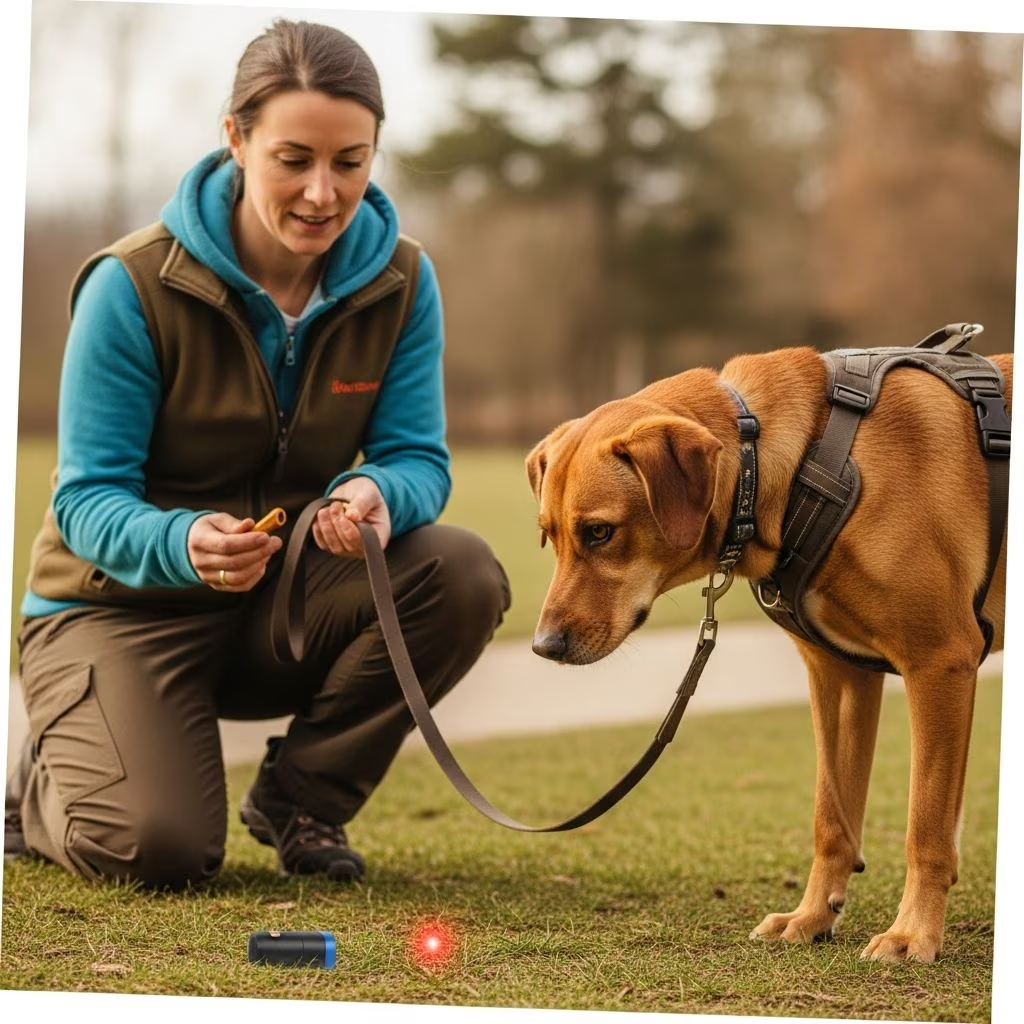
Walking your dog should be an enjoyable experience, yet many pet owners struggle with pulling, lunging, and inattention on the leash. Traditional approaches to leash training often rely on corrections or restraint, but modern training science reveals a more effective path forward. Precision point training offers a structured methodology that transforms how dogs understand leash walking by teaching them to focus on specific targets and respond to directional guidance. This approach combines marker training, reward positioning, and intentional body cues to create a dog that walks confidently alongside you rather than dragging you forward.
Understanding the Foundation of Target-Based Training
Before dogs can walk reliably on a leash, they must understand what you’re asking of them. Many traditional methods assume dogs instinctively know to stay beside their handler, but this requires explicit teaching. Target-based training begins with establishing clear communication channels between you and your dog. The foundation rests on three core elements: a marker system that identifies correct behavior, strategic treat placement that reinforces desired positioning, and consistent verbal cues that guide movement.
The marker system serves as a bridge between your dog’s action and their reward. This marker can be a clicker device or a verbal marker like “yes,” creating a distinct sound that signals to your dog they’ve performed correctly and a reward is imminent. When used consistently, your dog learns to associate this marker with success, making it far easier to identify the exact moment they’ve done something right compared to delayed rewards.
Unlike general obedience training, precision point training emphasizes location-based rewards. Rather than handing treats randomly, you position rewards near your leg or at specific points along your body. This teaches your dog that the valuable position isn’t just “somewhere near you” but a precise location where rewards appear. Over time, your dog naturally orients toward this target area because it’s become associated with positive outcomes.
Building the Marker Foundation Before Leash Work
Jumping directly into leash training without establishing a solid marker system often leads to confusion and slow progress. The marker must become automatic for your dog—they should instantly recognize it as a signal of reward availability. To build this foundation, begin in a distraction-free environment within your home.
Start by clicking or using your verbal marker in a quiet space. Immediately follow with a treat, delivered consistently. Repeat this sequence multiple times until your dog begins anticipating treats when they hear the marker. You’ll know the foundation is solid when your dog’s attention naturally turns toward you upon hearing the marker sound, even before you’ve reached for a treat.
Once the marker is established, practice using it in various situations before incorporating leash work. This pre-training phase might include marking moments when your dog looks at you voluntarily, when they sit, or when they move toward you. This flexibility with the marker prevents your dog from learning it means only one behavior—later on the leash, you’ll use the marker to reinforce many different correct choices.
Introducing Positional Targeting and Body Awareness
With a reliable marker in place, the next phase teaches your dog to maintain specific positioning relative to your body. This differs fundamentally from simply “not pulling.” Your dog learns that particular locations—typically your left or right leg—are reward zones. This targeted positioning creates a gravitational pull toward your leg without any physical correction or leash pressure.
Begin this phase while stationary. Stand in a neutral position with treats held at your leg. When your dog moves into the correct position beside you, immediately mark and reward at that spot. If your dog moves away, remain silent and still. When they relocate toward you, mark and reward again. The pattern teaches your dog that positioning at your leg produces rewards, while other locations don’t.
Gradually expand this training by taking a single step and repeating the process. Walk one step, pause, and reward your dog for being in the correct position. Increase to two steps, then three, always maintaining your marker and reward system. This methodical progression prevents your dog from developing pulling habits because they’re continuously rewarded for proximity before frustration builds.
Directional Cueing and Movement Transitions
Once your dog reliably maintains position during forward walking, introduce directional communication. Dogs naturally assume they know where they’re going on walks, often leading rather than following. Teaching specific directional cues reestablishes your role as the navigator and teaches your dog to check in with you before changing course.
Implement directional cueing through these methods:
- Named direction markers: Use distinct verbal cues such as “left,” “right,” or “turn” before you change direction. Say the cue, execute the movement, then mark and reward your dog as they follow your lead
- Attention cues for turns: Before turning, say your dog’s name to capture their focus. This brief attention check ensures they’re oriented toward you before navigating the directional change
- Speed variation cues: Teach “trot” or “close” for faster pace walking and slower-paced equivalents. These cues give your dog clear expectations about movement speed
- Gathering technique: Learn to efficiently shorten the leash without adding tension, then use this as a pre-movement cue that signals your dog to orient toward you because something is about to happen
Each directional cue pairs the verbal marker with immediate reward, reinforcing that your dog successfully understood and executed your request. This prevents the frustration many handlers experience when their dog seems unpredictably distracted—instead, you’ve created a communication system where your dog actively seeks your guidance.
Managing Leash Tension and Automatic Check-Ins
Even with solid training, situations will occur where your dog reaches the end of the leash. Rather than allowing tension to trigger pulling behaviors, precision point training teaches automatic check-ins at leash end. This transforms a potential problem into a training opportunity.
When your dog reaches leash end, immediately say their name to capture attention. The moment they turn and look back toward you, mark the behavior and reward. Repeat this consistently across multiple leash interactions. Your dog learns that reaching the leash’s end is actually a cue to check in with you rather than a signal to pull harder. Over many repetitions, this becomes automatic—your dog habitually looks back rather than straining forward.
Additionally, employ leash management techniques that reduce tension before it builds. A “dip” maneuver—temporarily lowering your hands to remove tension from the leash—can become a cue for your dog to reorient toward you. By removing tension consciously rather than allowing your dog to break it through pulling, you maintain control of communication and prevent rewarding pulling behavior.
Progressive Training in Real-World Environments
Most dogs perform beautifully in controlled environments but struggle when outdoor distractions emerge. Precision point training accommodates this by building environmental challenges gradually. Begin practicing in your home or quiet yard, then progress to less familiar locations as your dog demonstrates reliability.
The progression should follow this pathway:
- Establish all behaviors in your home environment with minimal distractions
- Practice in quiet outdoor spaces like empty parking lots or quiet residential streets
- Introduce mild distractions such as light traffic or other distant people
- Progress to moderately stimulating environments with pedestrian activity and environmental changes
- Finally, practice in highly stimulating settings like parks or downtown areas
At each environmental stage, you may need to increase reward frequency or return to shorter training sessions. This isn’t regression—it’s appropriate progression. Your dog’s understanding transfers across environments only when you systematically teach them that the same behaviors produce rewards regardless of location.
Selecting Appropriate Equipment and Tools
The right equipment supports precision point training without replacing it. A properly fitted harness or collar prevents neck pressure and allows your dog comfortable movement. For most dogs, a front-clipping harness encourages natural check-ins by redirecting pulling into a turn toward you, reducing strain by up to 98 percent while you teach the remaining behavioral component.
Leash selection matters equally. A standard six-foot fixed leash offers better control and clearer communication than retractable leashes, which create inconsistent tension and confusing signals. Your hand position on the leash should allow you to maintain steady pressure control while keeping your hands at a comfortable height. Many trainers hold treats in one hand while maintaining a relaxed leash grip in the other, allowing smooth marker-and-reward sequences during walking.
Troubleshooting Common Challenges
The Persistent Puller: Some dogs have deeply ingrained pulling habits. Return to stationary positioning work, rewarding heavily for correct placement. Gradually increase movement duration. Use equipment that reduces pulling’s effectiveness while you rebuild the behavioral foundation. Patience during this phase is critical—the dog must learn that pulling no longer works before they’ll invest energy in the new behavior.
Selective Attention: Dogs that ignore cues in stimulating environments may need higher-value rewards in those settings. Identify treats your dog finds irresistible and reserve them for challenging environments only. This creates extra motivation to pay attention where distraction is highest.
Inconsistent Handler Technique: Precision point training requires consistent marker placement, reward positioning, and cue usage. If different family members use different techniques, your dog receives conflicting messages. Establish household standards for cues, reward locations, and equipment setup. Brief all handlers on these specific techniques before they practice with your dog.
Integrating Play and Positive Communication
Leash training needn’t be serious business. Dogs respond enthusiastically to upbeat, playful energy during training. Use varied vocal tones, occasionally make exciting sounds to capture attention, and express genuine enthusiasm when your dog succeeds. This positive emotional context makes walking reinforcing in itself, not just a means to reach a destination.
Incorporate occasional brief play breaks during longer walks. A few seconds of play or an enthusiastic celebration of good leash behavior reinforces that walking with you is genuinely enjoyable. This emotional positive association becomes as important as treat rewards in maintaining long-term walking behavior.
FAQs About Precision Point Training for Leash Walking
How long until I see results? Most dogs show noticeable improvement within two to three weeks of consistent daily practice. Significant behavioral transformation typically requires four to eight weeks depending on the dog’s age, prior learning history, and training consistency.
Can this work for adult dogs or only puppies? Precision point training works effectively for dogs of all ages. Adult dogs sometimes learn faster than puppies because they can focus longer, though they may have more established habits to overcome.
What if my dog doesn’t respond to treats? Identify your dog’s highest-value motivators—some dogs prefer play, toys, or enthusiastic praise. Use these reinforcers instead of treats. The principle remains identical: mark correct behavior and immediately deliver what your dog finds rewarding.
Should I use this method exclusively or combine it with other training? Precision point training pairs well with other positive reinforcement methods. Avoid combining it with punishment-based techniques, which create conflicting messages about leash behavior.
Maintaining Long-Term Success
Once your dog demonstrates reliable leash walking, maintenance involves occasional reinforcement sessions. Continue rewarding excellent leash behavior even after perfect walking becomes your norm. This prevents extinction—the gradual fading of learned behaviors when rewards stop appearing. Monthly “refresher” training sessions with varying rewards and environments keep the behavior fresh.
Precision point training transforms leash walking from a frustrating struggle into a rewarding communication system between you and your dog. By establishing clear markers, teaching specific positional targets, introducing directional cues, and progressing through environmental challenges, you build a dog that walks confidently beside you while actively engaging with your guidance. This approach respects your dog’s learning capacity while creating the controlled, enjoyable walks that benefit both your physical activity and your relationship.
References
- How To Teach a Puppy To Walk on a Leash — American Kennel Club. 2024. https://www.akc.org/expert-advice/training/teach-puppy-walk-leash/
- Training Tips: Loose Leash Walking — San Diego Humane Society. 2024. https://sdhumane.org/resources/training-tips-loose-leash-walking/
- Ask Crystal: Leash Walking Training Tips — Blue Ridge Humane Society. 2024. https://www.blueridgehumane.org/leash-walking-training-tips/
- To Teach Loose Leash Walking, Loosen the Leash — Kiki Yablon Dog Training. 2019. https://kikiyablondogtraining.com/kiki-blog/2019/12/17/loose-leash-walking-lessons
- How to train your dog to walk nicely on the lead — RSPCA. 2024. https://www.rspca.org.uk/adviceandwelfare/pets/dogs/training/walknicely



