

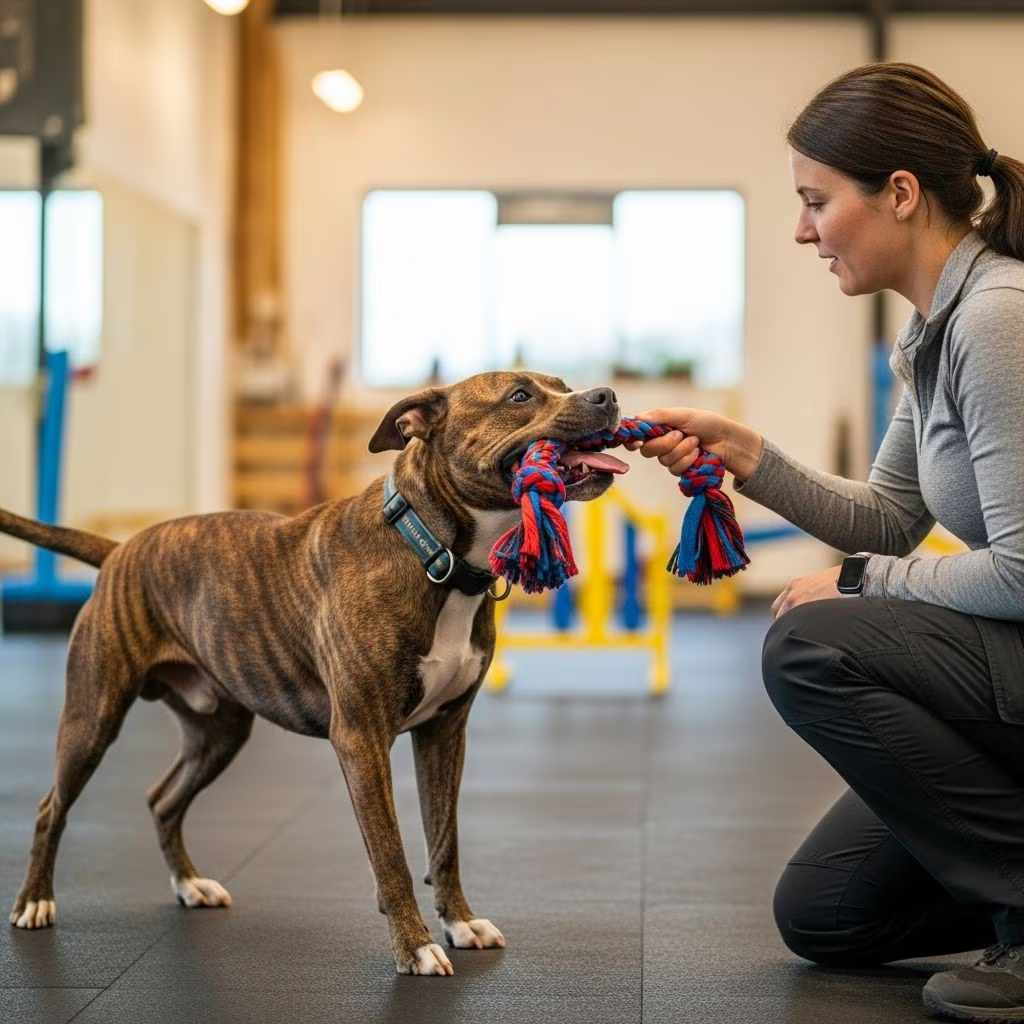
Play training offers a powerful, enjoyable way to address aggression in dogs by channeling their energy into positive interactions and building essential social skills. Unlike traditional correction-based methods, play leverages a dog’s natural instincts to foster trust, impulse control, and relaxed behavior, leading to lasting improvements in temperament.
Understanding Dog Aggression and the Role of Play
Dog aggression often stems from fear, frustration, resource guarding, or lack of socialization, manifesting as growling, snapping, or biting. Research in animal behavior reveals that **play fighting**, a common social activity among dogs, mimics aggressive behaviors like chasing, tackling, and neck biting but includes key signals—such as play bows and inhibited bites—that distinguish it from real conflict.
By incorporating structured play, owners can teach dogs to differentiate playful from serious interactions, reducing miscommunications that escalate to aggression. Studies by ethologists like Marc Bekoff demonstrate that dogs use meta-communication during play to ‘pretend,’ performing actions that look aggressive but signal fun, helping them negotiate relationships and form bonds.
For aggressive dogs, play provides a safe outlet to practice self-handicap behaviors, like rolling over or yielding, which build confidence and reciprocity without real threat.
The Science Behind Play Training for Aggression
Scientific observations over a decade show that play does not require a strict 50/50 role balance for dogs to enjoy it and benefit. Contrary to old myths, one dog can dominate play (e.g., pinning or slamming) while the other enthusiastically participates, as seen in pairs like Sage and Sam, where imbalance strengthened their friendship without escalation.
In littermate studies, puppies like Pink preferred assertive partners, initiating play more with dominant siblings, indicating dogs seek challenging play for social learning. For aggressive adults, like the German Shepherd Safi, who always took the top role, others still invited play, suggesting assertive interactions can reduce tension rather than provoke fights.
Critically, hundreds of hours of play observations found zero escalations to real fights in established pairs, affirming play’s safety and efficacy in aggression management. The American Veterinary Society of Animal Behavior (AVSAB) endorses play-based positive reinforcement over punishment, noting it prevents fear-aggression cycles.
Benefits of Play Training for Aggressive Dogs
Play training yields multiple benefits:
- Improves Bite Inhibition: Games like tug teach controlled mouthing, essential for dogs with poor inhibition.
- Boosts Impulse Control: Structured play practices ‘drop it’ and ‘wait,’ countering frustration-based aggression.
- Enhances Socialization: Mimics dog-dog interactions, rebuilding confidence around triggers.
- Reduces Arousal Aggression: Channels high energy safely, preventing over-stimulation bites.
- Strengthens Human-Dog Bond: Cooperative games build trust, outperforming treats in reinforcement.
Unlike wrestling, which risks human injury due to predation-style moves, play training emphasizes dog-appropriate activities.
Do’s and Don’ts of Play Training Aggressive Dogs
Success hinges on rules tailored to aggression-prone dogs.
Do’s
- Incorporate Training into Play: Use chase for recalls, tug for ‘take it/drop it,’ hide-and-seek for stays—making lessons fun and effective.
- Play Tug with Rules: Ideal for most dogs; teaches cooperation and mouth control. Let non-pushy dogs ‘win’ occasionally, per Rooney and Bradshaw’s study showing no relationship harm.
- Let Dogs Chase You: Builds reliable recalls without associating approach with chase.
- Use Toys for Engagement: Redirects aggression to objects, preserving focus during sessions.
Don’ts
- Avoid Wrestling/Teasing: High arousal mimics fights; risks bites even from good dogs.
- Never Chase Your Dog: Teaches fleeing from humans, worsening recall in aggressive scenarios.
- Skip Tug for High-Risk Dogs: Contraindicated for arousal-aggressive, poor-inhibition, or resource-guarders.
- Don’t Interrupt Balanced Play: Breaking up non-escalating rough play disrupts social language.
| Activity | Suitable for Aggressive Dogs? | Why/Alternatives |
|---|---|---|
| Tug-of-War | Yes, with rules | Builds control; avoid if guarding |
| Wrestling | No | Risks bites; use fetch instead |
| Chase (Dog Chases) | Yes | Improves recall |
| Play Fighting (Dog-Dog) | Yes, monitored | Teaches signals; no 50/50 needed |
Step-by-Step Play Training Program
Implement a 6-week program for gradual progress.
- Week 1: Assess and Prepare – Observe triggers; select toys; ensure vet clearance for underlying issues.
- Week 2: Build Foundations – Short tug sessions (5 mins) with ‘drop it’; reward calm releases.
- Week 3: Introduce Chase Games – Run away calling name; reward returns with play.
- Week 4: Social Play – Supervised dog park play; intervene only on signals of stress (lip licking, yawning).
- Week 5: Impulse Challenges – ‘Wait’ before tug; vary toy access to mimic resources.
- Week 6: Real-World Integration – Practice near triggers (e.g., strangers) using play breaks.
Track progress: Note reduced growls, increased play bows. Adjust for small dogs, often more aggressive due to inconsistent training.
Real-Life Success Stories
Sage and Sam’s decade-long play overcame initial pinning concerns, proving imbalance works. Safi, the dominant Shepherd, attracted playmates, reducing isolation aggression. A resource-guarder transformed via tug, learning shares without snaps. These align with AVSAB guidelines favoring play over dominance.
Early socialization prevents aggression across sizes; small dogs benefit equally.
Common Myths Debunked
- Myth: Tug Increases Aggression – Truth: No evidence; enhances control if taught properly.
- Myth: Rough Play Always Escalates – Truth: Never observed in studies.
- Myth: Training Can’t Mix with Play – Truth: Optimal combo for learning.
Frequently Asked Questions (FAQs)
Q: Can play training work for fear-aggressive dogs?
A: Yes; start low-arousal with toys, gradually expose to triggers, building positive associations.
Q: How do I know if play is turning aggressive?
A: Watch for inhibited bites, role reversals, play bows; stop if hard stares, tucked tail, or escalation.
Q: Is tug safe for puppies?
A: Yes, teaches bite inhibition early; supervise to prevent guarding.
Q: What if my dog resource-guards during play?
A: Skip tug; use two-toy trades to desensitize.
Q: How often should sessions last?
A: 5-15 mins, 2-3x daily; end on high note to avoid frustration.
Warnings and When to Seek Pros
Not for bite-history dogs without certified trainer (CPDT-KA). High-arousal cases need vets for medical checks. AVSAB warns against punishment.
References
- Is Your Dog’s Rough Play Appropriate? — Kinship. 2023. https://www.kinship.com/dog-behavior/your-dogs-rough-play-appropriate
- The Do’s and Don’ts of Playing with Your Dog — Kinship. 2023. https://www.kinship.com/dog-behavior/three-myths-about-playing-your-dog
- Are Small Dogs More Aggressive Than Large Dogs? — Adopt-a-Pet. 2024. https://www.adoptapet.com/blog/behavior-training/are-small-dogs-more-aggressive-than-large-dogs
- Position Statement on Puppy Socialization — American Veterinary Society of Animal Behavior (AVSAB). 2023-04-01. https://avsab.org/wp-content/uploads/2018/03/Puppy_Socialization_Position_Statement_Download_-_10-3-14.pdf
- Position Statement on Humane Dog Training — AVSAB. 2024-06. https://avsab.org/resources/position-statements/



