

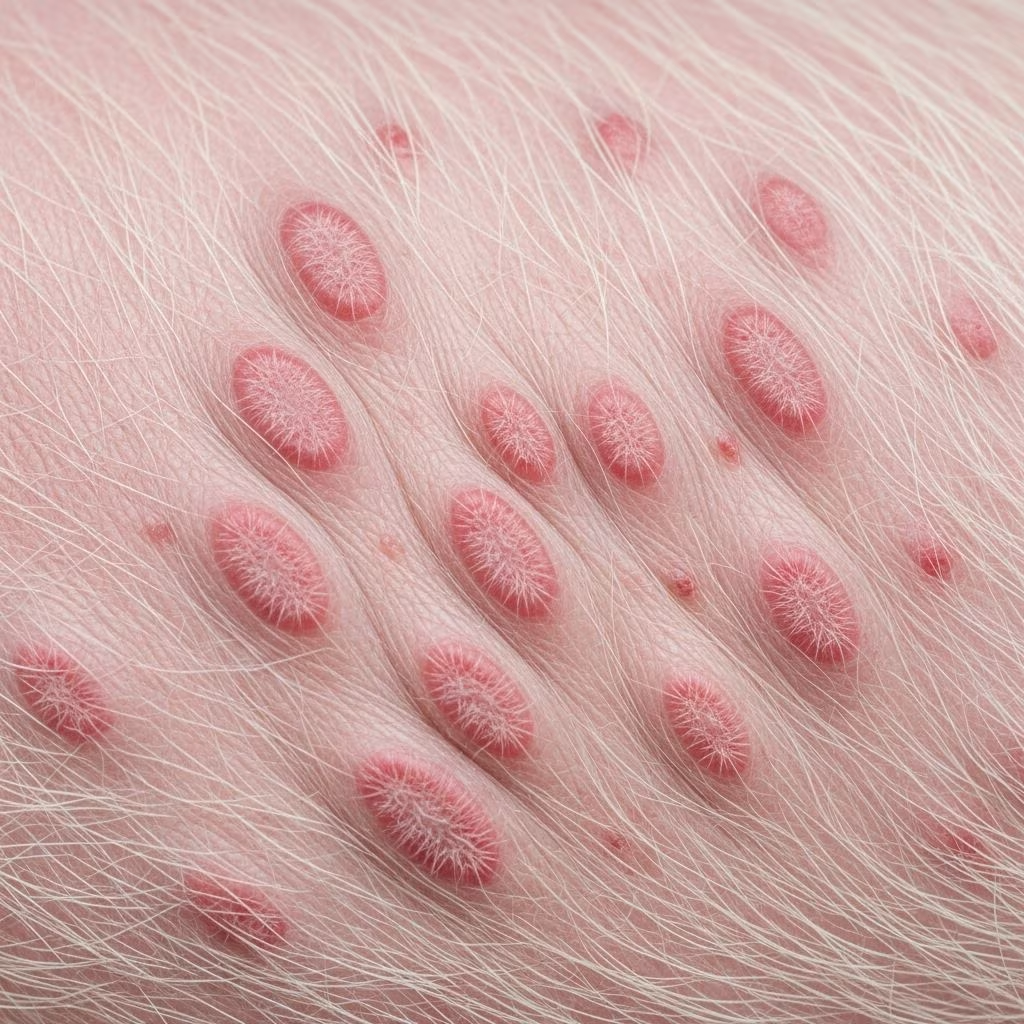
Pityriasis rosea, alternatively termed porcine juvenile pustular psoriasiform dermatitis, represents a distinctive dermatological condition primarily affecting young pigs. This disorder manifests through characteristic epidermal ring formations, typically observed on the underside of the abdomen and medial thigh regions. Unlike many infectious skin ailments, it poses no significant threat to overall health but can influence carcass quality at slaughter due to aesthetic alterations.
Clinical Presentation and Visible Signs
The hallmark of this condition involves the emergence of circular, ring-like epidermal lesions. These begin as small, elevated pustules that evolve into expanding rings with central healing, often displaying dry, flaky centers while the periphery remains active and erythematous. Lesions predominantly localize to the ventral abdomen, inner thighs, and occasionally extend to hind limbs, creating a pattern that aids in preliminary identification.
- Initial stage: Small, red pustules measuring a few millimeters in diameter.
- Progression: Rings enlarge up to several centimeters, with raised borders and clearing centers.
- Distribution: Primarily non-pruritic, sparing the face, ears, and extremities in most cases.
Affected pigs exhibit no systemic discomfort, maintaining normal appetite and growth trajectories. The condition’s sporadic nature means outbreaks may involve scattered individuals within a group rather than entire litters.
Epidemiology and Affected Populations
This dermatosis targets piglets aged 3 to 14 weeks, aligning with the post-weaning phase when environmental stressors peak. Incidence peaks in intensive production systems, potentially linked to genetic predispositions within certain breeds or lines. Reports indicate higher prevalence in pigs around two weeks old in some regions, suggesting early-life triggers.
Geographically, cases surface worldwide, with documentation from Europe, Asia, and North America. No strong seasonal patterns emerge, though indoor housing may facilitate observation. Morbidity remains low, typically under 10% of a cohort, with negligible mortality.
Potential Etiological Factors
The precise cause eludes definitive identification, distinguishing it from bacterial or parasitic counterparts. Current hypotheses center on hereditary components, as familial clustering occurs in affected herds. Genetic analyses propose an autosomal recessive inheritance, though confirmatory studies lag.
Environmental contributors, such as abrasive flooring or nutritional imbalances, may exacerbate lesion initiation, mirroring mechanisms in related dermatoses. Absence of identifiable pathogens in lesion cultures reinforces its non-infectious status. Ongoing research explores immune-mediated epidermal hyperproliferation akin to human psoriasiform conditions.
Differential Diagnosis: Distinguishing Similar Conditions
Accurate differentiation proves crucial to avoid unnecessary interventions. The table below outlines key comparators:
| Condition | Key Features | Age Group | Itch Level | Distribution |
|---|---|---|---|---|
| Pityriasis Rosea | Ring-like lesions, central healing | 3-14 weeks | Non-pruritic | Ventral abdomen, thighs |
| Swine Pox | Papules to scabs, occasional vesicles | All ages | Mild | Generalized, less ventral |
| Ringworm | Circular alopecia, crusty | Weaners/growers | Mild-moderate | Back, sides |
| Greasy Pig Disease | Greasy exudate, black crusts | Neonatal | Non-pruritic | Face, body |
| Mange (Sarcoptic) | Intense rubbing, papules | Variable | Severe | Whole body |
Swine pox merits exclusion due to vesicular elements, while ringworm involves fungal hyphae detectable via microscopy. Greasy pig disease, caused by staphylococcal toxins, presents acutely with systemic signs absent here.
Diagnostic Approaches
Diagnosis relies on characteristic morphology and history. Skin scrapings rule out mites, and fungal cultures exclude dermatophytosis. Histopathology reveals psoriasiform epidermal hyperplasia with pustule formation, lacking viral inclusions or bacteria. In ambiguous cases, biopsy confirms the pustular psoriasiform pattern.
- Visual inspection: Primary tool for field diagnosis.
- Microbiology: Negative for Staphylococcus, mites, fungi.
- Biopsy: Epidermal acanthosis, parakeratosis, Munro microabscesses.
Management and Treatment Strategies
Treatment proves unnecessary given the self-limiting course, resolving spontaneously within weeks without scarring. Severely affected pigs benefit from topical emollients to soften scales and enhance cosmetic recovery. Systemic antibiotics contraindicate absent secondary infection.
Slaughter considerations focus on organoleptic impact; lesions confined to ventral surfaces minimally affect carcass value. Quarantine isolates unnecessary due to non-contagious profile.
Prevention Through Husbandry Practices
Breeding selection against affected lines holds promise, though polygenic traits complicate eradication. Optimize housing to minimize abrasions: Provide soft bedding, ample space, and routine cleaning. Nutritional balance, particularly zinc and essential fatty acids, supports skin integrity.
- Select sires/gilts from unaffected pedigrees.
- Maintain dry, non-abrasive environments.
- Monitor early weaners for familial patterns.
Integrated biosecurity curbs differentials like ringworm or pox, indirectly benefiting overall skin health.
Economic Implications for Producers
Direct losses stem from downgraded carcasses, estimated at 1-2% value reduction in high-incidence herds. Indirect costs include diagnostic expenses and growth checks if confounded with treatable conditions. Proactive genotyping could yield long-term savings via selective breeding.
Research Frontiers and Future Directions
Genomic studies aim to pinpoint susceptibility loci, potentially enabling marker-assisted selection. Comparative dermatopathology with human pityriasis rosea unveils conserved pathways, fostering novel therapies. Field trials evaluate probiotic skin supplements for lesion mitigation.
Frequently Asked Questions (FAQs)
Is pityriasis rosea in pigs contagious?
No, it spreads neither between pigs nor to other species, confirmed by failed transmission attempts.
Can this condition affect adult pigs?
Rarely; it predominantly strikes juveniles under 14 weeks.
Does it impact pig growth or fertility?
No systemic effects occur; growth and reproduction remain unaffected.
How do I differentiate it from ringworm?
Ringworm causes hair loss and crusts dorsally; microscopy reveals fungi absent in pityriasis rosea.
Should I treat affected piglets?
Observation suffices; topicals aid aesthetics if destined for premium markets.
Case Studies from the Field
In a Korean outbreak, symptoms debuted at two weeks, resolving by market age without intervention. European reports highlight breed-specific risks, underscoring genetic screening value.
References
- Skin conditions – Pig Diseases – Farm Health Online — Farm Health Online. 2013. https://www.farmhealthonline.com/US/disease-management/pig-diseases/skin-conditions/
- Exudative Epidermitis in Pigs – Integumentary System — Merck Veterinary Manual. Accessed 2026. https://www.merckvetmanual.com/integumentary-system/exudative-epidermitis/exudative-epidermitis-in-pigs
- Cutaneous skin lesions in swine — SESC. 2008-11-17. https://sesc.cat/en/cutaneous-skin-lesions-in-swine/
- Porcine juvenile pustular psoriasiform dermatitis in Korea — Yoon & Lee. Semantics Scholar. https://www.semanticscholar.org/paper/Porcine-juvenile-pustular-psoriasiform-dermatitis-Yoon-Lee/43c09f30f73a5baf95207509a80f70e600288717
- Porcine Ringworm — NADIS. https://www.nadis.org.uk/disease-a-z/pigs/porcine-ringworm/
- Pityriasis Rosea in Pigs — Merck Veterinary Manual. Accessed 2026. https://www.merckvetmanual.com/integumentary-system/pityriasis-rosea-in-pigs-porcine-juvenile-pustular-psoriaform-dermatitis/pityriasis-rosea-in-pigs



