

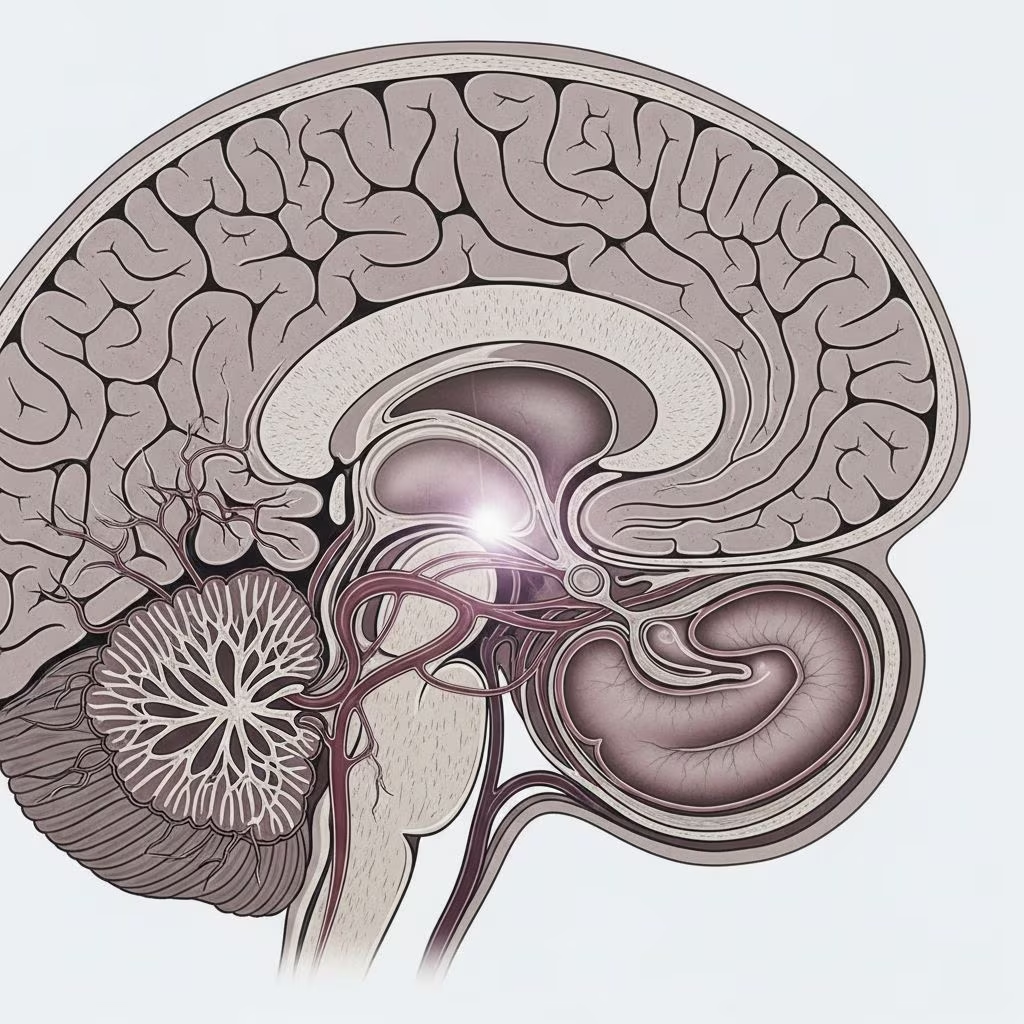
The pituitary gland stands as a cornerstone of the endocrine system in animals, orchestrating a wide array of physiological processes through its hormone secretions. Often dubbed the ‘master gland,’ it influences growth, metabolism, reproduction, and stress responses across diverse species, from domestic pets to livestock and wildlife. Nestled at the base of the brain, this small yet powerful organ integrates signals from the hypothalamus to maintain bodily homeostasis.
Anatomical Foundations of the Pituitary
The pituitary, or hypophysis, develops embryonically from Rathke’s pouch, an ectodermal invagination, interacting with neural tissues from the brain. This dual origin gives rise to its two primary divisions: the adenohypophysis (anterior pituitary) and the neurohypophysis (posterior pituitary), with an intermediate region in many species. In veterinary contexts, understanding these structures is crucial for diagnosing disorders in dogs, cats, horses, and farm animals.
Species variations abound. In mammals like dogs, the gland features distinct lobes, while in birds and fish, adaptations reflect evolutionary divergences. The gland’s position beneath the optic chiasm and its vascular connections via the hypophyseal portal system enable precise hormonal delivery.
Dissecting the Anterior Pituitary: Adenohypophysis
The adenohypophysis dominates the pituitary’s volume, comprising the pars distalis, pars tuberalis, and pars intermedia. The pars distalis houses chromophils (acidophils and basophils) and chromophobes, specialized endocrine cells producing tropic hormones.
- Acidophils: Somatotrophs secrete growth hormone (GH), promoting tissue growth and metabolism via insulin-like growth factor-1 (IGF-1) from the liver.
- Basophils: Include gonadotrophs (LH, FSH for reproduction), thyrotrophs (TSH for thyroid function), and corticotrophs (ACTH for adrenal cortex stimulation).
- Lactotrophs: Produce prolactin, essential for lactation and influenced by non-endocrine feedback.
The pars tuberalis supports the portal vasculature, aiding hypothalamic hormone transport. In dogs, the pars intermedia uniquely synthesizes ACTH alongside melanotrophs producing MSH. Cells exhibit cyclic activity, ramping up synthesis during high demand.
Posterior Pituitary: Neurohypophysis Mechanics
Unlike the glandular anterior lobe, the neurohypophysis serves as a storage and release site for hypothalamic hormones. Composed of the infundibulum, pars nervosa, and sometimes pars cava, it contains Herring bodies—axon terminals storing peptides.
Key hormones include:
- Antidiuretic hormone (ADH/vasopressin): Regulates water balance by enhancing kidney reabsorption; deficiency leads to diabetes insipidus.
- Oxytocin: Facilitates uterine contraction in labor and milk ejection; vital in reproductive veterinary care.
In dogs, anatomical subdivisions optimize hormone release into systemic circulation. Fish and amphibians show direct neural innervation variations, contrasting mammalian portal systems.
Hypothalamic-Pituitary Axis: The Command Pathway
The hypothalamus exerts dominance via releasing and inhibiting hormones delivered through the portal system. This neurovascular link ensures pulsatile secretion, critical for target organ responsiveness.
| Hormone | Hypothalamic Regulator | Target Effect |
|---|---|---|
| ACTH | CRH (stimulatory) | Adrenal cortisol release |
| TSH | TRH | Thyroid hormone production |
| GH | GHRH (stim), Somatostatin (inhib) | Growth and IGF-1 |
| Gonadotropins (LH/FSH) | GnRH | Gonadal steroidogenesis |
| Prolactin | Dopamine (inhib) | Mammary development |
Feedback loops refine control: short-loop (pituitary hormones inhibit hypothalamus) and long-loop (peripheral hormones like cortisol suppress both). Complex cases like GH involve metabolites.
Species-Specific Adaptations and Evolutionary Insights
Vertebrate evolution conserved the pituitary’s tri-lobed plan but diversified communication modes. Teleost fish feature direct hypothalamic innervation to endocrine cells, bypassing portals. Tetrapods rely on vascular delivery, with gap junctions and folliculostellate (FS) cells forming networks for paracrine signaling.
In poultry, arginine vasotocin parallels ADH, supporting osmoregulation. Mammalian pars intermedia varies: prominent in rodents for MSH, reduced in humans but relevant in dogs for Cushing’s disease. Orca whales exhibit scaled-up glands matching their size, underscoring physiological coordination.
Hormonal Feedback: Simplicity to Complexity
Tropic hormones like TSH and ACTH follow classic negative feedback from thyroid/adrenal hormones. Conversely, prolactin and GH engage peripheral tissues: prolactin via mammary glands, GH via hepatic IGF-1. Hypothalamic dual control (e.g., GHRH/somatostatin for GH) adds nuance.
FS cells, glial-like networks spanning 5-10% of anterior pituitary in mammals, facilitate intercellular communication, adapting to cycles like estrus. Plasticity in connexins supports dynamic responses.
Veterinary Relevance: Disorders and Diagnostics
Pituitary dysfunction manifests as hyperadrenocorticism (Cushing’s) in dogs from ACTH oversecretion, or hypopituitarism impairing growth. Diagnostics involve imaging (MRI), hormone assays, and suppression tests.
- Hypersecretion: Acromegaly (GH excess) in cats, PDH in dogs.
- Hyposecretion:
- Diabetes insipidus (ADH lack).
Therapies range from surgery to medications like trilostane for Cushing’s, emphasizing early detection.
Research Frontiers and Clinical Frontiers
Advances reveal homotypic/heterotypic cell networks maintaining pituitary integrity. Gap junction changes link to aging and physiological states. Vertebrate studies illuminate conserved mechanisms, aiding cross-species medicine.
In aquaculture, pituitary implants boost fish growth; in equine medicine, pars intermedia dysfunction causes PPID. Future therapies target hypothalamic-pituitary signaling for precision veterinary endocrinology.
Frequently Asked Questions (FAQs)
What is the main function of the animal pituitary gland?
It secretes hormones regulating growth, reproduction, metabolism, and stress via anterior tropic hormones and posterior neuropeptides.
How does the pituitary differ in dogs versus cats?
Dogs often develop pituitary-dependent Cushing’s due to pars intermedia ACTH; cats more prone to acromegaly from GH excess.
Can pituitary disorders be treated?
Yes, via medications (e.g., mitotane), radiation, or surgery, with prognosis varying by type and species.
What role does the hypothalamus play?
It releases factors via portal blood to control pituitary secretion patterns.
Is the pituitary similar across all animals?
Core structure is conserved, but innervation and lobe prominence vary, e.g., direct in fish, vascular in mammals.
References
- Overview of the Pituitary Gland in Animals — Merck Veterinary Manual. 2023. https://www.merckvetmanual.com/endocrine-system/the-pituitary-gland/overview-of-the-pituitary-gland-in-animals
- Pituitary Gland – Veterinary Histology — Ohio State University Pressbooks. 2023. https://ohiostate.pressbooks.pub/vethisto/chapter/pituitary-gland/
- Functional Pituitary Networks in Vertebrates — PMC/NCBI (Peer-reviewed). 2021-02-09. https://pmc.ncbi.nlm.nih.gov/articles/PMC7873642/
- Pituitary Function — Veterian Key. 2023. https://veteriankey.com/pituitary-function/
- Canine and Feline Pituitary Gland Diseases — dvm360. 2023. https://www.dvm360.com/view/canine-and-feline-pituitary-gland-diseases-proceedings



