

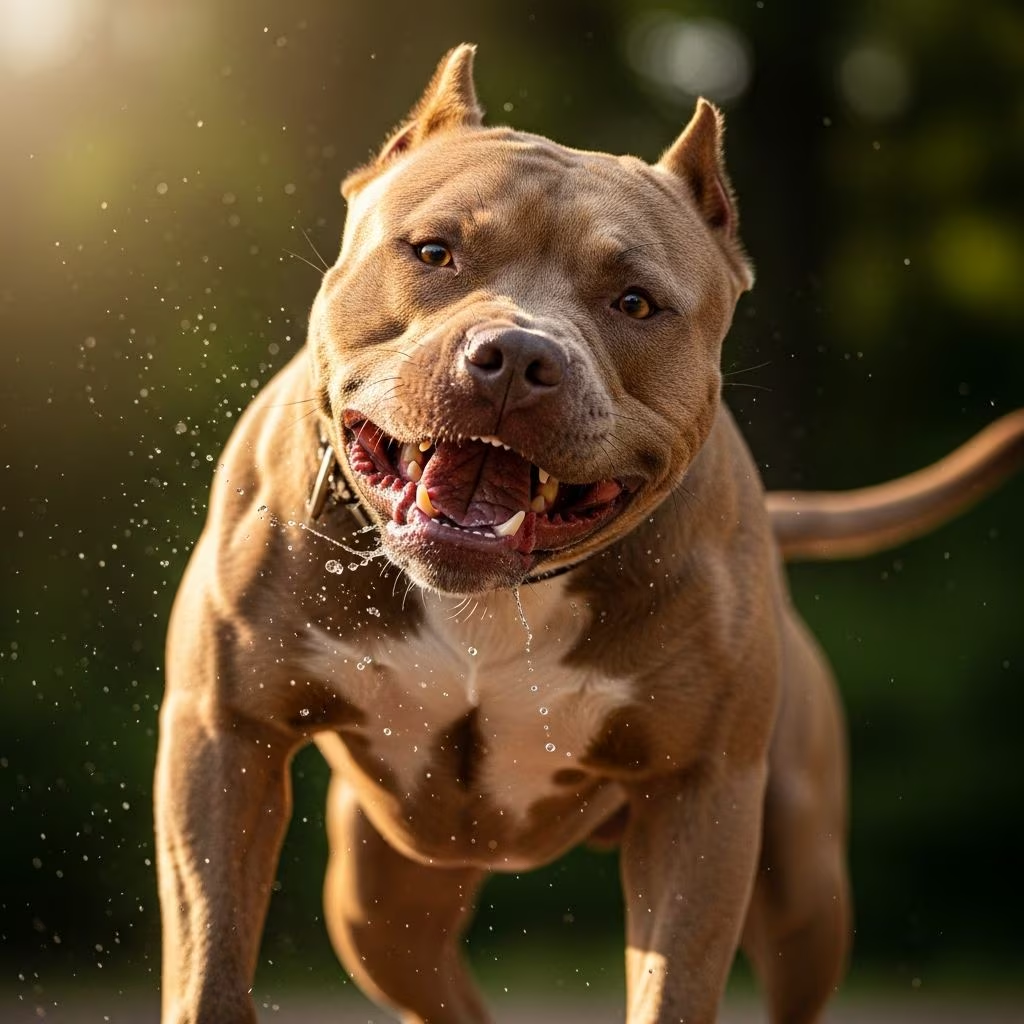
The notion that pit bulls possess an extraordinarily powerful bite has persisted for years, often fueled by sensational stories and misinformation. In reality, scientific studies show that pit bull bite force aligns closely with other dogs of similar size, debunking claims of superhuman jaw strength.
Understanding Canine Bite Force Basics
Bite force in dogs refers to the pressure exerted by the jaws during a bite, typically measured in pounds per square inch (PSI) or Newtons (N). This metric helps assess jaw mechanics but varies widely based on measurement methods and individual dogs.
Researchers use several approaches to quantify bite force:
- Geometric analysis of skull and jaw leverage.
- Electrical stimulation of jaw muscles in anesthetized dogs.
- Direct measurement during voluntary bites.
- Post-mortem modeling based on muscle cross-sections.
These methods yield different results, with stimulated bites often producing higher readings due to lack of self-limitation.
Myths Surrounding Pit Bull Jaw Strength
Common myths claim pit bulls have locking jaws or bite forces exceeding 2,000 PSI—figures far beyond any verified data. No peer-reviewed study supports a 2,700 PSI claim for pit bulls or any dog; such numbers stem from unverified anecdotes or backyard tests.
Another persistent falsehood is that pit bulls bite differently or more severely due to unique jaw structure. Scientific consensus refutes this: no evidence shows breed-specific bite mechanics beyond size correlations.
Actual Measurements from Reliable Studies
Real-world data paints a different picture. Dr. Brady Barr’s National Geographic study measured a pit bull at 235 PSI, lower than a Rottweiler (328 PSI) and comparable to a German Shepherd (238 PSI).
A comprehensive peer-reviewed study in the Journal of Anatomy calibrated bite forces in 20 domestic dogs under anesthesia. Canine tooth bites ranged from 147 N to 926 N (roughly 33-208 PSI), while molar bites reached up to 3,417 N (about 767 PSI). These forces scaled with body weight and skull morphology, not breed.
| Breed/Type | Average Bite Force (PSI) | Notes |
|---|---|---|
| Pit Bull-Type | 235 | Below average for tested breeds |
| German Shepherd | 238 | Similar size comparison |
| Rottweiler | 328 | Higher due to larger build |
| Kangal | 743 | Strongest measured; largest breed |
| Overall Average | 325 | Across multiple breeds |
Bite force increases with dog size, shorter jaws, and wider skulls in medium-to-large breeds, explaining variations without breed specificity.
Factors Influencing Bite Strength in Dogs
Size dominates bite force determinants. Larger dogs generate more power due to greater muscle mass and leverage. A 30 kg dog outlier bit weaker than expected, highlighting individual variation.
Skull shape matters: breeds with robust temporalis muscles and efficient jaw pivots produce higher forces. However, no method consistently links pit bull morphology to exceptional power.
Behavior plays a role—dogs rarely use maximum force in real conflicts to avoid injury. Anesthetized measurements represent theoretical maxima, not typical bites.
Comparing Pit Bulls to Other Breeds
Pit bulls, typically 40-60 lbs, fall mid-range. Mastiffs and Kangals, much larger, top charts. Rottweilers edge out pit bulls slightly due to mass.
Studies emphasize: bite severity ties to the dog’s overall strength and energy, not genetics alone. Pit bulls match peers like Labs or Shepherds in comparable weights.
Implications for Safety and Ownership
Understanding true bite dynamics shifts focus from breed bans to responsible practices. Training, socialization, and health management reduce risks more effectively than stereotypes.
Any dog can bite under stress; prevention involves recognizing triggers like fear or pain. Owners should prioritize positive reinforcement and professional guidance.
Health Considerations for Jaw Strength
Dental issues or muscle atrophy can weaken bites. Regular vet check-ups ensure optimal jaw function. Obesity burdens the temporomandibular joint, potentially reducing power.
Debunking PSI vs. Newton Confusion
Many myths misuse PSI (pressure) instead of Newtons (force). Studies favor Newtons for accuracy. Converting roughly: 1 PSI ≈ 6,895 N/m², but direct canine data uses N.
Frequently Asked Questions
Do pit bulls have the strongest bite of any dog?
No. Larger breeds like Kangals measure up to 743 PSI; pit bulls average 235 PSI.
Is pit bull bite force higher than a human’s?
Yes, but comparable to many breeds. Average human bite is 120-160 PSI; dogs exceed this based on size.
Can bite force predict aggression?
No. Aggression stems from behavior, not jaw power. Capability doesn’t equal intent.
How is dog bite force scientifically measured?
Via jaw stimulation, skull modeling, or force sensors. Results vary by method and dog.
Does neutering affect bite force?
Indirectly, via muscle tone changes, but studies focus on size over hormones.
Expert Insights on Canine Jaw Mechanics
Peer-reviewed calibration shows models underestimate live forces by 39-61%. Adjusted equations using body weight and fossa dimensions predict accurately.
Cross-sectional muscle area, especially temporalis (85% of power), drives force. Pterygoids add minor contributions.
Historical Context of Bite Force Research
Early studies like Lindner (1995) measured voluntary bites; modern ones refine with anesthesia for maxima. No breed outliers emerge.
National Geographic tests popularized data, consistently placing pit bulls mid-pack.
Practical Advice for Dog Owners
- Measure your dog’s size accurately to gauge expected force.
- Avoid provocation; respect space.
- Train for bite inhibition from puppyhood.
- Consult vets for jaw health issues.
Knowledge empowers safe coexistence. Pit bulls, like all dogs, thrive with facts over fear.
References
- Myth Busted: Pit Bulls Don’t Bite Differently — Animal Farm Foundation. 2022. https://www.animalfarmfoundation.org/myth-busted-pit-bulls-dont-bite-differently/
- Pit Bull Myths vs. Facts — ARWOB.org. 2022. https://www.arwob.org/info/file?file=s2148m6372.pdf
- Calibration of estimated biting forces in domestic canids — Journal of Anatomy (PMC). 2008-05-22. https://pmc.ncbi.nlm.nih.gov/articles/PMC2423399/
- Myths & Facts — Prince George’s Pet Unity Project. 2023. https://www.petunityproject.org/myths
- Misconceptions About Pit Bull Bites — PitbullHero. 2023. https://www.pitbullhero.org/misconceptions-about-pit-bull-bites
- Pit Bull Myths Debunked! — Animal Justice League. 2022-01. http://www.animaljla.org/wp-content/uploads/2022/01/Pit-Myths-Debunked-Website.pdf



