

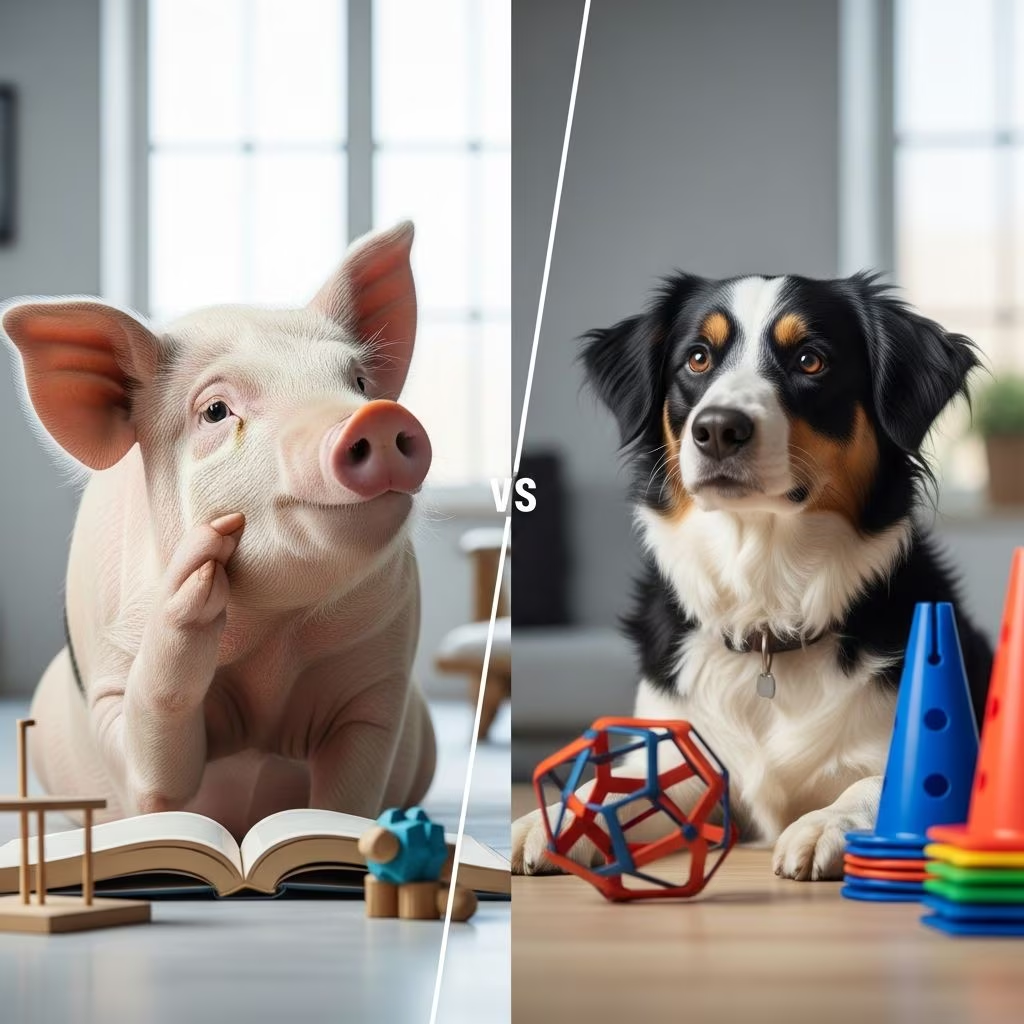
Scientific studies increasingly reveal that pigs possess cognitive abilities rivaling or surpassing those of dogs in key areas like problem-solving and memory, though dogs maintain an edge in human-directed communication. This comparison draws from decades of research highlighting both species’ remarkable mental capacities.
Defining Animal Intelligence Beyond Human Standards
Intelligence in animals encompasses learning from experience, adapting to new situations, and making decisions based on memory and foresight. Pigs demonstrate a grasp of time passage, object differentiation, and self-awareness, traits that align them cognitively with three-year-old human children who explore playfully and express preferences. Dogs, while highly trainable, often rely on human cues rather than solo efforts, shaping their intelligence profile uniquely through domestication.
Researchers measure these skills via tasks testing memory retention, spatial navigation, and emotional recognition. Pigs excel in win-shift foraging strategies, remembering food locations over hours and avoiding empty sites, unaffected even by social stress. This robustness underscores their independent cognitive processing.
Cognitive Benchmarks: Pigs Outshine in Solo Challenges
Pigs consistently outperform dogs in tasks demanding self-reliance. In joystick-based video games, pigs hit targets more adeptly, showcasing fine motor control and learning speed. They also distinguish their own drawings from others’, indicating self-recognition and abstract thinking absent in many species.
Problem-solving tests place pigs ahead: presented with inaccessible food, pigs persist independently, using tools or memory, while dogs seek human aid. A Hungarian study at Eotvos Lorand University observed 11 miniature pigs staring frustratedly at a box only humans could open, unlike dogs who communicated effectively with owners.
| Task Type | Pigs Performance | Dogs Performance |
|---|---|---|
| Independent Problem-Solving | Persist solo, use tools | Seek human help |
| Memory Retention (2 hours) | Recall food sites accurately | Variable, context-dependent |
| Video Game Joystick | Superior targeting | Less adept |
| Spatial Foraging | Win-shift strategy robust | Good but stress-affected |
This table summarizes key experimental outcomes, drawn from controlled studies.
Dogs’ Mastery of Human Interaction
Dogs shine in socio-communicative skills honed by millennia of cohabitation. They gaze between owners and objects, establishing eye contact to solicit help, a trait pigs show less spontaneously. In two-way choice tasks, dogs follow human pointing gestures above chance levels, while pigs orient more to bodies than faces, especially without rewards.
Such behaviors stem from domestication: dogs adjust to visual human signals readily, whereas pigs, despite trainable pointing response, prioritize self-directed exploration. Pigs match dogs in basic orientation and touching during neutral conditions but lag in face-focused communication.
Emotional Depth and Social Complexity
Both animals display rich emotional lives. Pigs recognize names, dream, follow commands, and seek human comfort, mirroring dogs’ affection. A review by neuroscientist Dr. Lori Marino and Prof. Christina Colvin details pigs’ cognition, emotion, self-awareness, personality, and social traits comparable to dogs and chimpanzees.
Pigs exhibit distinct personalities, play creatively, and empathize, outperforming three-year-olds on some cognitive mirrors—not ‘magic’ to them, indicating self-awareness. They learn tricks like fetching, differentiating balls from frisbees, and hold long-term memories rivaling primates.
Memory and Learning: Long-Term Retention Compared
Pigs’ spatial memory endures: over 10-minute to 2-hour intervals, they relocate valuable sites precisely. This holds under stress, unlike some dog performances. Pigs also grasp object permanence and temporal concepts, informing future decisions.
- Working Memory: Pigs navigate mazes and discrimination tasks flawlessly.
- Foraging Intelligence: They strategize searches, adapting to changing rewards.
- Tool Use: Emerging evidence shows pigs manipulating objects creatively.
Dogs learn quickly via reinforcement but depend more on social cues, per interspecific studies.
Implications for Welfare and Perception
Recognizing pigs’ intellect challenges factory farming stereotypes, urging better welfare standards akin to companion animals. Their problem-solving persistence and emotional range demand enriched environments for play and exploration. Dogs’ human affinity makes them ideal pets, but pigs’ independence suits them for therapy or farm roles with stimulation.
Comparative psychology reveals no single ‘smarter’ species; contexts matter. Pigs lead in autonomy, dogs in partnership.
Common Myths Debunked
- Myth: Pigs are dirty. They are clean, intelligent manipulators of environments.
- Myth: Dogs are always smarter. Pigs surpass in non-social cognition.
- Myth: Intelligence is linear. Multispecies tests show nuanced profiles.
FAQs
Are pigs smarter than dogs overall?
No absolute winner; pigs excel independently, dogs socially.
Can pigs learn tricks like dogs?
Yes, including fetching and video games.
How do pigs compare to children?
Cognitively akin to three-year-olds in exploration and emotion.
Why do dogs communicate better with humans?
Domestication enhanced eye contact and gesturing.
What tasks do pigs outperform dogs in?
Solo problem-solving, memory, joystick control.
References
- Pig Intelligence — New Roots Institute. Accessed 2026. https://www.newrootsinstitute.org/articles/pig-intelligence
- Pig Cognition and Behavior Compares Favorably to Dogs and Primates — Farm Sanctuary. 2015 (authoritative review). https://www.farmsanctuary.org/news-stories/pig-cognition-behavior-compares-favorably-to-dogs-and-primates/
- Don’t Do It Yourself: Why Dogs Trump Pigs at Problem Solving — Jim Carroll’s Blog. 2023-06-29. https://www.jimcarrollsblog.com/blog/2023/6/29/9gynnujrf5dsrzlvzgkl29qu0rz3bd
- Pigs Are Intelligent and Clean Animals, Actually — Sentient Media. Accessed 2026. https://sentientmedia.org/pig-intelligence/
- Comparing interspecific socio-communicative skills of socialized dogs and pigs — PMC (Peer-reviewed). 2019-10-23. https://pmc.ncbi.nlm.nih.gov/articles/PMC6834752/
- Thinking Pigs: A Comparative Review of Cognition, Emotion, and Personality — Wellbeing International Studies Repository (Academic PDF). Accessed 2026. https://www.wellbeingintlstudiesrepository.org/cgi/viewcontent.cgi?article=1042&context=acwp_asie



