

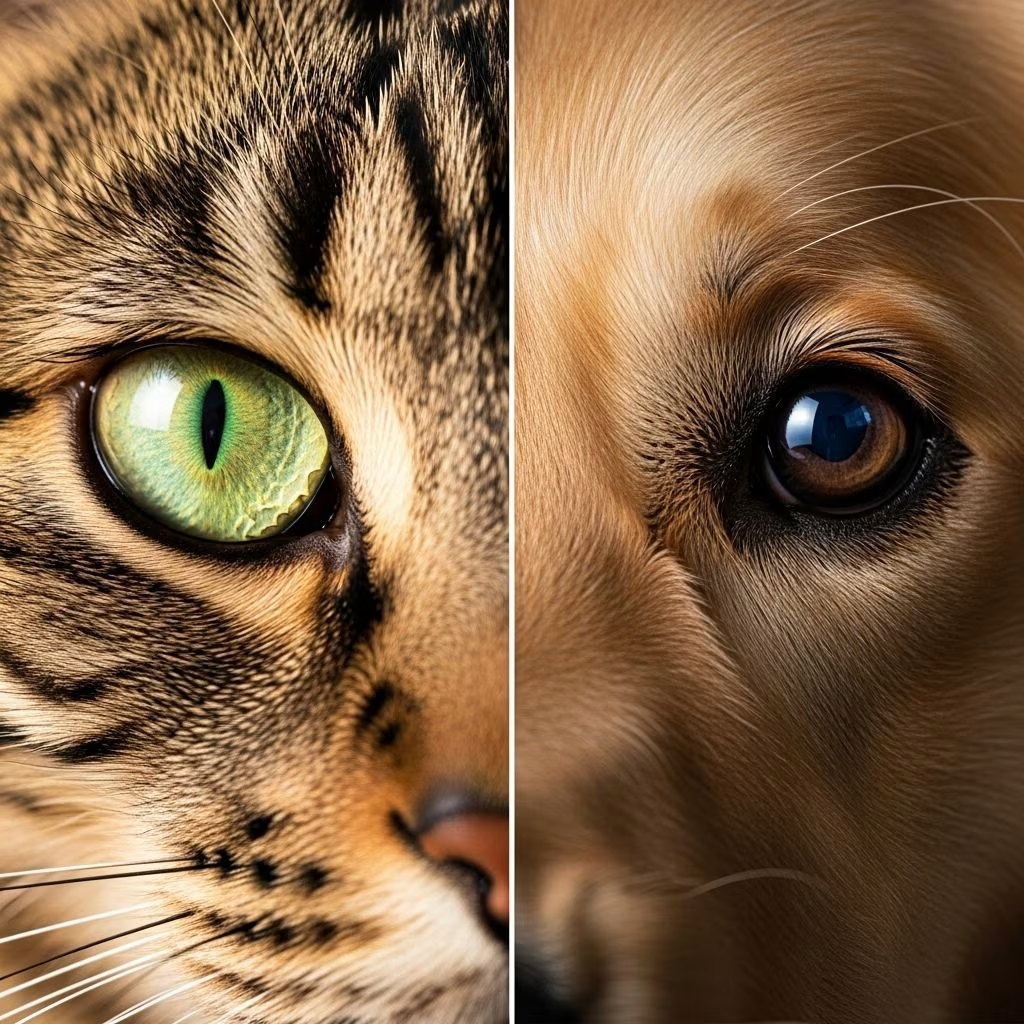
The eyes of our feline and canine companions hold remarkable adaptations shaped by evolution for hunting, survival, and navigating their environments. While humans enjoy sharp color vision and detailed daytime sight, cats and dogs prioritize motion detection and low-light performance, revealing a world filtered through rods, cones, and specialized structures like the tapetum lucidum.
Evolutionary Foundations of Feline and Canine Eyesight
Cats and dogs descended from nocturnal predators, leading to visual systems optimized for dawn, dusk, and darkness rather than broad daylight clarity. Cats, as solitary hunters, developed eyes for precise pouncing on nearby prey, while dogs, pack animals, evolved broader peripheral awareness for group coordination and distant tracking. These differences manifest in retinal cell distribution, pupil shapes, and eye positioning.
Rods dominate their retinas—photoreceptors sensitive to low light and motion—outnumbering cones, which handle color and fine detail. Humans possess about 120 million cones for vibrant hues, but cats have roughly one-tenth that amount, trading color richness for shadowy prowess. Dogs follow a similar pattern, with even fewer cone varieties, emphasizing their reliance on scent and sound over visual specificity.
Decoding Color Perception in Pets
Human trichromatic vision relies on three cone types detecting red, green, and blue wavelengths. Dogs, dichromats with only blue and yellow-sensitive cones, perceive reds as murky browns and confuse greens with yellows. This limited palette—blues, yellows, grays—suffices for identifying prey against natural backdrops but falters in artificial settings with vivid toys or foods.
Cats edge closer to trichromacy yet still falter on reds and oranges, viewing them dimly due to fewer red-sensitive cones. Their world appears desaturated, akin to human protanopia (red-blindness), where reds fade into dark tones. Despite this, both species discern blues and yellows effectively, explaining preferences for blue toys that mimic sky or water reflections.
| Aspect | Cats | Dogs | Humans |
|---|---|---|---|
| Cone Types | 3 (limited red) | 2 (blue/yellow) | 3 (full spectrum) |
| Color Range | Blue, yellow, gray; poor red/orange | Blue, yellow; red as brown | Full RGB |
| Best For | Short-range hunting | Distant motion | Detail & color |
Night Vision: The Tapetum Lucidum Advantage
A iridescent layer called the tapetum lucidum lies behind the retina in both cats and dogs, reflecting light back through photoreceptors for a second pass. This boosts low-light sensitivity dramatically—cats need just 1/6th the light humans require, seeing clearly at levels where we’d stumble blindly. The glow-in-the-dark eye shine stems from this mirror-like structure, scattering flashlights or moonlight.
Cats surpass dogs here, with a denser tapetum and more rods, making their night vision roughly twice as efficient. Larger corneas and slit pupils further amplify light intake; cat pupils dilate to massive circles in dimness or narrow to slits in brightness, a range far exceeding human capabilities. Dogs’ round pupils expand broadly too, supported by bigger eyes in many breeds, granting solid but secondary nocturnal sight.
- Cats: 200° field, elite low-light (1/6 human needs), slit pupils for control.
- Dogs: 240-280° field, good low-light, round pupils for volume.
- Shared: Tapetum glow, rod-heavy retinas for motion in dark.
Field of View and Depth Perception Trade-offs
Eye placement dictates visual scope. Human forward-facing eyes yield 180° fields with overlapping binocular zones for depth judgment. Cats’ slightly frontal positioning grants 200° peripheral vision—enough to spot sideways prey while fixating ahead—yet sacrifices some depth for hunting agility.
Dogs’ lateral eyes expand fields to 240-280°, ideal for scanning horizons during pursuits, but reduce binocular overlap, weakening depth cues. Breed variations amplify this: brachycephalic faces (Pugs) mimic cat-like frontality, while sighthounds (Greyhounds) maximize side vision. Both pets suffer nearsightedness—cats falter beyond 20 feet, dogs struggle under a foot—relying on whiskers, hearing, and smell for close or far tasks.
Visual Acuity: Clarity in the Shadows
Acuity measures detail resolution. Human 20/20 vision means discerning at 20 feet what a normal eye sees at that distance. Cats average 20/100 to 20/200—blurry beyond medium range—optimized for pouncing, not reading. Dogs vary by breed but generally match or exceed cats in distance, spotting hand signals from afar despite color limits.
Central vision zones differ: cats’ “visual streak” packs rods for motion streaks, dogs’ “area centralis” mirrors this with rod density over human foveal cones. A third eyelid (nictitating membrane) in both keeps eyes moist without blinking, aiding prolonged focus—humans envy this during screen time.
Unique Anatomical Features Enhancing Sight
Cat corneas are large and elliptical, funneling light efficiently; dogs’ vary by breed but often feature more eyelashes for protection. Both boast moisture-rich tears preventing dry-out, and pupils adapting dynamically. These traits, plus superior motion detection, make pets adept at tracking scurrying rodents we might miss.
Common Eye Conditions in Cats and Dogs
Despite adaptations, pets face vision threats. Cataracts cloud lenses, common in aging dogs (e.g., Labs), surgically treatable. Glaucoma raises pressure, painful in both species—early vet checks save sight. Cats risk conjunctivitis from viruses, dogs dry eye (keratoconjunctivitis sicca). Breed predispositions: Siamese cats for progressive retinal atrophy, Boston Terriers for cherries eye.
Preventive care includes annual exams, UV-protective goggles for outdoors, and diet rich in antioxidants like lutein from carrots or fish. Symptoms to watch: cloudiness, redness, squinting, bumping objects—prompt intervention preserves their vital senses.
Tips for Supporting Your Pet’s Vision Health
Enhance their world with blue/yellow toys for visibility. Provide dim-lit play at dusk to leverage strengths. Regular grooming clears eye gunk, and omega-3 supplements bolster retinal health. Avoid human meds; consult vets for drops or surgery.
FAQs on Cat and Dog Eyesight
Do cats see better than dogs at night?
Yes, cats’ denser rods and tapetum make them superior in true darkness, about twice as efficient as dogs.
Can dogs see colors?
Dogs see blues and yellows but interpret reds as browns due to dichromatic cones.
Why do pet eyes glow in photos?
The tapetum lucidum reflects flash, causing the eerie shine absent in human eyes.
How far can cats see clearly?
Cats are nearsighted, sharp up to 20 feet, relying on other senses beyond.
Are there vision differences by dog breed?
Yes, head shape affects eye position—wide-set for herders, forward for hunters.
References
- Cats and dogs and how they see — Yummypets. 2017-03-09. https://www.yummypets.com/mag/2017/03/09/96812/the-eyes-and-vision-of-cats-and-dogs
- The Vision Of Cats Vs. Dogs — Eye Consultants of Atlanta. N/A. https://www.eyeconsultants.net/the-vision-of-cats-vs-dogs/
- How Cats and Dogs See the World — YouTube (Seeker). N/A. https://www.youtube.com/watch?v=19GZbHVXCm0
- Let’s paws to talk about pet eyesight — Michiana Eye Center. N/A. https://www.michianaeye.com/blog/85570-lets-paws-to-talk-about-pet-eyesight
- The Dish on Dog and Cat Vision — Animal Arts. N/A. https://www.animalarts.com/the-dish-on-dog-and-cat-vision/
- Understanding the anatomy of the eye (cats and dogs) — Dechra UK. N/A. https://www.dechra.co.uk/companion-animal/ophthalmology/anatomy-of-the-eye
- How are my eyes different from other animals? — CEENTA. N/A. https://www.ceenta.com/news-blog/how-are-my-eyes-different-from-other-animals



