Pet Poison Metabolism: 4 Key Pathways, Signs, And Care
Understand how pets process toxins through absorption, liver transformation, and excretion to enable timely interventions.
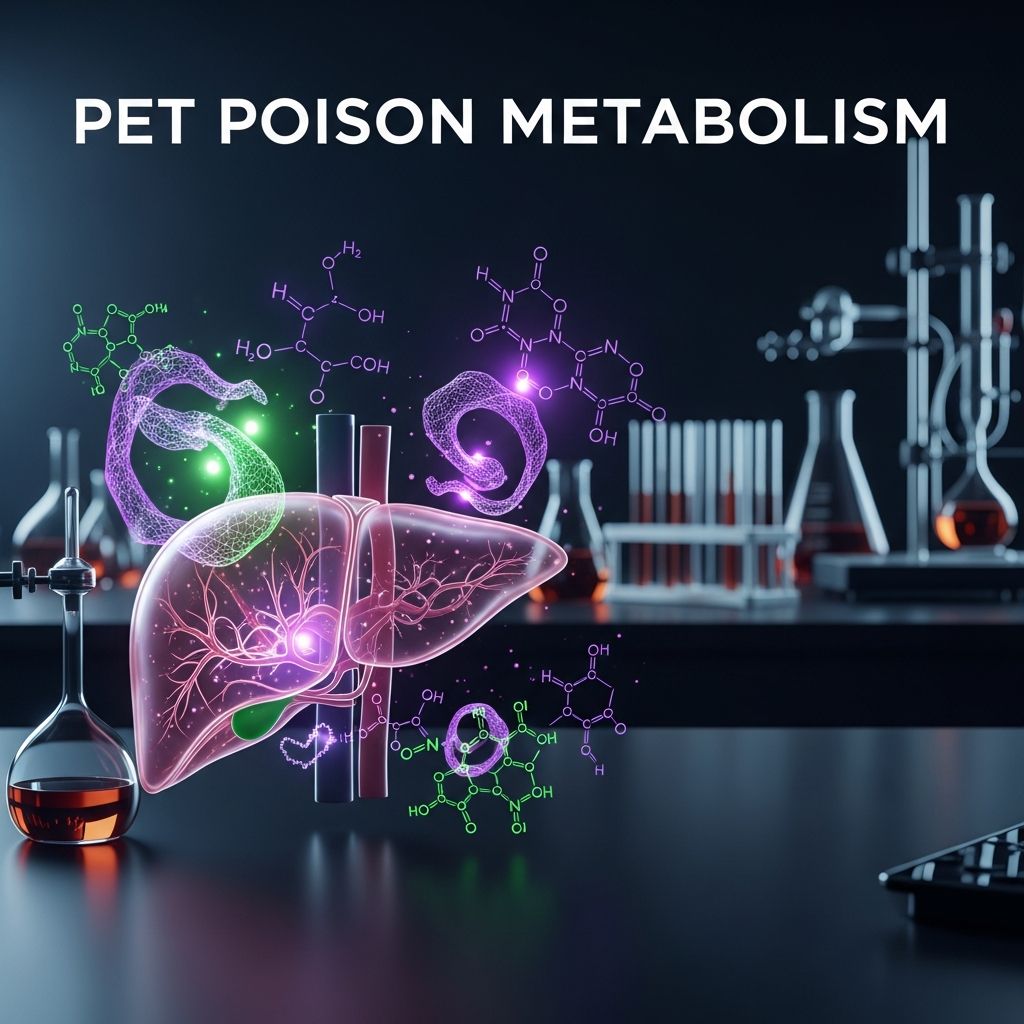
Pet Poison Metabolism
Animals encounter toxins through ingestion, inhalation, or skin contact, triggering complex metabolic responses aimed at neutralization and elimination. The liver plays a central role in biotransformation, converting harmful substances into excretable forms via enzymatic phases, though species variations can amplify risks.
Routes of Toxin Entry into the Pet’s System
Toxins primarily gain access via the gastrointestinal tract after oral exposure, which is common in curious pets. Absorption speed depends on the substance’s solubility and pH; weak acids absorb faster in acidic stomachs, while bases favor intestinal environments. Cats exhibit quicker GI transit than dogs or humans, hastening uptake of sustained-release drugs. Dermal absorption occurs with lipid-soluble poisons like pesticides, and inhalation suits volatile gases.
- Oral ingestion: Fastest for liquids and small particles; solids delay due to dissolution.
- Skin contact: Favors non-polar compounds crossing lipid barriers.
- Respiratory: Rapid for aerosols, distributing via bloodstream instantly.
Distribution Patterns Across Pet Tissues
Once absorbed, toxins circulate in plasma, partitioning into tissues based on lipophilicity. Highly fat-soluble compounds accumulate in adipose, prolonging exposure as they slowly release. Liver and kidneys receive high portal blood flow, concentrating initial loads. Certain toxins target specifics: paraquat localizes to lungs. Postmortem redistribution can alter concentrations due to tissue breakdown.
| Toxin Property | Distribution Preference | Pet Impact Example |
|---|---|---|
| Lipophilic | Fat depots, brain | Persistent CNS depression |
| Hydrophilic | Plasma, kidneys | Quick urinary clearance |
| Protein-bound | Liver, extracellular fluid | Delayed metabolism |
Phase I: Initial Chemical Modifications
The first metabolic stage introduces reactive groups through oxidation, reduction, or hydrolysis, primarily via cytochrome P450 enzymes in hepatocytes. This often activates inert toxins into proximate forms, like converting organophosphates to lethal analogs—a process termed lethal synthesis. Products become polar for phase II or direct excretion if soluble enough.
Cats show P450 variations, struggling with phenolic structures. Pyrogens lose fever-inducing power here, raising pain thresholds temporarily.
Phase II: Conjugation for Safe Excretion
Phase II attaches endogenous molecules like glucuronic acid or sulfate, enhancing water solubility. Common in most species, but cats lack sufficient glucuronyl transferase for morphine or phenols, slowing detox. They compensate partially via glycine but remain vulnerable. Acetylation falters due to arylamine N-acetyltransferase deficiency.
- Glucuronidation: Primary for phenols; cat impairment key in acetaminophen cases.
- Sulfation: Backup pathway, limited in felines.
- Glycination: Cat alternative, though inefficient.
Species-Specific Vulnerabilities in Pets
Dogs handle diverse toxins robustly, but cats’ enzyme shortages heighten risks. For acetaminophen, cats’ poor glucuronidation/sulfation yields toxic NAPQI, depleting glutathione and causing methemoglobinemia via para-aminophenol oxidation of hemoglobin. Half-life extends to 5 hours versus 1.1 in dogs. Birds and reptiles show unique profiles, often lacking mammalian pathways.
Prior exposures can induce enzymes, building tolerance temporarily.
Primary Excretion Pathways
Kidneys filter water-soluble metabolites into urine, bile carries others to feces, and lungs expel volatiles. Fat-stored lipophiles re-enter circulation slowly. Milk excretion risks nursing young. Volatility matters; improper storage loses samples.
- Renal: Ionized, polar toxins; pH manipulation aids.
- Hepatobiliary: Large conjugates via enterohepatic recirculation.
- Pulmonary: Gases like ethanol vapors.
- Mammary: Lipophilic to milk.
Case Study: Acetaminophen in Cats
Acetaminophen (APAP) exemplifies metabolic pitfalls. Rapid GI absorption precedes P450 oxidation to NAPQI, which glutathione normally neutralizes. Cats’ conjugation deficits allow NAPQI to ravage liver membranes and, via para-aminophenol, induce Heinz bodies and methemoglobinemia. Monitor blood methemoglobin 2-4 hours post-ingestion; peaks early. Liver enzymes rise by 24 hours. Treatment: charcoal pre-methemoglobinemia, avoid emesis due to speed.
Practical Management of Toxicoses
Decontamination targets absorption: emetics for GI, charcoal adsorption. Diuresis enhances renal clearance. Monitor toxico kinetics—absorption rate, distribution volume, biotransformation, elimination. Ethanol toxicoses show zero-order elimination at high doses, with hypoglycemia from gluconeogenesis block. Hemodialysis accelerates for severe cases.
Veterinary toxicology demands rapid ID, toxico kinetic assessment, and species-tailored therapy. APCC data: cats 14% of calls 2005-2014.
Diagnostic Approaches and Sample Handling
Confirm exposure via blood, urine, gastric contents. Preserve volatiles chilled; avoid degradation. Metabolism studies use radiolabels for residues in food animals. Forensic cases note postmortem changes.
FAQs
Why are cats more prone to certain poisonings?
Cats’ glucuronyl transferase deficiency impairs detox of phenols, acetaminophen.
How does toxin lipophilicity affect duration?
Fat storage prolongs release, extending effects.
What roles do liver phases play?
Phase I activates; phase II detoxifies via conjugation.
Can prior exposure help pets?
Enzyme induction may confer tolerance.
When is activated charcoal useful?
Pre-methemoglobinemia for APAP; adsorbs effectively.
Preventive Strategies for Pet Owners
Secure medications, plants, rodenticides. Recognize signs: ataxia, vomiting, lethargy. Immediate vet contact vital; delays worsen as metabolism activates toxins.
References
- Toxicology — Veterian Key. 2023. https://veteriankey.com/toxicology-2/
- Metabolism of Poisons — Merck Veterinary Manual. 2023. https://www.merckvetmanual.com/special-pet-topics/poisoning/metabolism-of-poisons
- Observations on Veterinary Toxicology in Short — OMICS International. 2015. https://www.omicsonline.org/open-access-pdfs/observations-on-veterinary-toxicology-in-short.pdf
- Veterinary Forensic Toxicology — S. M. Gwaltney-Brant, Veterinary Pathology. 2016-05-01. https://journals.sagepub.com/doi/10.1177/0300985816641994
- Perspectives in Veterinary Pharmacology and Toxicology — Frontiers in Veterinary Science. 2016-10-27. https://www.frontiersin.org/journals/veterinary-science/articles/10.3389/fvets.2016.00082/full
- Ethanol Toxicosis: A Review — Today’s Veterinary Practice. 2023. https://todaysveterinarypractice.com/toxicology/practical-toxicologyethanol-toxicosis-review/
Similar Articles




Read full bio of Sneha Tete