

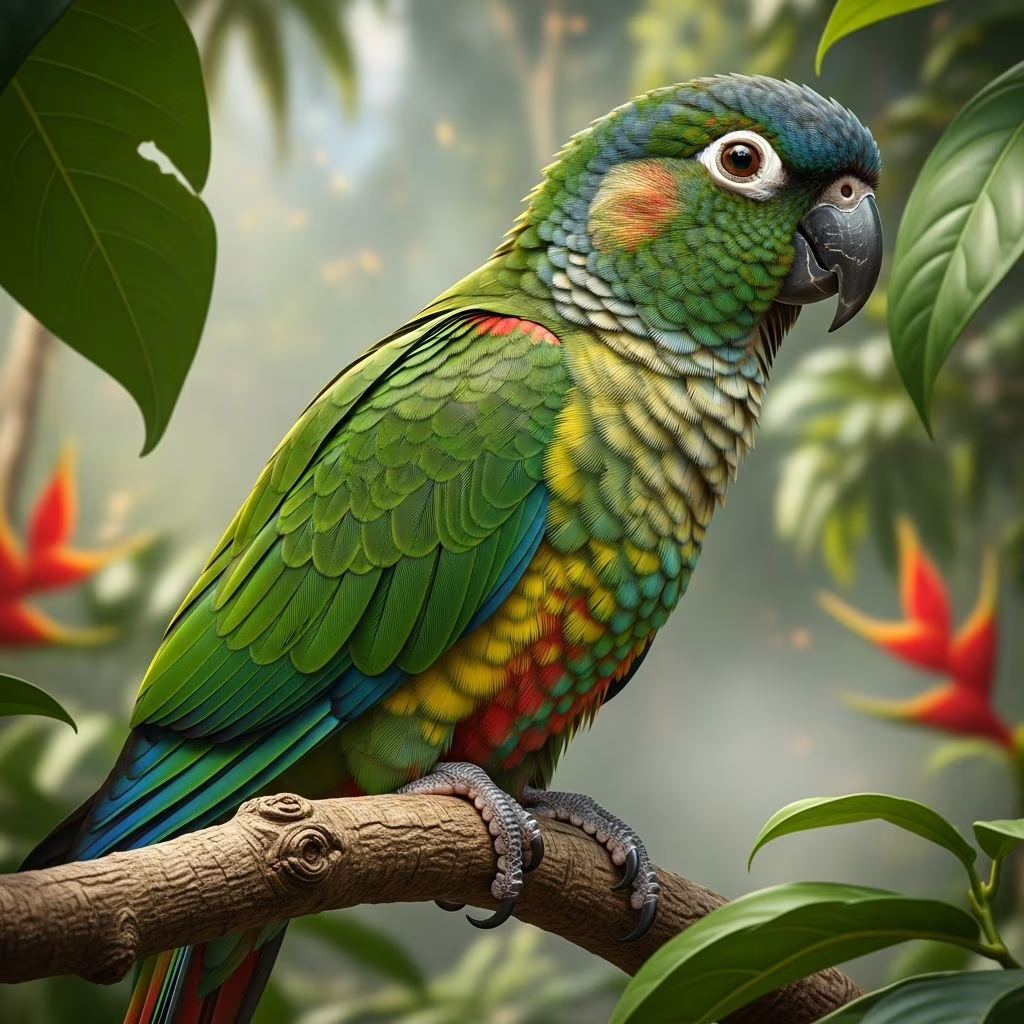
Parrots have captivated human imagination for centuries, largely due to their remarkable ability to mimic human speech. From ancient Rome to modern living rooms, these intelligent birds have earned a reputation as natural communicators. However, much of what people believe about parrot talking is based on misconceptions rather than scientific fact. Understanding the truth about parrot vocalization, training methods, and species-specific abilities is essential for anyone considering bringing a parrot into their home or simply wanting to better understand these fascinating creatures.
The mythology surrounding talking parrots has deep historical roots. Professional parrot teachers were employed in ancient Rome to teach birds to speak Latin, and historical writings even documented methods involving hitting birds on the head with iron bars—a practice far removed from modern, humane training techniques. In medieval Europe, talking parrots were so highly valued that Pope Martin V appointed a \”Keeper of the Parrots\” to ensure their care. These historical perspectives shaped cultural beliefs about parrot abilities that persist today, often leading to unrealistic expectations and misunderstandings about how parrots actually acquire and use human language.
Myth 1: All Parrots Can Talk Equally Well
One of the most pervasive myths about parrots is that all parrots have equal talking ability. In reality, talking capacity varies dramatically between species, individual birds, and even between males and females within the same species. Some species are renowned for their vocal prowess, while others remain relatively quiet regardless of training efforts.
African grey parrots, for instance, are celebrated for their ability to vocalize in human language with remarkable clarity and context. These birds possess an inherent language structure that includes clicks and specific sounds that many individuals within the species produce. Their cognitive abilities allow them to understand and use words in contextually appropriate ways, making them among the most impressive talking parrots.
Conversely, parrotlets—tiny parrots that have gained popularity as apartment-friendly pets—have limited talking ability compared to larger species. According to surveys conducted by the International Parrotlet Society, approximately 80 percent of male parrotlets and only about 20 percent of female parrotlets kept as pets develop talking ability. When parrotlets do learn to speak, they typically master only a few words, though some exceptional individuals may learn several words and phrases.
Quaker parrots occupy a middle ground, known for their considerable talking abilities. When hand-raised and spoken to from an early age, quakers may begin using words as early as three months of age. After about a year, they typically pick up words relatively quickly, depending on the owner’s efforts and consistency in training.
Myth 2: All Male Parrots Talk Better Than Females
Another common misconception is that all male parrots are superior talkers compared to females. While data from parrotlet studies shows a significant gender difference—with males far more likely to talk than females—this pattern does not necessarily hold uniformly across all parrot species.
The dramatic disparity in parrotlet talking ability between genders (80 percent males versus 20 percent females) is well-documented. However, other parrot species may show less pronounced gender differences or different patterns altogether. Individual personality, socialization level, training methods, and environmental factors often play more significant roles than gender alone in determining whether a specific parrot will develop talking ability.
This myth likely persists because the parrotlet data is so striking and well-publicized. Pet owners may assume this pattern applies universally, leading to incorrect assumptions about female parrots’ potential. The truth is more nuanced: while gender can influence talking ability in some species, it is not a reliable predictor across all parrot types, and individual variation remains substantial.
Myth 3: You Can Force a Parrot to Talk Through Repetition Alone
Many people believe that simply repeating words or phrases at a parrot will eventually result in the bird learning to speak. While repetition is certainly important in parrot training, it is far from sufficient on its own. The quality of interaction, consistency, reward systems, and the individual bird’s inherent capabilities all play crucial roles in developing talking ability.
Effective parrot communication training requires active engagement and positive reinforcement. When a parrot speaks or mimics a sound correctly, immediate rewards—whether treats, praise, or interaction—strengthen the behavior. Simply playing recordings or repeating words without this interactive element and reward structure produces minimal results.
The timing of training also matters significantly. Hand-raised baby parrots are far more receptive to learning human speech than adult birds. Starting communication training early, during the socialization period when the bird is most receptive and bonded with its caregiver, dramatically improves outcomes. However, even adult parrots can learn with proper training techniques, though it typically requires more time and patience than training young birds.
Environmental factors also influence talking ability. Parrots that receive regular social interaction, mental stimulation, and consistent training sessions are far more likely to develop talking ability than birds kept in isolation or with minimal human contact. The relationship between the bird and its owner fundamentally shapes the bird’s willingness to mimic human speech.
Myth 4: Parrots Understand Everything They Say
A fascinating myth that captures the imagination is the idea that parrots fully comprehend the meaning of every word they speak. While some parrots—particularly African greys—demonstrate remarkable ability to use words in contextually appropriate ways, most parrots engage in sophisticated mimicry rather than true linguistic comprehension.
African greys stand out for their ability to use language in context. These intelligent birds can associate words with specific objects, actions, or situations and use them appropriately. They respond differently to various commands and seem to understand conversational nuances. This level of cognitive processing is genuinely impressive and suggests a deeper understanding than simple mimicry.
However, many parrots that \”talk\” are primarily engaging in advanced vocal mimicry. They learn to reproduce human sounds and associate certain sounds with specific outcomes—such as getting attention, receiving treats, or triggering particular reactions from their owners. The parrot has learned that producing certain vocalizations leads to desired results, but this learned behavior differs fundamentally from linguistic understanding.
This distinction becomes particularly evident when parrots repeat words or phrases in seemingly random contexts or reproduce sounds they have heard only once or twice. A quaker parrot that mimics coughing, sneezing, or other household sounds has learned to reproduce these vocalizations through exposure, not because the bird understands what these sounds mean. Similarly, parrots that seem to \”speak in context\” may actually be responding to subtle environmental cues that humans don’t consciously recognize, rather than demonstrating true linguistic comprehension.
Myth 5: Quiet Parrots Never Talk
Some people assume that parrots which are generally quiet or not naturally vocal will never develop talking ability. This myth overlooks both individual variation within species and the distinction between inherent noise level and talking ability.
Parrotlets exemplify this principle perfectly. These birds are renowned for being the quietest of the hookbill parrots. They cannot scream and do not produce the loud squawks characteristic of larger species. Even their loud chirps are typically quieter than many canaries and cockatiels. Despite this generally quiet disposition, approximately 80 percent of male parrotlets do develop talking ability, demonstrating that a bird’s overall noise level does not determine its capacity for speech.
Similarly, quaker parrots, while capable of producing loud squawks, are generally among the quieter parrot species. They speak and chatter throughout the day at moderate levels but are not as prone to screaming as some other species. Yet quakers are well-known for their talking ability and are frequently chosen as pets specifically for their capacity to learn and reproduce human speech.
The distinction between general vocalization level and talking ability reflects different brain functions and behaviors. A quiet parrot may lack the drive to produce constant vocalizations but still possess the neurological capability to learn and reproduce human speech. Training, socialization, and individual personality traits often determine whether a naturally quiet parrot will develop talking ability, rather than the bird’s inherent noise level.
The Science Behind Parrot Communication
Understanding how parrots actually learn to \”talk\” requires examining the neurological and behavioral mechanisms underlying their vocal abilities. Parrots are among the few non-human animals capable of vocal learning—the ability to modify vocalizations based on experience and social interaction. This capacity, shared with songbirds and some marine mammals, sets them apart from most other species.
Parrots possess specialized brain structures that facilitate vocal learning and production. These neural systems allow them to hear, process, and reproduce complex sounds with remarkable accuracy. The strength of the bond between a parrot and its human companion significantly influences the bird’s motivation to learn and produce human speech. Parrots are highly social creatures that evolved to communicate within their flocks; when a human becomes part of the bird’s social circle, the parrot is motivated to communicate with that individual using familiar vocalizations.
Training techniques that leverage these natural instincts prove far more effective than those that ignore the bird’s social and neurological nature. Positive reinforcement, consistent interaction, appropriate timing, and realistic expectations form the foundation of successful parrot communication training. Understanding species-specific abilities, recognizing individual differences, and respecting the bird’s inherent capabilities lead to better outcomes and healthier, happier birds.
Frequently Asked Questions
Q: At what age should I start training my parrot to talk?
A: Hand-raised baby parrots are most receptive to learning during their early socialization period. Starting communication training at this stage produces the best results. However, adult parrots can still learn to talk with patient, consistent training, though it typically requires more time and effort than training young birds.
Q: Why doesn’t my parrot talk even though other parrots of the same species do?
A: Individual variation in talking ability stems from multiple factors including genetics, early socialization, training methods, quality of human interaction, environmental enrichment, and personality traits. Some birds have less inherent drive to communicate vocally, while others may have learned through experience that other behaviors (like biting or flying) produce desired outcomes more effectively than talking.
Q: Can female parrots learn to talk as well as males?
A: While some parrot species show gender differences in talking ability, this pattern varies by species. Female parrots can definitely learn to talk, though they may be less likely to do so in species like parrotlets. Individual variation often matters more than gender in determining talking ability across different parrot species.
Q: What’s the difference between a parrot mimicking sounds and actually understanding language?
A: Mimicry involves reproducing sounds the bird has heard, often through association with outcomes or rewards. True language understanding involves grasping meaning and using words contextually and appropriately. While some parrots like African greys demonstrate contextual language use, many parrots engage primarily in sophisticated mimicry rather than language comprehension.
Q: Are there parrot species that never develop talking ability?
A: Yes, some species have limited talking ability regardless of training. However, even within species known for quiet behavior, some individuals may develop talking ability. Species-specific traits influence the likelihood of talking, but individual variation ensures that generalizations have exceptions.
Q: How can I encourage my parrot to talk if it’s naturally quiet?
A: Provide consistent social interaction, use positive reinforcement when the bird produces any vocalizations, engage in training sessions during the bird’s active periods, ensure adequate mental and physical stimulation, and maintain realistic expectations based on your species’ typical abilities. A quiet parrot may never become a prolific talker, but many can still learn some words or phrases through patient training.
References
- Parrotlets: Pint-Sized Parrots — Chewy Editorial. Accessed November 2025. https://www.chewy.com/education/bird/parrot/parrotlets-pint-sized-parrots
- What Makes Quaker Parrots Such Great Pet Birds? — Chewy Editorial. Accessed November 2025. https://www.chewy.com/education/bird/parrot/quaker-parrots-great-pet-birds
- Amazon Parrot Behavior Revealed — Chewy Editorial. Accessed November 2025. https://www.chewy.com/education/bird/parrot/amazon-parrot-behavior-revealed
- Do’s And Don’ts For African Grey Parrots — Chewy Editorial. Accessed November 2025. https://www.chewy.com/education/bird/parrot/dos-and-donts-for-african-grey-parrots
- Parrot History: Yesterday & Today — Chewy Editorial. Accessed November 2025. https://www.chewy.com/education/bird/parrot/parrot-history-yesterday-today



