

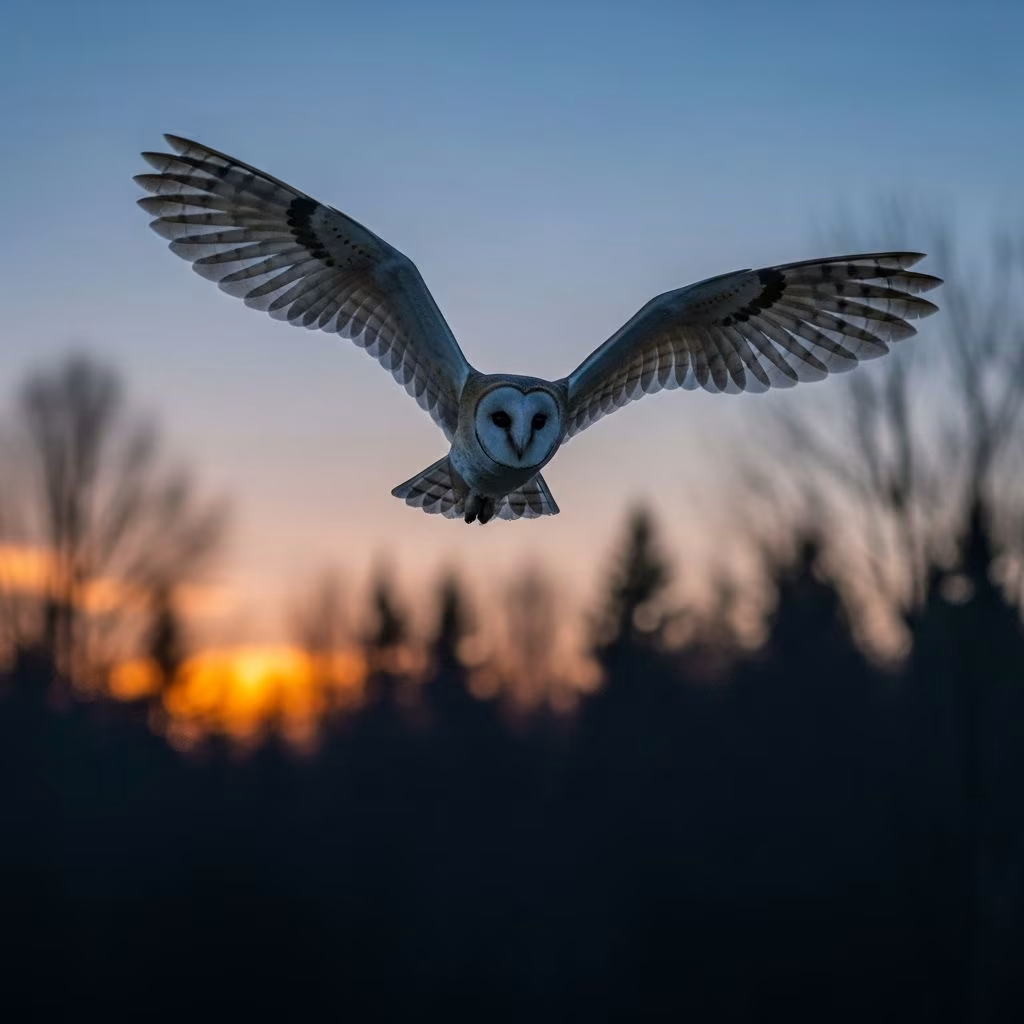
Owls captivate with their ability to navigate and hunt in complete darkness, primarily due to their extraordinary silent flight capability. This adaptation allows them to approach prey without detection, a key survival trait for most nocturnal species.
The Evolutionary Edge of Noise-Free Flight
Nocturnal owls have evolved wings that produce minimal sound during flight, contrasting sharply with the audible wingbeats of diurnal birds. This silence stems from specialized feather structures that disrupt airflow turbulence, the main source of flight noise. Unlike bats, owls rely on vision and acute hearing rather than echolocation, making quiet wings essential for stealthy approaches.
Research shows that even large species like Barn Owls achieve near-silent flight, enabling them to weave through dense forests undetected. This trait is less critical for diurnal owls, such as Burrowing Owls, which hunt in brighter conditions where visual cues suffice.
Decoding the Feather Architecture Behind Silence
Owl wings feature three primary modifications for sound suppression: a fringed leading edge, a velvety trailing edge, and flexible feather barbs. The leading-edge comb, resembling soft bristles, breaks up air vortices that generate noise during wing downstrokes.
- Leading-Edge Comb: Wider in nocturnal species, these serrations diffuse turbulent air, reducing whooshing sounds.
- Trailing-Edge Fringe: Frayed feather tips absorb airflow disruptions at the wing’s rear, muffling turbulence.
- Velvety Dorsal Surface: Downy barbs on the upper wing create a porous layer that dampens vibrations.
These features correlate with hunting environments; forest-dwelling owls exhibit more pronounced combs than open-country species. Acoustic studies confirm these structures lower flight noise to levels inaudible to small mammals.
Nocturnal vs. Diurnal: A Comparative Analysis
While most owls are strictly nocturnal, some are crepuscular (dawn/dusk active) or diurnal, influencing their need for silent flight. Nocturnal hunters prioritize auditory prey detection, necessitating ultra-quiet wings to avoid self-interference.
| Owl Type | Activity Pattern | Silent Flight Intensity | Key Examples |
|---|---|---|---|
| Nocturnal | Night | High (wide combs) | Barn Owl, Barred Owl |
| Crepuscular | Dawn/Dusk | Moderate | Pygmy Owl |
| Diurnal | Day | Low | Burrowing Owl, Short-eared Owl |
Nocturnal owls under forest canopies face near-total darkness (as low as 0.7 mlux on moonless nights), relying heavily on sound. Diurnal counterparts, active in lit conditions, forgo extensive silencing.
Why Silent Flight? Competing Scientific Theories
Two main hypotheses explain silent flight’s evolution: the stealth hypothesis and the self-masking hypothesis.
The stealth model posits silence prevents prey from hearing the owl’s approach. Prey like mice detect aerial threats via wing noise, freezing or fleeing upon detection. Silent wings allow owls to close distances undetected until strike.
Conversely, self-masking argues owls silence flight to hear faint prey sounds without interference from their own wingbeats. Nocturnal hunters localize rustling voles acoustically; self-noise could mask these cues. Evidence supports this: nocturnal owls have superior silencing relative to diurnal ones.
Both theories likely interplay, with studies showing owls adjust flight post-detection—gliding silently while listening.
Hunting Tactics Enhanced by Quiet Wings
Silent flight integrates with owl predation strategies. Many perch, listen for prey noise, then launch into stealthy glides. Barn Owls hover briefly, flapping minimally before diving.
In dense woods, spatial memory aids navigation, minimizing collisions that could produce alerting sounds. Great Gray Owls punch through snow to voles, their silence preserving focus on subsurface noises.
- Sit-and-wait ambushes in low light.
- Mid-flight reorientation via prey sounds.
- Intermittent prey vocalizations exploited during silent approaches.
Sensory Synergy: Hearing and Vision in the Dark
Owl ears are asymmetrically placed for precise sound localization, augmented by facial discs funneling noises. Silent wings ensure these senses operate unhindered.
Their forward-facing eyes provide binocular vision for depth perception, with rod-rich retinas maximizing low light (50-100 mlux under full moon). Total darkness limits them, underscoring silent flight’s role in closing gaps undetected.
Broader Implications: Silent Flight Beyond Owls
Owls aren’t alone; nightbirds share convergent traits like aerial nocturnality. This suggests silent flight evolves under similar pressures: dark, sound-reliant hunting. Bat wing acoustics warrant further study for parallels.
Understanding these mechanisms inspires biomimicry, from quieter drones to noise-reduced aircraft.
Conservation Challenges for Silent Hunters
Habitat loss fragments forests, disrupting owl hunting grounds. Light pollution elevates nocturnal brightness, potentially reducing silence’s advantage. Protecting woodlands preserves these evolutionary marvels.
Frequently Asked Questions (FAQs)
Do all owls fly silently?
Primarily nocturnal species do, with specialized feathers; diurnal owls have less need.
How do owl feathers reduce noise?
Combs, fringes, and velvet surfaces disrupt and absorb airflow turbulence.
Can humans hear owl wingbeats?
No—sensitive mics detect infinitesimal sounds inaudible to us.
Why don’t diurnal owls need silent flight?
Prey detects them visually in light; auditory stealth is secondary.
Is silent flight only for hunting?
It aids navigation and collision avoidance in dark forests too.
References
- Owl – Wikipedia — Wikipedia. 2023-10-01. https://en.wikipedia.org/wiki/Owl
- The Silent Flight of Owls, Explained — National Audubon Society. 2019-11-01. https://www.audubon.org/magazine/silent-flight-of-owls-explained
- Owls: Silent Creatures of the Night — The Woodlands. 2020-02-18. https://www.woodlandsphila.org/blog/2020/2/18/owls-silent-creatures-of-the-night
- Evolution and Ecology of Silent Flight in Owls and Other Flying Animals — PMC (Peer-reviewed). 2020-11-01. https://pmc.ncbi.nlm.nih.gov/articles/PMC7671161/
- Quiet flight, the leading edge comb, and their ecological correlates in Owl — Oxford Academic (Peer-reviewed). 2022-01-01. https://academic.oup.com/biolinnean/article/135/1/84/6446340
- Nocturnal Adaptations of Owls — Schlitz Audubon Nature Center. 2018-10-02. https://www.schlitzaudubon.org/2018/10/02/nocturnal-adaptations/



