

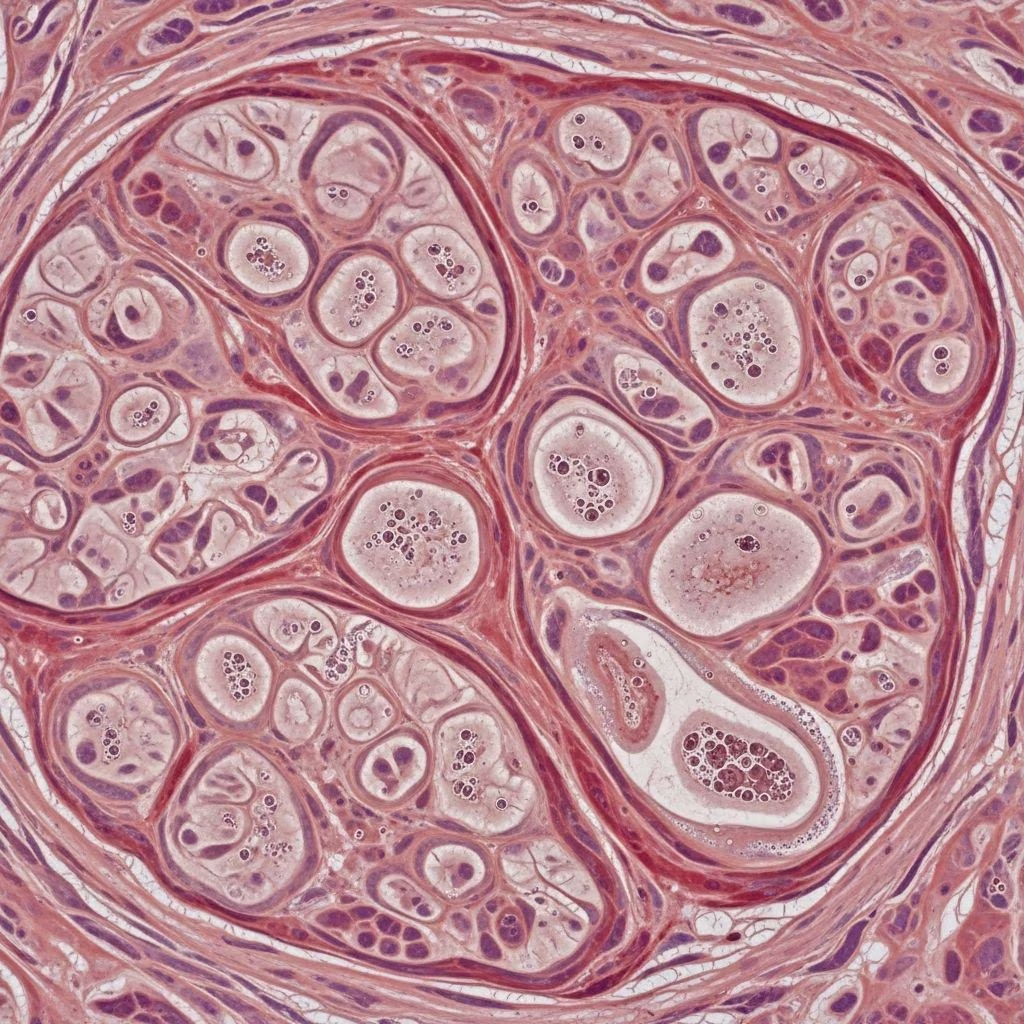
Ovine pulmonary adenocarcinoma (OPA), also known as jaagsiekte, represents a significant transmissible neoplastic disease primarily impacting sheep lungs. This condition arises from infection with the Jaagsiekte sheep retrovirus (JSRV), leading to tumor formation that compromises respiratory function and overall herd productivity.
The Nature and Impact of OPA on Sheep Herds
OPA manifests as a contagious lung cancer that spreads efficiently within flocks, posing challenges for sheep farmers worldwide. Unlike bacterial pneumonias, OPA tumors do not respond to antibiotics, distinguishing it from common infections. Affected animals experience progressive deterioration, often lagging behind the group during movement, which signals advanced disease.
The economic toll includes reduced wool and meat yields due to emaciation, alongside increased mortality rates. In endemic areas, prevalence can reach notable levels, with studies reporting up to 8% positivity in necropsied sheep via PCR testing. Goats occasionally suffer subclinical cases, but sheep bear the brunt of clinical manifestations.
Causative Agent: Jaagsiekte Sheep Retrovirus
At the core of OPA lies JSRV, an exogenous betaretrovirus uniquely oncogenic in its natural host. This virus integrates into host DNA, triggering uncontrolled proliferation of type II pneumocytes and Clara cells, the precursors to adenomatous tumors. Transmission occurs primarily through inhalation of virus-laden aerosols from respiratory secretions, especially during close contact or in confined spaces.
Infected carriers remain asymptomatic for months or years, shedding virus without visible tumors, complicating early intervention. Experimental inoculations confirm tumor development post-infection, underscoring the virus’s direct carcinogenic role.
Recognizing Clinical Manifestations
- Weight loss and emaciation: Sheep maintain appetite but fail to thrive, appearing unthrifty despite normal feed intake.
- Respiratory distress: Dyspnea and tachypnea intensify with exercise; sheep often trail the flock.
- Nasal discharge: Thin, mucoid fluid from nostrils, frothy when abundant, especially after positioning hindquarters upward.
- Coughing and moist rales: Audible lung sounds from fluid accumulation; cold exposure may precipitate rapid decline.
Clinical onset typically strikes sheep aged 2-4 years, though lambs under one year can be affected. Secondary bacterial pneumonias frequently complicate cases, leading to fever and sudden death unresponsive to treatment.
Gross and Microscopic Pathology
Post-mortem examinations reveal hallmark lung changes: enlargement, failure to collapse, and heavy weight due to edema and tumors. Affected lobes display firm, gray-to-purple nodules, 1-3 cm or larger, with granular to meaty cut surfaces exuding grayish fluid.
Histologically, alveoli fill with papillary projections from hyperplastic epithelial cells, forming gland-like structures that obstruct lumens. Bronchial lymph nodes often enlarge with edema or metastases, though distant spread is rare.
| Pathological Feature | Description | Common Location |
|---|---|---|
| Enlarged lungs | Heavy, non-collapsible with edema | Diaphragmatic lobes |
| Tumor nodules | Firm, purple-gray masses | Cranio-ventral regions |
| Fluid accumulation | Frothy, clear to pink exudate | Airways and alveoli |
| Lymph node changes | Edema, occasional metastases | Bronchial/mediastinal |
These findings differentiate OPA from abscesses, lungworms, or pasteurellosis, though overlaps necessitate confirmatory tests.
Diagnostic Approaches
Antemortem diagnosis hinges on combining history, signs, and targeted tests, as auscultation alone lacks sensitivity.
- Ultrasound imaging: Trans-thoracic scans detect lesions as small as 2 cm, showing hypoechoic areas displacing lung tissue. High specificity in studies, ideal for screening purchases or outbreaks.
- PCR and serology: Lung tissue or fluid tests for JSRV DNA/RNA; positive in 8% of suspect necropsies. Detects preclinical carriers but not always pre-tumor infection.
- Tracheal wash/bronchoalveolar lavage: Analyzes fluid for viral antigens via ELISA or immunoblot; positive fluid confirms OPA but absence does not rule out.
Definitive diagnosis requires necropsy with histopathology, revealing characteristic adenomatous hyperplasia.
Transmission Dynamics and Risk Factors
JSRV spreads via airborne droplets from coughing or exhalations, amplified in poor ventilation or overcrowding. In-contact sheep acquire infection early, developing tumors variably.
Flock-level risks include introducing undetected carriers via purchases. Lambs from infected ewes face higher exposure through milk or close nursing, though colostrum transmission is unproven. Seasonal stressors like cold may hasten clinical signs.
Prevention and Control Measures
No vaccine or treatment exists, so management focuses on biosecurity and surveillance.
- Flock screening: Ultrasound adults before integration; cull confirmed cases.
- Isolation: Separate suspects; avoid mixing ages in housing.
- Breeding selection: Favor rams from OPA-free flocks; monitor progeny.
- Hygiene: Improve ventilation, reduce stocking density to curb aerosols.
Eradication succeeds in closed flocks via test-and-cull, but reintroduction risks persist without regional programs.
OPA in Goats and Comparative Insights
Goats rarely develop clinical OPA, often remaining subclinical despite tumors. Similar pathology occurs, but fluid production is less pronounced. JSRV detection mirrors sheep methods.
OPA serves as a model for human lung adenocarcinoma research due to shared molecular pathways, aiding oncological studies.
Frequently Asked Questions (FAQs)
What causes OPA in sheep?
OPA results from JSRV infection, a retrovirus inducing lung tumors via genetic integration.
Can OPA be treated with antibiotics?
No, as it is viral neoplasia; antibiotics only address secondary infections.
How accurate is ultrasound for OPA detection?
Highly specific for lesions over 2 cm, useful for screening but not 100% sensitive for early cases.
Is OPA zoonotic?
No evidence of transmission to humans; confined to sheep and rarely goats.
How can farmers prevent OPA outbreaks?
Implement screening, biosecurity, and culling; source from low-risk flocks.
References
- Diagnosis and prevalence of ovine pulmonary adenocarcinoma (jaagsiekte) in north India — Sharma et al. 2016-05-19. https://pmc.ncbi.nlm.nih.gov/articles/PMC4864477/
- Ovine Pulmonary Adenomatosis Factsheet — Center for Food Security and Public Health, Iowa State University. 2017-01-01. https://www.cfsph.iastate.edu/Factsheets/pdfs/ovine_pulmonary_adenomatosis.pdf
- Latest on Ovine Pulmonary Adenocarcinoma (OPA) — Moredun Research Institute. 2023-01-01. https://moredun.org.uk/resources/factsheets/an-update-on-ovine-pulmonary-adenocarcinoma-opa-or-jaagsiekte-2
- Ovine Pulmonary Adenocarcinoma (OPA) — NADIS. 2022-01-01. https://www.nadis.org.uk/disease-a-z/sheep/ovine-pulmonary-adenocarcinoma-opa/
- Ovine Pulmonary Adenocarcinoma: A Unique Model to Study Lung Cancer — Griffiths et al. 2019-04-26. https://www.frontiersin.org/journals/oncology/articles/10.3389/fonc.2019.00335/full
- Ovine pulmonary adenocarcinoma (adenomatosis) — World Organisation for Animal Health (WOAH). 2023-01-01. https://www.woah.org/fileadmin/Home/fr/Health_standards/tahm/3.08.08_OPA.pdf



