
Ossifying Myopathy In Dobermans: A Practical Guide
Exploring the causes, symptoms, diagnosis, and management of ossifying myopathy, a muscle condition prevalent in Doberman Pinschers.
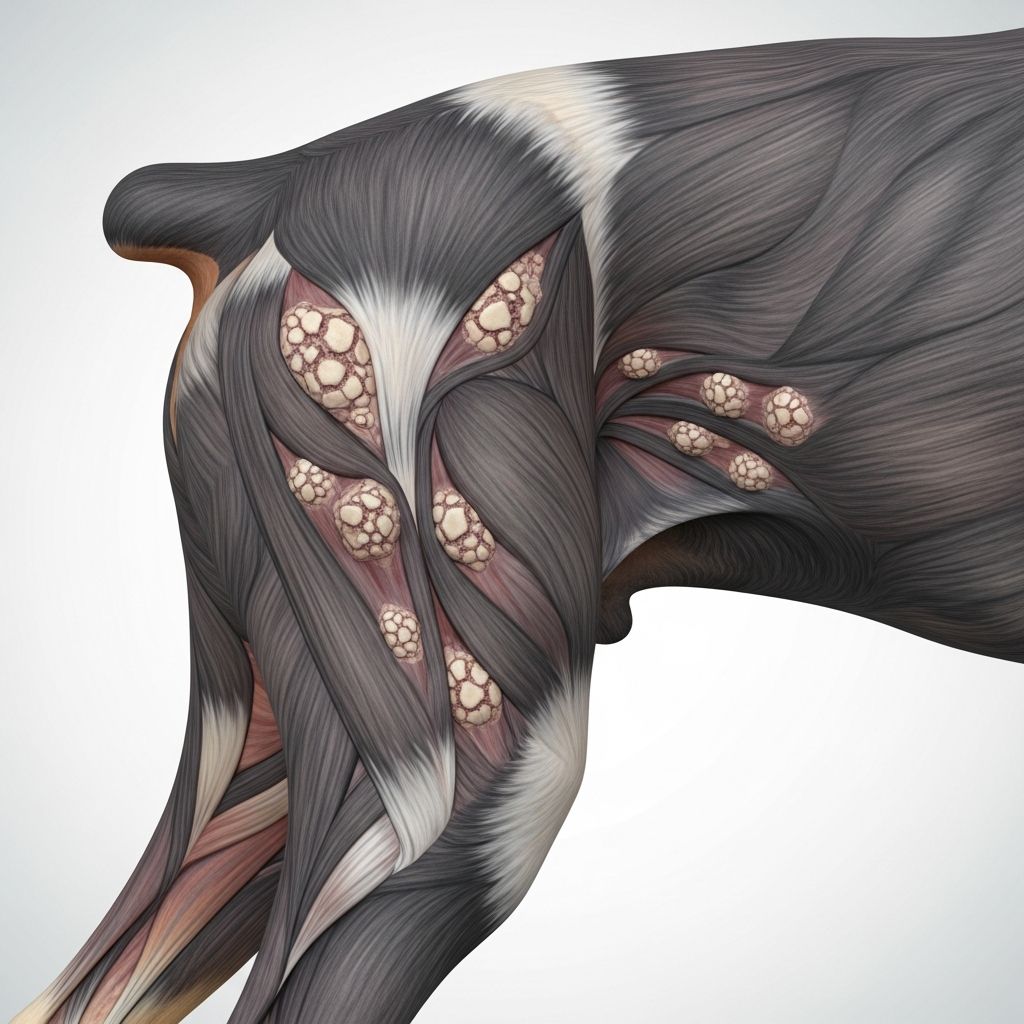
Ossifying myopathy, also known as myositis ossificans, involves the abnormal formation of bone tissue within muscle and connective tissues, particularly in Doberman Pinschers near the hip region. This condition leads to progressive lameness and functional impairment, often linked to trauma or underlying bleeding disorders.
Understanding the Condition’s Development
In dogs, especially Dobermans, ossifying myopathy arises from heterotopic ossification where soft tissues transform into bone-like structures adjacent to bones or periosteum. This process typically follows injury, resulting in hematoma formation that evolves into ossified masses, causing muscle stiffness and reduced limb function.
The pathophysiology includes excessive fibrous tissue growth, muscle degeneration, and dystrophic calcification. In severe cases, generalized forms affect multiple muscles, leading to widespread degeneration. Localized versions create tumor-like lesions that restrict movement and may compress nerves, resulting in partial paralysis.
Primary Causes and Risk Factors
Trauma remains the leading trigger, stemming from intense physical activity, direct blows, or injections into muscles. Only about 40-60% of cases show clear trauma history, suggesting other factors at play.
Doberman Pinschers face heightened risk due to von Willebrand disease, a bleeding disorder causing microvascular hemorrhage post-trauma. This bleeding promotes fibrosis and mineralization, exacerbating ossification.
- Intense exercise: Agility training or sudden bursts of activity in working dogs.
- Direct trauma: Falls, collisions, or fights.
- Injections: Repeated intramuscular vaccinations or medications.
- Genetic predisposition: Breed-specific issues like von Willebrand factor deficiency.
Recognizing Clinical Signs
Dogs exhibit noticeable gait changes, including a shortened stride, lack of stifle extension, and hyperflexion of joints. Owners often observe a firm, palpable mass in the thigh, particularly caudal muscles like the semimembranosus.
Lameness starts mildly but progresses to monoparesis, where the limb shows weakness or inability to bear weight. Affected dogs avoid running and display internal rotation of the stifle during walking.
| Symptom | Description | Common Location |
|---|---|---|
| Lameness | Grade 2-3 at walk, worsens with activity | Hind limb, pelvis |
| Palpable mass | Hard fibrous band parallel to femur | Thigh muscles |
| Gait alteration | Goose-step or jerky motion, reduced stride | Swing phase of gait |
| Joint changes | Limited extension, internal rotation | Stifle and hock |
Diagnostic Approaches
Diagnosis combines clinical exams, imaging, and specialized tests. Palpation reveals firm masses, while gait analysis quantifies abnormalities like reduced range of motion (ROM) in stifle joints.
Radiography shows mineralized plaques in muscles, and ultrasound detects fibrotic changes without joint pathologies. Kinematic studies compare affected limbs to healthy ones, highlighting shortened stance phases and angular deficits.
Biochemical markers, such as elevated creatine kinase (CK), support muscle involvement. Histopathology confirms woven bone formation amid atrophied muscle fibers.
Gait Analysis Insights
Advanced kinematic evaluation uses markers on key points like the trochanter, stifle, and hock to track linear and angular patterns. Affected Dobermans show larger ROM in hocks but restricted stifle extension, mimicking equine cases.
These metrics aid early detection, as visual “jerky gait” correlates with measurable stride reductions, helping differentiate from ligament injuries.
Treatment Strategies
Surgical excision of ossified masses is the primary intervention, often yielding positive results by restoring limb use. Complete removal proves challenging due to lesion adherence to bone.
Post-surgery, physical therapy promotes muscle recovery and prevents recurrence. Anti-inflammatory drugs manage pain during recovery.
- Conservative care: Rest and pain relief for mild cases.
- Surgery: Resection of mineralized tissue.
- Rehabilitation: Controlled exercise to rebuild strength.
Prognosis and Long-Term Management
Outcomes vary; guarded prognosis reflects excision difficulties, but many dogs regain function. Recurrence risks persist without addressing trauma or bleeding issues.
Breeders should screen for von Willebrand disease via DNA tests. Owners of active Dobermans must monitor for injuries and limit high-impact activities.
Preventive Measures for Owners
Regular veterinary check-ups, trauma avoidance, and genetic testing reduce incidence. Balanced training programs prevent overexertion in young dogs.
For Dobermans in sports, warm-ups and proper conditioning minimize injection-related risks.
FAQs
What breeds are most affected by ossifying myopathy?
Doberman Pinschers predominate, linked to von Willebrand disease, though other breeds report cases post-trauma.
How does ossifying myopathy differ from other myositides?
Unlike immune-mediated masticatory myositis, it involves bone formation from trauma, affecting limb muscles primarily.
Can gait analysis confirm the diagnosis?
Yes, it reveals specific patterns like stifle hyperextension deficits, supporting clinical findings.
Is surgery always necessary?
Not initially; mild cases may resolve with rest, but advanced ossification requires excision.
What is the role of von Willebrand disease?
It promotes bleeding and fibrosis in Dobermans, accelerating ossification after minor injuries.
Comparative Overview of Myopathies in Dogs
| Type | Affected Areas | Causes | Treatment |
|---|---|---|---|
| Ossifying Myopathy | Thigh muscles, hip | Trauma, bleeding disorder | Surgical excision |
| Masticatory Myositis | Chewing muscles | Immune-mediated | Immunosuppressants |
| Polymyositis | Multiple muscles | Infectious, immune | Antibiotics, steroids |
| Dermatomyositis | Skin, muscles | Hereditary | Symptomatic care |
This condition underscores the need for breed-specific awareness in veterinary practice. Early intervention improves quality of life for affected dogs.
References
- Myositis ossificans in Dogs (Canis) — Vetlexicon. Accessed 2026. https://www.vetlexicon.com/canis/musculoskeletal/articles/myositis-ossificans/
- Kinematic characteristics of myositis ossificans of the semimembranosus muscle in a dog — PMC – NIH. 2010-02-01. https://pmc.ncbi.nlm.nih.gov/articles/PMC2822373/
- Myositis Ossificans in Doberman Pinschers — Merck Veterinary Manual. Accessed 2026. https://www.merckvetmanual.com/musculoskeletal-system/myopathies-in-small-animals/myositis-ossificans-in-doberman-pinschers
Similar Articles








Read full bio of Sneha Tete


