

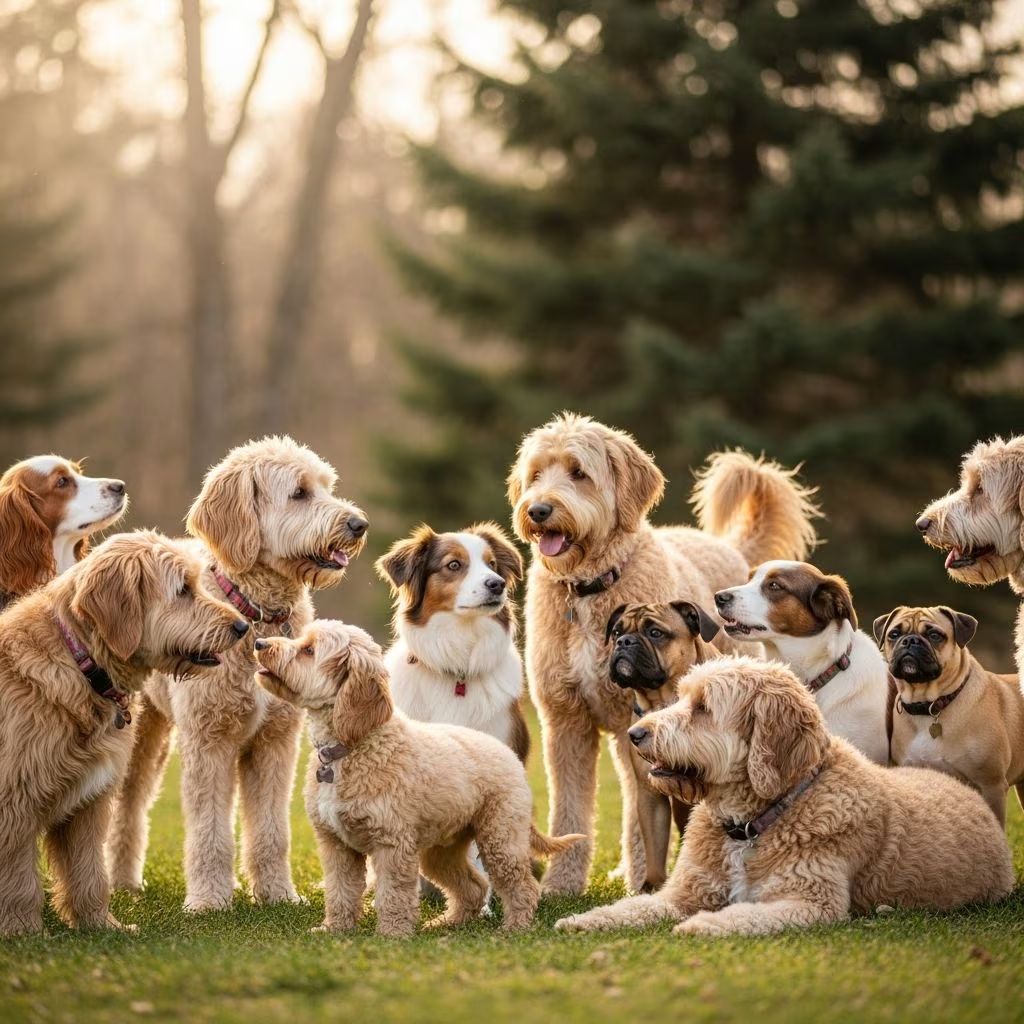
Hybrid dog breeds represent a deliberate fusion of canine genetics, blending traits from distinct lines to enhance desirable qualities like health, temperament, and utility. Unlike random mixed breeds, hybrids often stem from purposeful crossbreeding, a practice with roots stretching back thousands of years to the earliest domestication events.
Ancient Beginnings: From Wolves to Early Hybrids
Dog domestication began around 20,000 to 40,000 years ago, primarily from an extinct wolf species shared with modern gray wolves. Genetic evidence points to East Asia or Siberia as key origination points, where nomadic humans selected wolves with cooperative traits for breeding. These early dogs spread globally via human migration, adapting through natural and selective crosses with local wolf populations.
Archaeological and genomic studies confirm dogs accompanied humans across the Bering Strait into the Americas around 23,000 years ago, forming distinct New World lineages like ancestors of the Peruvian Hairless and Xoloitzcuintli. Isolation preserved unique genetics until European contact introduced hybridization, blending Old and New World dogs.
- East Asian origins: Oldest lineages from nomadic tribes selecting work-ready traits.
- Siberian migration: Pre-Columbian dogs in Americas from Asian migrants.
- European influences: Crosses creating scent hounds like those from the Talbot hound.
Medieval and Renaissance Crossbreeding Innovations
By medieval Europe, humans actively hybridized dogs for specific roles. Farmers crossed wire-haired hounds with local stock to produce terriers adept at vermin control, yielding breeds like the Rat Terrier and Scottish Terrier. Sighthounds, depicted in 4,000-year-old art, emerged from crosses emphasizing speed and sight for hunting.
Genomic analyses reveal extensive haplotype sharing across breeds, indicating repeated hybridization events. For instance, Asian Spitz breeds show recent crosses, while Mediterranean types remained more isolated. Terrier-mastiff hybrids from 1860-1870s Ireland optimized for dog fighting exemplify targeted breeding.
| Era | Key Hybrid Examples | Purpose |
|---|---|---|
| Medieval | Terriers from hounds | Vermin hunting |
| Renaissance | Sighthounds | Game pursuit |
| 19th Century | Bull-terriers | Fighting/Guarding |
The Victorian Explosion: Birth of Modern Breeds
The 19th century marked a breeding boom in Victorian England, fueled by Darwin’s natural selection theories. Kennel clubs standardized breeds through intense crossbreeding, creating most recognizable types today. This era disconnected many breeds genetically from ancient ancestors due to widespread mixing.
Herding dogs exemplify this: UK, Northern European, and Southern European lines developed independently, each with unique strategies reflected in their DNA. Breeds like the German Shepherd incorporated New World influences, possibly from Peruvian Hairless or herding dogs during the Columbian Exchange.
Small breeds drew from global imports; Pugs from Asia contributed to toys, while American Terriers and Toys formed monophyletic groups via local hybridization.
20th Century: Functional Hybrids Beyond Purebreds
Hybridization extended to utility breeds. In Russia, golden jackal-Lapponian Herder crosses produced sniffer dogs with superior smell in cold climates. Further mixes with Fox Terriers and Spitz created the Sulimov dog for airport security. These quarter-breed hybrids excel in confined spaces and low temperatures.
Aeroflot deployed 25 such jackal-dog hybrids since 2002 for bomb detection, building on a 1975 program. Experimental jackal-dog crosses in British India showed persistent wild traits over generations, highlighting hybridization’s complexities.
Designer Dogs: The Hybrid Revolution Today
Modern “designer dogs” like Labradoodles and Goldendoodles promise “hybrid vigor,” reducing inherited diseases through outcrossing. Marketed as superior blends, they revive ancient practices with scientific backing.
Genomics confirms hybrid histories in breeds like the Chinook, mixing multiple ancestors. Traits like hairlessness or herding arose multiply via independent crosses, underscoring hybridization’s role in canine diversity.
- Labradoodle: Labrador + Poodle for hypoallergenic service.
- Cockapoo: Cocker Spaniel + Poodle for companionship.
- Sulimov: Jackal hybrids for detection work.
Genetic Insights into Hybrid Success
Studies show breeds’ hybrid origins via admixture timing and haplotype analysis. New World dogs influenced European breeds like German Shepherds, resolving migration puzzles. Victorian isolation preserved some signatures, but most modern dogs result from 19th-century blends.
Multiple domestication events—Europe, Asia, Siberia—led to parallel breed development, with humans breeding independently for herding, hunting, and guarding.
Health and Ethical Considerations in Hybrids
Hybrid vigor offers healthier dogs by avoiding purebred inbreeding, but inconsistent breeding risks perpetuating issues. Responsible hybridization prioritizes temperament and vitality over novelty.
Genomic tools now trace disease alleles transferred via crosses, aiding ethical breeding.
FAQs
What defines a hybrid dog versus a mutt?
Hybrids result from intentional first-generation crosses of two purebreds; mutts have unknown, multi-generational mixing.
Do hybrids live longer than purebreds?
Often yes, due to hybrid vigor minimizing genetic diseases, though data varies by cross.
Are designer dogs recognized by kennel clubs?
Most are not; they’re marketed as companions rather than show breeds.
Can hybrids inherit wild traits?
Rarely, but jackal hybrids retain enhanced senses without full wildness.
How has globalization affected dog hybrids?
It enabled trait transfers, like Asian Pugs in European toys and New World dogs in herders.
References
- Evolution of Dog Breeds and Their Roles — Greenlin Pet Resorts. 2023. https://www.greenlinpetresorts.com/blog/the-evolution-of-dog-breeds-and-their-roles/
- Genomic analyses reveal the influence of geographic origin — PMC (NIH). 2017-06-29. https://pmc.ncbi.nlm.nih.gov/articles/PMC5492993/
- From Wolves to Pugs and Great Danes – The History of Dog Breeds — Morris Animal Foundation. 2023. https://www.morrisanimalfoundation.org/article/evolution-of-dogs
- Canid hybrid — Wikipedia (informed by primary sources). 2023. https://en.wikipedia.org/wiki/Canid_hybrid
- Pre-Columbian origins of Native American dog breeds — Royal Society Publishing. 2014. https://royalsocietypublishing.org/rspb/article/280/1766/20131142/74769/Pre-Columbian-origins-of-Native-American-dog



