

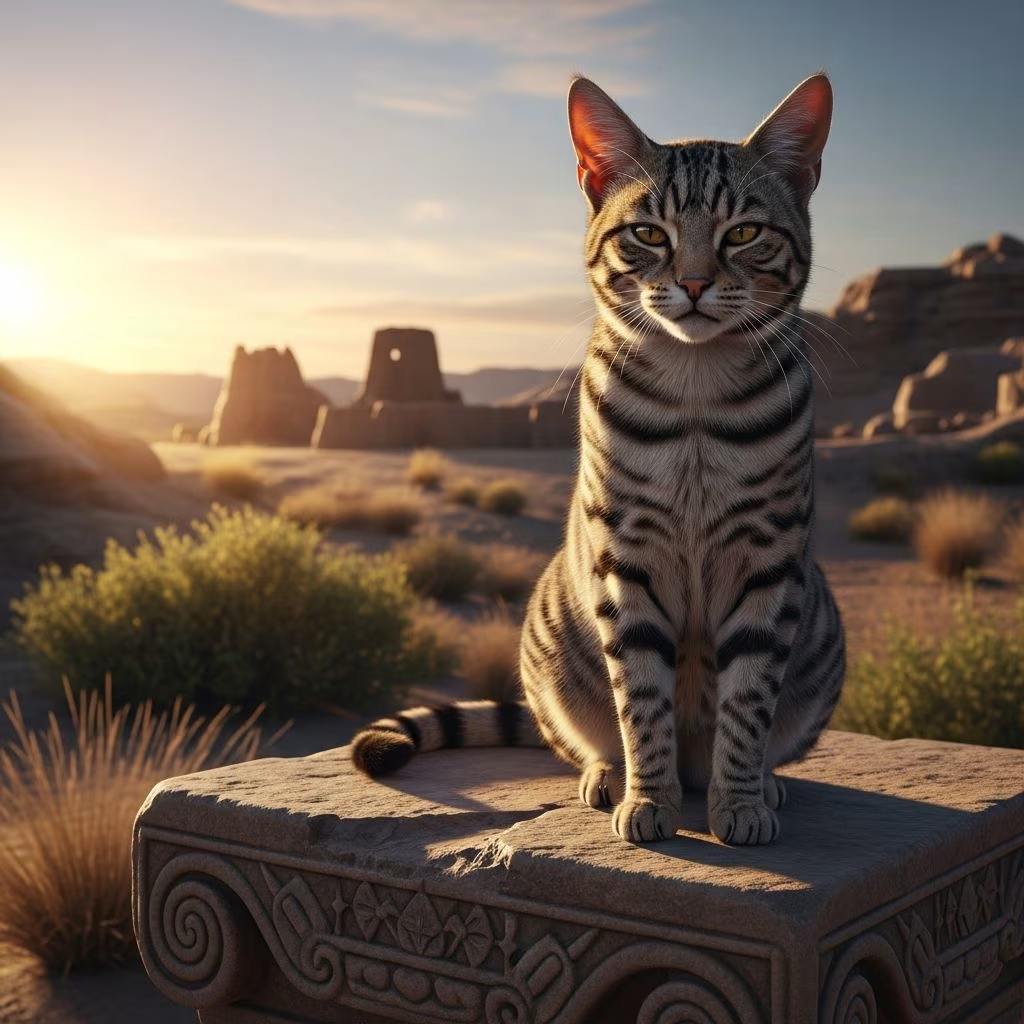
The story of the first cat breed begins not with selective breeding by humans, but with a remarkable process of self-domestication by wild felines around 10,000 years ago in the Fertile Crescent region of the Near East. These early cats, descendants of the African wildcat (Felis silvestris lybica), adapted to human settlements by hunting rodents attracted to stored grain, forging a mutually beneficial relationship that laid the groundwork for all domestic cats today.
Ancient Beginnings in the Fertile Crescent
Archaeological and genetic evidence points to the Near East—encompassing modern-day Israel, Syria, and surrounding areas—as the cradle of cat domestication. Around 10,000 years ago, as agriculture flourished, wildcats ventured into human villages to prey on mice and rats infesting grain stores. This proximity selected for tamer individuals over generations, leading to the emergence of Felis catus, the domestic cat species.
One of the earliest pieces of direct evidence comes from Cyprus, where a 9,500-year-old burial site revealed a human interred alongside a cat. Notably, no native wildcats existed on the island, implying that Neolithic peoples intentionally transported these animals from the mainland, marking one of the first signs of a budding human-feline bond.
The African Wildcat: Progenitor of Domestic Cats
The African wildcat, specifically the Near Eastern subspecies Felis silvestris lybica, is widely recognized as the direct ancestor of modern domestic cats. Genetic studies confirm that domestic cat DNA is nearly identical to that of these wildcats, with domestication involving a small founder population rather than widespread hybridization.
- Key Traits: Slender build, sandy fur with subtle stripes, and a wary disposition that persists in some feral populations today.
- Domestication Driver: Self-selection for less aggressive behaviors, allowing coexistence with humans without forced captivity.
- Timeline: Initial adaptation ~10,000 years ago, with full domestication traits evident by 9,000 years ago.
Unlike dogs, which underwent intensive human-driven breeding, cats domesticated themselves gradually, retaining much of their independent nature.
Egypt’s Pivotal Role in Cat Worship and Breeding
By around 3,700 years ago, cats were commonplace in Fertile Crescent settlements, but Egypt elevated their status dramatically. Associated with the goddess Bastet around 2,900 years ago, cats became sacred symbols of protection and fertility. Temples bred thousands for rituals, including mummification and sacrifice, accelerating selective breeding for desired traits.
Genetic sampling from Egyptian cat mummies reveals close ties to African wildcats, suggesting targeted domestication of specific wild populations. This era saw an explosion in cat numbers during the first millennium BC, coinciding with the Roman Empire’s rise. Artifacts like tomb paintings depict spotted felines resembling modern breeds, hinting at early purposeful selection.
Global Spread Through Trade and Empires
Ancient trade networks propelled cats beyond Egypt. Phoenicians, Greeks, and Romans transported them across the Mediterranean for pest control on ships and in ports. Remains from Sardinia dated to 200 BC predate other European domestic cats, linked to Punic trade routes.
| Region | Arrival Timeline | Key Evidence | Mitochondrial Group |
|---|---|---|---|
| Cyprus | ~9,500 years ago | Human-cat burial | N/A |
| Egypt | ~3,700 years ago | Temple mummies | IV-A, IV-C |
| Austria (Mautern) | 50 BC–80 AD | Roman site remains | IV-A, IV-C |
| Britain | ~400–300 BC | Gussage All Saints | IV-A |
| Denmark (Vikings) | 900–1100 AD | Viking settlements | IV-D |
Roman expansion carried cats to Britain, Serbia, Italy, and Anatolia by 100–300 AD. Later, Viking ships introduced group IV-D cats to the British Isles, Orkney, and Poland around 900–1100 AD, where they aided rodent control and held ritual significance tied to Freyja.
Emergence of the Earliest Recognized Breeds
While most modern breeds originated in the last 150 years, ancient landraces—naturally occurring populations shaped by isolation and mild selection—represent the true precursors. The Egyptian Mau stands out as one of the oldest, with depictions in pharaonic tombs from ~3,000 years ago showing its distinctive spots.
- Egyptian Mau: Likely a direct descendant of temple-bred cats; natural spots and speed set it apart.
- Norwegian Forest Cat: Traces to Viking-era introductions, adapted for cold climates.
- Turkish Angora: Possibly from medieval Middle Eastern imports to Europe via Crusaders.
These landraces blended wildcat ancestry with domestic traits, influencing later breeds like the Ocicat.
Genetic Insights into Cat Evolution
Modern mitochondrial DNA analysis divides domestic cats into groups tracing ancient migrations. Groups IV-A and IV-C dominate Egyptian and early Roman sites, while IV-D marks Norse pathways. Remarkably, all domestic cats worldwide share ~95.6% genetic similarity with F. s. lybica, underscoring a single primary origin.
Studies of ancient remains, such as those from Roman Ephesus and Byzantine monasteries, confirm successive waves of introduction rather than independent domestications elsewhere.
From Wild Hunters to Household Companions
The transition from wild predator to pet was gradual. Early cats provided pest control, earning tolerance; Egyptians formalized breeding; empires globalized them. Today, over 600 million domestic cats inhabit the world (except Antarctica), their wild heritage evident in hunting instincts and independence.
Unlike dogs’ pack loyalty, cats’ solitary wild roots foster affectionate yet autonomous bonds with humans.
Modern Implications for Cat Lovers
Understanding these origins informs breeding practices, health, and conservation. Efforts to protect wildcat populations prevent hybridization dilution. Breeders prioritize genetic diversity to avoid issues from ancient bottlenecks.
Popular ancient-derived breeds like the Egyptian Mau remain prized for their historical authenticity and athleticism.
Frequently Asked Questions
What is the oldest cat breed still around?
The Egyptian Mau is among the oldest, with roots tracing to ancient Egyptian temple cats over 3,000 years old.
Were cats domesticated before dogs?
No, dogs were domesticated around 15,000–40,000 years ago; cats followed ~10,000 years ago.
Do all domestic cats descend from one wild species?
Primarily from the African wildcat (Felis silvestris lybica), with minimal input from other subspecies.
How did cats reach Europe?
Via Egyptian trade, Greek/Roman empires for pest control, and later Vikings.
Are wildcats dangerous to domestic cats?
They can hybridize, posing genetic risks; conservation separates populations.
References
- The Origins of the Domestic Cat — Optimal Selection. 2023. https://optimal-selection.com/blogs/news/the-origins-of-the-domestic-cat
- The Top 10 Oldest Cat Breeds Ever — A-Z Animals. 2024. https://a-z-animals.com/pets/cats/cat-lists/oldest-cat-breeds/
- The Origins of Cats — International Cat Care. 2023. https://icatcare.org/articles/the-origins-of-cats
- What Was the First Breed of Cat on Earth? — Catster. 2024. https://www.catster.com/lifestyle/what-was-the-first-breed-of-cat-on-earth/



