

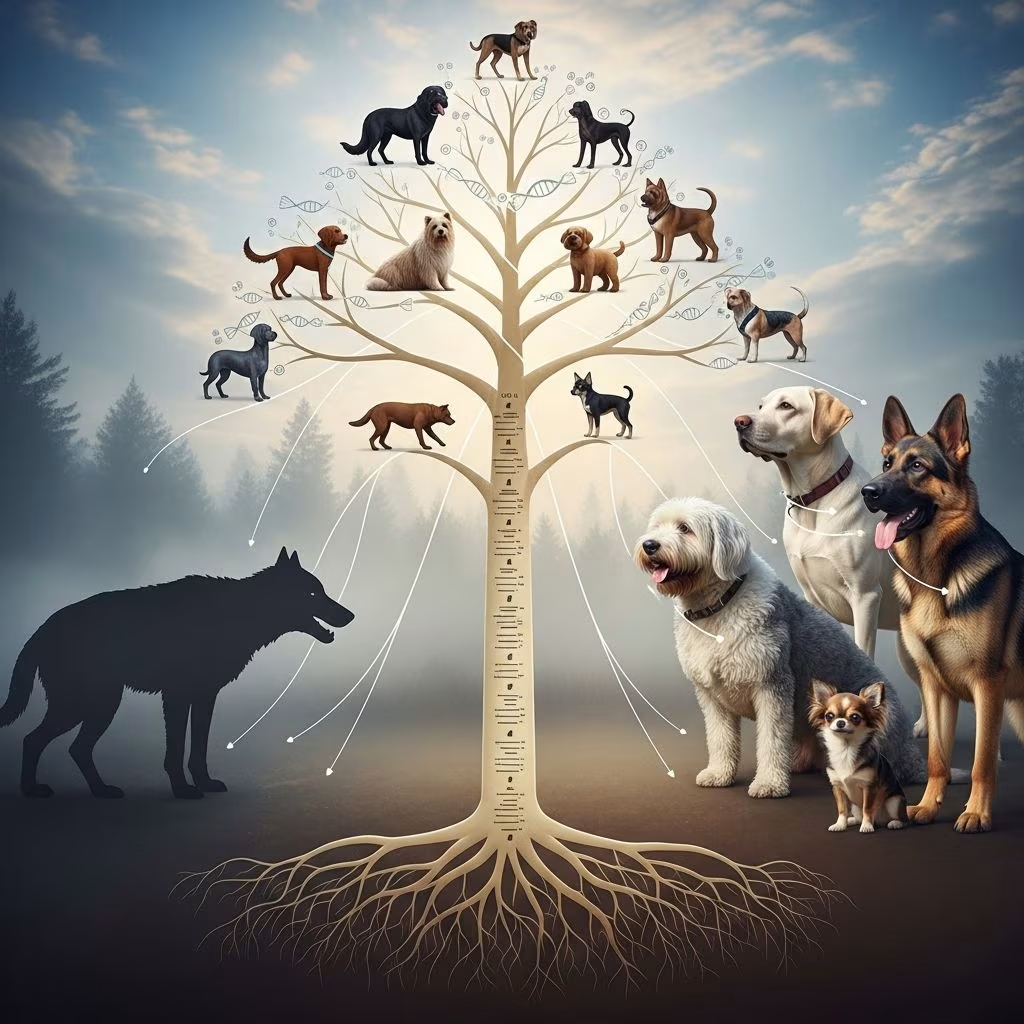
Modern dogs come in thousands of shapes, sizes, and personalities, but beneath all that diversity lies a shared history written in their DNA. By analyzing dog genetics across hundreds of breeds, researchers have mapped an intricate dog family tree that shows how different dogs are related, how they were developed, and how history shaped the companions we live with today.
This article walks through the origins of that family tree, how scientists built it, what the major breed groupings (called clades) show, and how this genetic story connects to dog behavior, including herding and hunting styles.
How Scientists Built the Dog Family Tree
The modern dog family tree is based on large-scale genetic studies of purebred dogs. Researchers collected DNA from many breeds and analyzed hundreds of thousands of genetic markers (single nucleotide polymorphisms, or SNPs) to understand how closely different breeds are related.
By comparing these markers, they were able to:
- Measure genetic similarity between breeds.
- Identify shared ancestry and historical lineages.
- Cluster breeds into related groups, or clades.
- Trace when and where major breed types emerged.
These methods are similar to those used in human population genetics, where scientists reconstruct population histories and migrations by comparing patterns in DNA across groups.
From DNA to a Cladogram
The core visual output of this work is a cladogram – a branching diagram that shows how breeds cluster into groups according to shared genetic history. Each branch point represents a split from a common ancestor population, and groups of closely related breeds form distinct clusters.
In the dog study that inspired the “dog family tree” visualization, almost all breeds fell into about 23 major groupings, known as clades.
What Are Clades in the Dog Family Tree?
In evolutionary biology, a clade is a group of organisms that includes a common ancestor and all of its descendants. In dogs, clades represent sets of breeds that share a relatively recent ancestor and that often developed for similar functions or in similar regions.
On the dog family tree, clades tend to line up with:
- Function – such as herding, guarding, hunting, or companionship.
- Geography – breeds that originated in the same region.
- Historical breeding practices – for example, Victorian-era kennel clubs refining specific lines.
| Term | Meaning | How It Applies to Dogs |
|---|---|---|
| Clade | A group sharing a common ancestor | Cluster of related breeds that share genetic roots and often a similar job |
| Cladogram | Branching diagram of relationships | The dog family tree showing how breed clades split over time |
| Phylogeny | Evolutionary history of a group | The story of how modern dog breeds developed from earlier dog populations |
Major Stories Revealed by the Dog Family Tree
When researchers overlaid historical records and known breed functions onto the genetic tree, several striking patterns emerged. These patterns help explain why certain types of dogs look and behave the way they do today.
1. Herding Dogs Have Diverse Origins
One of the most surprising findings is that herding dogs do not form a single, tight clade. Instead, different herding breeds appear in multiple parts of the tree, reflecting distinct origins.
Even though we group them under the same job description, herding dogs use very different strategies to control livestock:
- Eye-stalk herders (like Border Collies) use intense staring and crouching to guide animals.
- Heelers may nip at livestock heels to drive movement.
- Guardian-type herders (like livestock guardian dogs) focus more on protection than active movement of the flock.
These differences in working style reflect separate breeding histories. The phylogenetic data supports what many dog experts suspected: herding dogs were developed in multiple places, at multiple times, from different ancestral stock, rather than from a single founding herding breed.
2. Pointers, Gun Dogs, and Spaniels Are Closely Related
In contrast, breeds developed for hunting game birds show very tight genetic clustering. Pointers, gun dogs, and Spaniels form a compact clade with relatively little genetic variation between them.
This tight grouping reflects a more recent and concentrated period of breed formation. Many of these breeds can be traced back to Victorian England, when formal breed standards, closed stud books, and selective breeding were heavily emphasized.
During this period:
- Hunters and breeders refined specific traits, such as pointing, flushing, and retrieving behavior.
- Appearance and performance were standardized through kennel clubs.
- Breeding pools narrowed, which decreased genetic diversity and produced distinct but closely related breeds.
3. Historical Breeding Practices Left a Strong Genetic Signature
The dog family tree shows clear genetic signatures of human decisions over hundreds of years:
- Regional isolation created geographically distinct clades (for example, some Asian or Arctic breeds).
- Victorian kennel culture produced clusters of tightly related breeds with narrow gene pools.
- Functional selection for jobs like herding, guarding, or hunting shaped the behavior and body types in different clades.
These patterns highlight how deeply human culture and history are intertwined with dog evolution. Dogs are not just pets; they are products of specific human needs and environments across time.
How Breed History Relates to Dog Behavior
The dog family tree is not just a story of genes and geography; it also connects to behavior. Many traits that people associate with certain types of dogs—like eagerness to herd, retrieve, or guard—have roots in their historical functions and genetic background.
However, genetics is only part of the picture. Large, recent studies suggest that breed alone explains less than 10% of variation in most dog behaviors, especially behaviors like aggression or fearfulness. While certain tendencies can be more common in some breeds, individual experience, training, and environment are far more powerful drivers of how a specific dog behaves.
Inherited Tendencies vs. Individual Personality
Research indicates that around 25% of behavioral variation in dogs is heritable, meaning influenced by genetic factors, but not determined by them. This aligns with how genetics works in many complex traits:
- Genes create predispositions, not guarantees.
- Early life experiences, socialization, and training profoundly shape outcomes.
- Even within a breed or clade, individual dogs can be shy, bold, calm, or intense.
So while the dog family tree can help explain why certain breed groups are well suited for specific jobs, it cannot predict the personality of any one dog.
Herding Style and Genetics
The diversity of herding dogs on the family tree mirrors the diversity of their working strategies. Different herding clades appear to have been shaped by distinct behavioral goals:
- Some lines emphasize control at a distance, using eye contact and body language.
- Others emphasize driving pressure, using bark, movement, or nipping.
- Guardian-type breeds focus on bonding with livestock and defending against predators, not active herding.
These styles likely emerged as humans in different regions selected dogs that naturally performed certain tasks well, reinforcing particular behavioral tendencies over generations.
Hunting Behavior in Pointers, Gun Dogs, and Spaniels
For hunting breeds, selective breeding in Victorian England strongly reinforced specialized behaviors:
- Pointers were refined for freezing into a pointing stance to indicate game birds.
- Spaniels were selected to flush birds into the air.
- Retrievers were bred to bring downed birds gently back to the hunter.
This intense selection for specific working roles, within tightly controlled breed lines, produced distinct but closely related clades where many individuals share strong instincts for those tasks.
What the Dog Family Tree Means for Pet Parents
Understanding the origins of the dog family tree is not just a scientific curiosity; it can help you interpret your own dog’s behavior and needs more clearly.
Reading Your Dog’s Genetic Story
If you know your dog’s breed or have a mixed-breed dog with DNA test results, you can use this information to understand:
- Which clades or breed groups are in their background.
- What those breeds were developed to do (herding, guarding, hunting, companionship).
- Which instincts or tendencies might still be present.
For example, a dog with herding background may be more likely to try to herd children, other pets, or even cars if their energy and instincts are not channeled appropriately, whereas a dog with pointer or retriever ancestry may be more motivated by games involving searching, tracking, or carrying objects.
Why Breed Does Not Fully Define Behavior
Despite the insights from clades and phylogeny, experts warn against assuming that breed equals behavior. Large-scale research shows that dogs of the same breed can behave very differently, and that breed explains only a small fraction of variance in traits like sociability, trainability, or fear.
This has practical implications:
- Do not assume a dog will be safe or dangerous based solely on their breed label.
- Focus on the individual dog’s history, training, and current behavior.
- Use breed information as one data point, not the whole story, especially when adopting or making behavior decisions.
Frequently Asked Questions (FAQs)
Q: What is a dog clade?
A dog clade is a group of breeds that share a relatively recent common ancestor, as revealed by genetic analysis. Breeds in the same clade are more closely related to each other than to breeds outside the clade, and often share historical functions or geographic origins.
Q: How many major clades are in the dog family tree?
In one influential genetic study that produced a widely shared dog family tree, almost all modern breeds fell into about 23 major clades. These clades reflect shared ancestry and often align with working roles or regional histories.
Q: Why don’t all herding dogs form one clade?
Herding dogs were developed in different places, at different times, and often from different ancestral dog populations. As a result, their DNA shows that they belong to multiple clades, even though we group them under the same job description. Their varied herding styles reflect these independent origins.
Q: Are pointers, gun dogs, and Spaniels closely related?
Yes. Pointers, gun dogs, and Spaniels form a very tight genetic grouping on the dog family tree, with relatively little variation between them. Their origins can often be traced to focused breeding programs in Victorian England, where hunting breeds were refined and standardized.
Q: Does a dog’s breed determine its behavior?
No. While breed can influence certain tendencies, large studies suggest that breed explains less than 10% of the variation in most behaviors across dogs. Around a quarter of behavior may be influenced by genetics overall, but environment, socialization, and training have major effects. Any individual dog, regardless of breed, can be fearful, friendly, anxious, or calm.
Q: What can I learn about my dog from their place on the family tree?
Your dog’s place on the family tree can provide context about the types of work their ancestors performed, common behavioral tendencies in their clades, and historical regions of origin. This can help you choose enrichment, training, and activities that align with their natural instincts, but it should not be used to stereotype or judge your dog’s character.
References
- More Evidence That Breed Does Not Equal Behavior — Kinship / Wisdom Panel summary of Science study. 2022-04-28. https://www.kinship.com/dog-behavior/breed-behavior-study
- Origins of the Dog Family Tree — Kinship. 2021-10-01 (approximate, article on dog clades and phylogeny). https://www.kinship.com/dog-behavior/origins-dog-family-tree
- Applied Dog Genomics — Erin C. Anderson. Humanimalia, 2021. https://humanimalia.org/article/download/19204/26635/68259
- Logical Word Learning: The Case of Kinship — Joshua B. Tenenbaum et al. 2022. PubMed Central. https://pmc.ncbi.nlm.nih.gov/articles/PMC9166873/



