

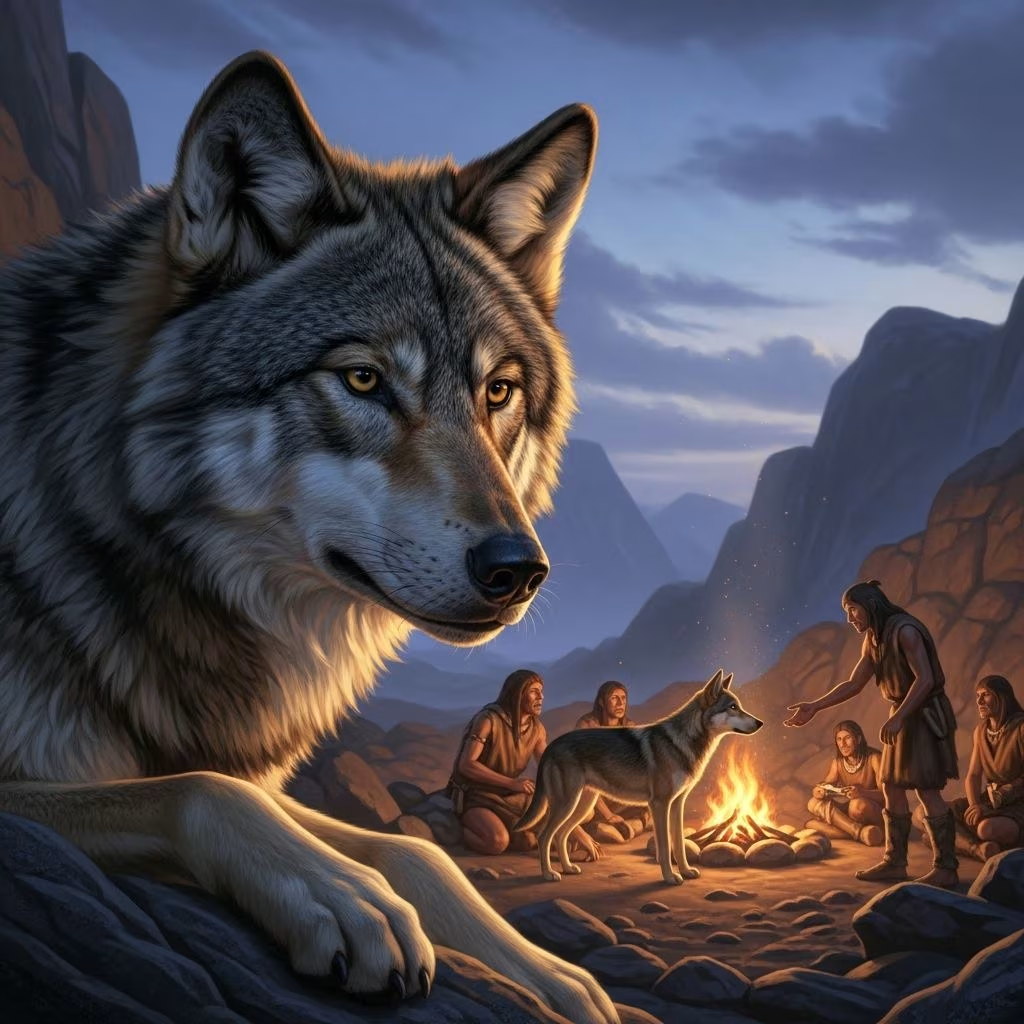
The domestication of dogs marks one of the most profound partnerships in human history, transforming fierce gray wolves into the diverse array of breeds we know today. Genetic and archaeological evidence points to this process beginning over 20,000 years ago, likely in harsh environments where early humans and wolves formed mutual bonds.
The Dawn of Domestication: Timing and Location
Scientific consensus, drawn from ancient DNA analysis, suggests dogs were first domesticated around 23,000 years ago in Siberia during the Last Glacial Maximum. This period of extreme cold isolated human populations and wolves, fostering close interactions. A study comparing human and dog population genetics from Siberia, Beringia, and North America reveals a strong correlation in their lineage divergences, indicating dogs accompanied the earliest human migrations into the Americas starting about 15,000 years ago.
Genetic splits within key mitochondrial haplogroups, such as the divergence between A1b and A2 at approximately 22,800 years ago (95% CI: 26,000–19,700 years), predate the oldest archaeological dog remains by thousands of years. This implies domestication occurred well before physical evidence in the fossil record.
Genetic Evidence Unlocking Canine Ancestry
Advances in paleogenomics have sequenced DNA from ancient canid remains, revealing dogs’ origins from an extinct gray wolf population. Research on specimens from Europe, Siberia, and North America shows modern dogs share closer genetic ties to ancient Asian wolves than European ones, supporting an eastern domestication center.
Mitochondrial DNA studies highlight specific haplogroups like A2a, which spread with Paleo-Inuit groups into the North American Arctic around 5,000 years ago. The coalescence of A2b (American dogs) and A2a lineages around 18,600–14,300 years ago aligns with the split between Northern and Southern Native American human lineages.
- Haplogroup A1b and A2 split: ~22,800 years ago, marking the deepest known dog lineage divergence.
- A2b and A2a coalescence: ~18,600–14,300 years ago, coinciding with American migrations.
- Deepest A2b event: ~16,900–13,400 years ago, overlapping early continental dispersals.
Debates on Single vs. Dual Domestication Events
While Siberia emerges as a primary origin, debates persist over whether dogs arose from one or multiple wolf populations. Some studies propose a dual ancestry, with independent domestications in Eastern and Western Eurasia. Genomic analysis of 72 ancient wolves spanning 100,000 years indicates dogs derive from two distinct wolf groups, one contributing to early European lines and another to Asian ones.
Evidence from Europe suggests domestication between 20,000 and 40,000 years ago, based on prehistoric dog genomes from Germany. These early dogs show continuity into the Neolithic era, though later admixtures occurred with incoming Asian dogs during the Bronze Age.
| Theory | Proposed Location | Timeframe | Key Evidence |
|---|---|---|---|
| Siberian Origin | Siberia (Ancient North Eurasians) | 26,000–19,700 years ago | mtDNA haplogroup splits, human-dog migration correlation |
| European Domestication | Europe | 20,000–40,000 years ago | Ancient German dog genomes |
| Dual Ancestry | East & West Eurasia | ~14,000–6,400 years ago divergence | Genomic resequencing, haplotype discontinuities |
| East Asian Phase | Southern East Asia | ~33,000 years ago | Migration routes from genomic data |
These conflicting models reflect ongoing research; no single theory fully reconciles all data, but Siberian origins gain traction due to recent ancient DNA correlations with human dispersals.
Migration Patterns: Dogs Journey with Humans
Dogs did not remain static post-domestication; they traveled globally alongside humans. From Siberia, they moved into the Americas with the first peoples ~15,000 years ago, carrying haplogroup A2b. In Europe, Near Eastern dogs arrived with Neolithic farmers, introducing new lineages.
Polynesian dogs reached New Zealand with their human companions, while Arctic dogs with A2a haplogroup supported Paleo-Inuit hunting cultures. American dogs, likely from East Asian stock, nearly vanished after European contact, leaving traces in canine transmissible venereal tumors from 8,000-year-old individuals.
Archaeological Corroboration
The oldest undisputed dog remains, like the Erralla dog from 17,500 years ago, align with genetic timelines, though disputed finds push back to 36,000 years. Siberian Altai Mountains and Belgian cave skeletons, dated ~33,000 years old, suggest early experimentation with wolf companionship.
Prehistoric sites from 30,000 to 15,000 years before present contain dog-like canids, indicating rapid evolution through natural and social selection rather than strict artificial breeding.
Evolution from Wolves: Adaptations and Selection
Domestication involved social selection, where wolves with tamer traits—smaller skulls, floppy ears, juvenile features—were favored by hunter-gatherers. This predated agriculture, occurring among megafauna hunters near the Last Glacial Maximum.
Genomes from thousands of modern and ancient dogs reveal wild wolf genes persist, with domestication dated to 20,000–22,000 years ago via molecular clocks. Prehistoric dogs evolved quickly, showing size reductions and behavioral shifts within millennia.
Modern Breeds: A Legacy of Ancient Foundations
Today’s 300+ breeds stem from these ancient lines, with admixtures shaping diversity. European breeds often trace to Neolithic continuity, while others reflect steppe migrations. Genetic legacies from Siberian founders underpin global canine variety.
Implications for Understanding Human History
The dog-human bond illuminates prehistoric migrations, from Beringia crossings to Pacific voyages. Shared genetic timelines constrain models of human dispersals, affirming dogs as co-travelers in our species’ expansion.
Frequently Asked Questions (FAQs)
When were dogs first domesticated?
Genetic evidence points to ~23,000 years ago in Siberia, with splits predating archaeological finds.
Did dogs come from one wolf population or multiple?
Debate favors dual ancestry from eastern and western Eurasian wolves.
How did dogs spread to the Americas?
They accompanied the first humans ~15,000 years ago via Beringia.
What role did the Last Glacial Maximum play?
It isolated groups, promoting wolf-human proximity and early domestication.
Are modern dogs genetically close to wolves?
Yes, many retain wolf genes, descending from an extinct gray wolf lineage.
References
- Dog domestication and the dual dispersal of people and dogs into … — Proceedings of the National Academy of Sciences (PNAS). 2021-01-19. https://www.pnas.org/doi/10.1073/pnas.2010083118
- Domestication of the dog — Wikipedia (references primary studies). 2021. https://en.wikipedia.org/wiki/Domestication_of_the_dog
- Study Sheds Light on Dog Origins — Stony Brook Medicine News. 2016. https://news.stonybrookmedicine.edu/news/study-sheds-light-on-dog-origins/
- Deciphering the puzzles of dog domestication — PMC – NIH. 2020. https://pmc.ncbi.nlm.nih.gov/articles/PMC7109016/
- Tell-tail signs of dual dog domestication — Science in the Classroom. N/A. https://www.scienceintheclassroom.org/research-papers/tell-tail-signs-dual-dog-domestication
- Rapid evolution of prehistoric dogs from wolves by natural and … — Royal Society Publishing. 2025. https://royalsocietypublishing.org/rspb/article/292/2040/20242646/104837/Rapid-evolution-of-prehistoric-dogs-from-wolves-by
- Thousands of genomes reveal the wild wolf genes in most dogs’ DNA — Smithsonian Institution. N/A. https://www.si.edu/stories/your-dog-little-wolfy



