

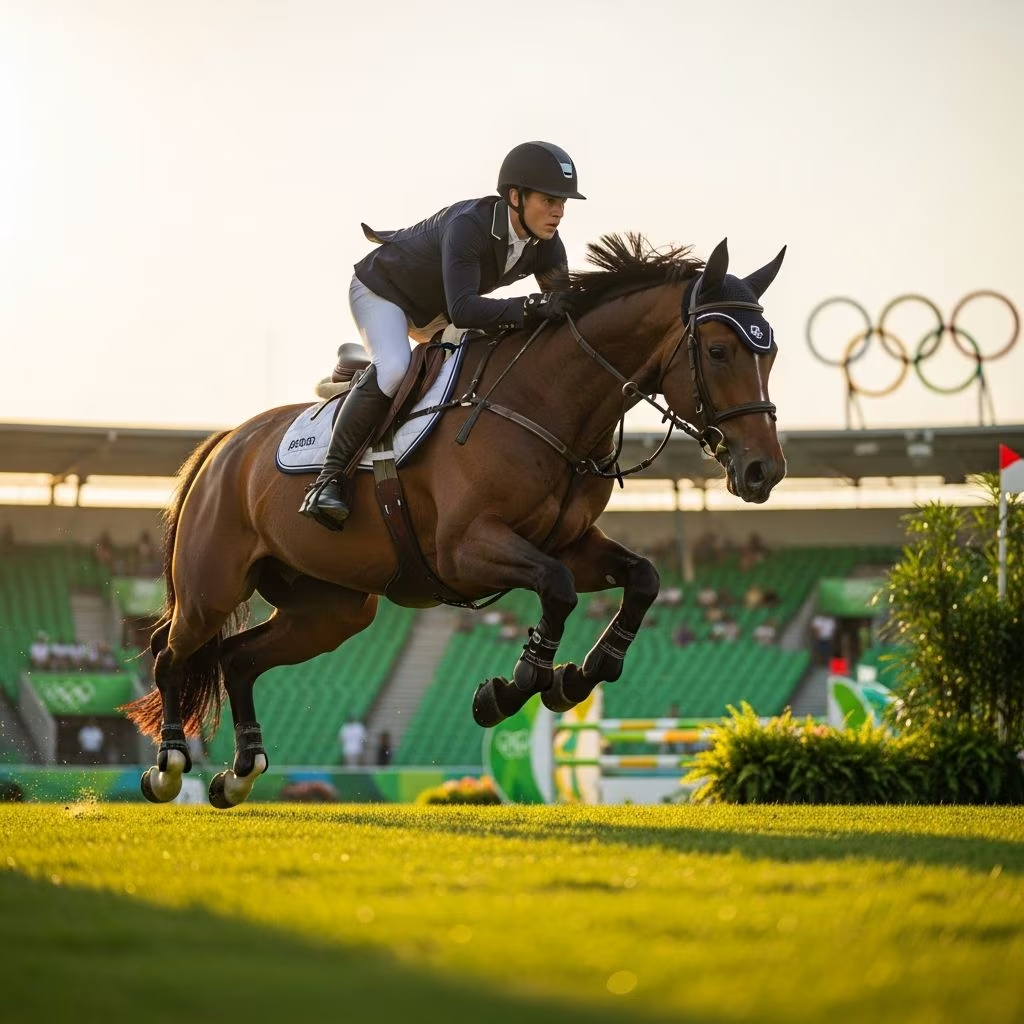
The Olympic Games have featured equestrian competition for over a century, making it one of the oldest and most prestigious international sporting arenas for horse and rider partnerships. Unlike most Olympic sports, equestrian competition stands apart as a uniquely inclusive discipline where male and female athletes compete directly against one another under identical rules and scoring systems. The sport encompasses three distinct competitive categories, each demanding specialized training, tactical expertise, and an extraordinary bond between horse and human.
The Foundation of Olympic Equestrian Competition
Equestrian sports joined the modern Olympic movement at the 1900 Paris Games, initially featuring jumping competitions alongside high jump, long jump, and mail coach events. However, the current structure of Olympic equestrian competition took shape in 1912 during the Stockholm Games, when the three primary disciplines—dressage, show jumping, and eventing—became officially recognized Olympic categories. Since the 1952 Helsinki Olympics, the sport has maintained its commitment to gender equality, allowing both men and women to compete in all disciplines on equal footing, making it a pioneering Olympic sport in terms of gender inclusivity.
The international governance of equestrian sports falls under the Fédération Équestre Internationale, which has overseen competitions since 1924. Throughout the decades, Germany has emerged as the dominant force in Olympic equestrian competition, consistently achieving medals across all three disciplines and establishing itself as a leader in equestrian excellence.
Dressage: The Art of Classical Horsemanship
Dressage represents the pinnacle of horse training and is often described as a living art form performed in an arena. The discipline showcases the ultimate harmony between rider and horse, with competitors executing a precisely choreographed sequence of movements from memory while under the watchful evaluation of a panel of specialized judges. The movements must demonstrate the horse’s flexibility, obedience, grace, and athletic capability across multiple gaits.
The evolution of dressage at the Olympic level has been significant since its introduction in 1912. Early dressage tests required horses to perform jumping movements as part of their routine, but modern dressage has evolved to emphasize movements performed on the flat, with particular emphasis on advanced movements such as the piaffe (a trotting movement performed in place) and passage (an elevated, rhythmic trotting gait). Today’s dressage horses are specifically bred for their natural movement and athleticism, displaying far more exaggerated and collected gaits than their early 20th-century counterparts.
Dressage Competition Formats
Olympic dressage competition is structured in multiple progressive stages, beginning with the Grand Prix test, which determines team winners and establishes the field for subsequent rounds. The Grand Prix test is performed in a standardized 20 by 60-meter arena and demonstrates fundamental dressage skills and movements required of top-level horses and riders. The top 25 individual competitors from the Grand Prix advance to the Grand Prix Special, a more challenging test that emphasizes advanced movements and precision. The top 13 performers from this stage compete in the Grand Prix Freestyle, a choreographed routine performed to music that allows individual riders creative expression while adhering to strict technical guidelines. This event was first introduced at the 1996 Olympics and has become a highlight of Olympic dressage competition.
Dressage offers both individual and team medal opportunities, with teams consisting of three to four riders per country. The discipline’s scoring system is based on judges’ evaluations of each movement, with marks awarded on a scale emphasizing precision, harmony, and athleticism.
Show Jumping: Precision and Speed Under Pressure
Show jumping, also referred to as hunter-jumper competition at the elite level, demands that horse and rider navigate a course of carefully designed obstacles within a specified time frame. Obstacles in Olympic competition can reach heights of up to 1.6 meters, testing the power, athleticism, and courage of both horse and rider. The sport combines technical skill with split-second decision-making, requiring competitors to assess distances, judge stride lengths, and execute precise approaches to each jump.
The scoring system in show jumping penalizes faults accrued during a round. Knockdowns—when a horse’s hooves dislodge the upper pole of an obstacle—each incur four faults. Refusals, where a horse stops before an obstacle or veers away from it, result in three faults for the first refusal, with additional penalties for subsequent refusals at the same obstacle. Exceeding the time allowed for the course results in one fault per four seconds over the limit. A clear round with no faults is exceptional and often results in a jump-off competition among those who achieved clean performances.
Competition Structure and Formats
Olympic show jumping features both individual and team events, allowing riders multiple opportunities to earn medals. Team competitions typically involve four riders per country, with scores combining to determine team placement. Individual competition determines which rider achieves the highest rankings. Courses are designed to test different aspects of horsemanship, including straightness, turning ability, rhythm, and confidence, with jumps positioned to require strategic planning and precise execution.
Eventing: The Ultimate Test of Versatility and Endurance
Eventing stands as the most comprehensive and demanding of the three Olympic equestrian disciplines, combining elements of dressage, cross-country, and show jumping into a single competition that tests the complete spectrum of horsemanship skills. This three-phase discipline highlights the versatility and stamina of the horse and the skill and endurance of the rider, making it a true test of horsemanship excellence.
The Three Phases of Eventing
The first phase of eventing competition is dressage, where competitors perform a choreographed test to demonstrate the training and harmony of their partnership. This phase is conducted in a standard arena and is scored identically to standalone dressage competitions, establishing a baseline score that carries through the remaining phases.
The second phase, cross-country, is a grueling endurance test where riders navigate a natural terrain course incorporating approximately 40 obstacles. These obstacles include natural features such as water crossings, ditches, banks, and solid wooden jumps, designed to test the horse’s courage, agility, and stamina across varied terrain. Riders must maintain specific speeds and complete the course within designated time parameters, adding a strategic element to their navigation of the course.
The final phase of eventing is show jumping, conducted in a stadium setting. Riders must demonstrate their horse’s ability to perform precise jumping in a controlled environment after the strenuous cross-country phase, showcasing the horse’s resilience and the rider’s ability to regain focus and precision following intense effort. This final phase serves as a test of recovery and concentration.
Eventing Competition Scoring
Eventing uses a cumulative scoring system where penalties from each phase are added together to determine final standings. Lower scores indicate better performances, as penalties are subtracted from a maximum starting score. Penalties can result from dressage judges’ scores, cross-country faults such as refusals or falls, and show jumping faults accrued in the final phase. Riders who accumulate excessive penalties can be eliminated from competition, emphasizing the critical importance of careful execution throughout all three phases.
Key Distinctions Among the Three Disciplines
| Discipline | Primary Focus | Performance Setting | Key Evaluation Criteria |
|---|---|---|---|
| Dressage | Harmony and training precision | Flat arena (20x60m) | Movement quality, obedience, rhythmic execution |
| Show Jumping | Technical jumping ability | Stadium arena with constructed obstacles | Clear rounds, time management, obstacle navigation |
| Eventing | Complete versatility and endurance | Multiple settings (arena, open terrain, stadium) | All-around capability, stamina, resilience |
The Unique Position of Equestrian Sports in the Olympic Movement
Equestrian competition maintains a singular distinction among Olympic sports as the only discipline involving animals competing at the international level. Both horses and riders are considered athletes, each contributing essential skills and physical capabilities to the partnership. This unique status has evolved over time, with modern understanding recognizing the horse as an athlete with training needs, physical conditioning requirements, and individual characteristics that influence performance.
The gender-inclusive nature of Olympic equestrian sports represents another exceptional feature. Since 1952, when women were first permitted to compete in dressage, followed by jumping in 1956 and eventing in 1964, equestrian sports have pioneered mixed-gender competition. Teams can include any combination of male and female riders, with no minimum requirements for either gender. This structure allows countries to select the best riders regardless of sex, making Olympic equestrian competition a leader in gender equality among Olympic sports.
Medal Opportunities and Competition Structure
Each of the three Olympic equestrian disciplines offers multiple pathways to medal success. Both individual and team medals are awarded in dressage, show jumping, and eventing, providing multiple opportunities for countries and riders to achieve Olympic recognition. Team competitions typically feature three or four riders per country, with scores aggregated to determine team placement. Individual competitions rank riders based on their performances in specified rounds, with the highest-performing riders earning medal positions.
The complexity of scoring systems varies by discipline, with dressage utilizing judges’ subjective evaluations of movement quality, show jumping employing a fault-accumulation system, and eventing combining all three phases into a comprehensive competitive assessment. This diversity ensures that different types of horsemanship excellence are recognized and rewarded at the Olympic level.
The Future of Olympic Equestrian Sports
The future of Olympic equestrian competition appears robust, with continued growth in participation and global interest. Advancements in breeding, training methodologies, and technological tools have enhanced the quality of equestrian competition, allowing horses and riders to achieve new levels of performance and precision. Modern facilities and standardized competition venues ensure that Olympic equestrian events maintain consistency and excellence across host cities and nations.
As the Olympic Games continue to evolve, equestrian sports remain a cornerstone event celebrating the extraordinary partnership between human athletes and equine partners. The three disciplines—dressage, show jumping, and eventing—showcase different facets of horsemanship excellence while maintaining the traditional values that have defined equestrian sport for generations.
Frequently Asked Questions About Olympic Equestrian Sports
What makes equestrian sports unique among Olympic disciplines?
Equestrian sports are the only Olympic events involving animals and feature gender-inclusive competition where men and women compete under identical rules and directly against one another in all events.
How long has equestrian been featured at the Olympics?
Equestrian sports have been part of the modern Olympic Games since 1900, though the three current disciplines were officially established in 1912. The sport is considered one of the oldest Olympic disciplines.
Are there team and individual medals in each discipline?
Yes, all three Olympic equestrian disciplines—dressage, show jumping, and eventing—offer both team and individual medal opportunities, allowing multiple pathways to Olympic recognition.
What countries dominate Olympic equestrian competition?
Germany has established itself as the leading power in Olympic equestrian competitions, consistently earning medals across all three disciplines.
Can female and male riders compete together in team events?
Yes, Olympic equestrian team events allow any combination of male and female riders, with no minimum requirements for either gender. Teams select the best riders regardless of sex.
References
- The History of Horse Sports in the Olympics — Equestroom. 2024. https://www.equestroom.com/blogs/equestrian-lifestyle/the-history-of-horse-sports-in-the-olympics
- Equestrian and Para equestrian – Hall of Fame — U.S. Olympic & Paralympic Museum. https://usopm.org/hall-of-fame/equestrian/
- Equestrian – Disciplines — LA28 Olympic Organizing Committee. 2024. https://la28.org/en/games-plan/olympics/equestrian.html
- Equestrian events at the Summer Olympics — Wikimedia Foundation. 2024. https://en.wikipedia.org/wiki/Equestrian_events_at_the_Summer_Olympics



