

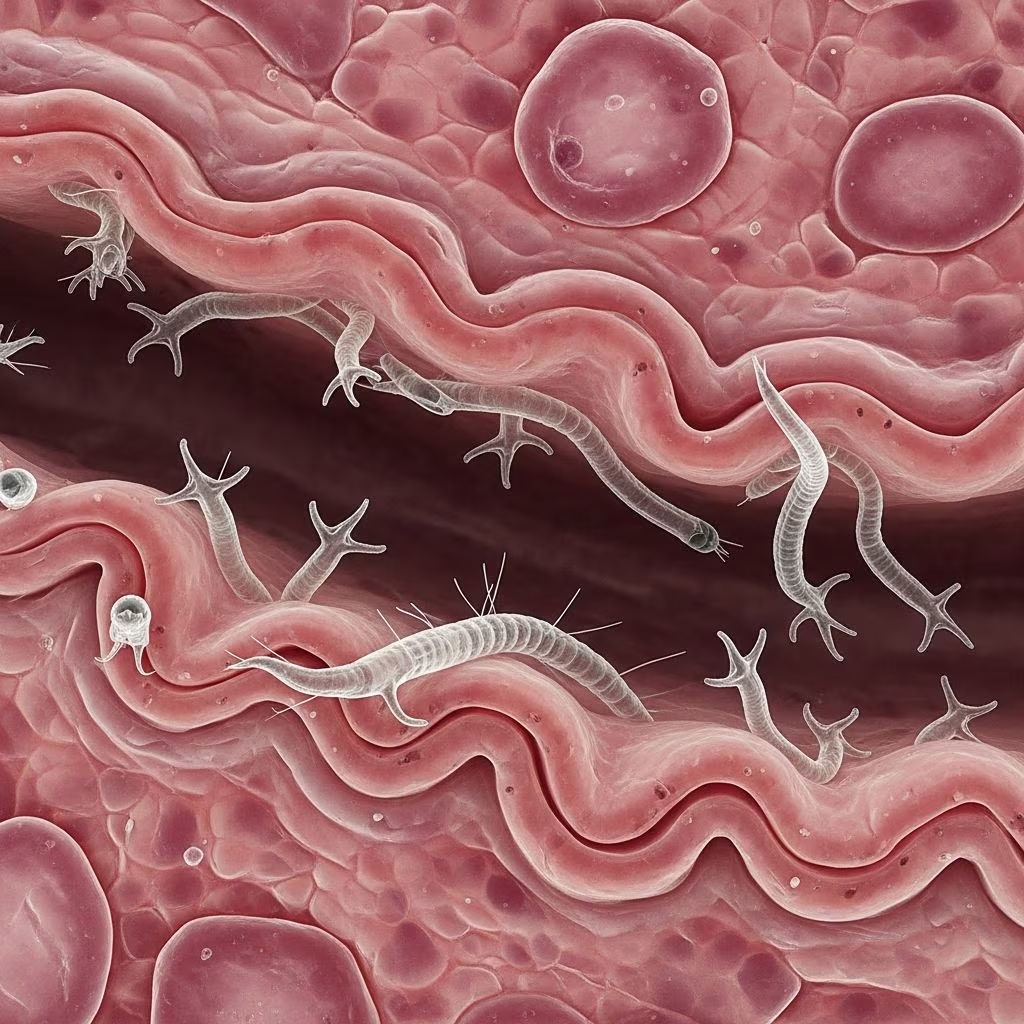
Ollulanus tricuspis is a microscopic nematode primarily infecting the stomachs of cats, leading to inflammation and potential chronic health issues. This parasite thrives in feline gastric mucosa, spreading through vomit ingestion and posing risks especially in multi-cat environments.
Characteristics of the Parasite
Adult Ollulanus tricuspis worms measure just 0.7 to 1.0 mm in length, making them invisible to the naked eye. Males are slightly smaller at 0.7-0.8 mm, while females reach 0.8-1 mm. Key identifying features include a coiled anterior end, a cup-shaped buccal capsule, and in females, a tail with three distinct cusps or tubercles. These trichostrongyle nematodes burrow into the stomach lining, causing localized irritation.
Unlike many helminths, O. tricuspis does not produce eggs that exit via feces. Instead, its reproduction is uniquely adapted to the gastric environment, enhancing its persistence within the host.
Lifecycle and Transmission Pathways
The lifecycle of Ollulanus tricuspis is direct, bypassing intermediate hosts. Eggs embryonate inside the female worm’s uterus, hatching into first-stage larvae. Second- and third-stage larvae develop within the mother, who then “gives birth” to live third-stage larvae directly into the stomach.
These third-stage larvae are immediately infectious. They can:
- Develop into adults within the same cat via autoinfection, allowing worm burdens to exceed 1,000 in solitary animals.
- Be expelled in vomit, surviving up to 12 days in the environment.
- Infect new hosts when cats ingest contaminated vomitus containing larvae, fourth-stage larvae, or adults.
From ingestion of third-stage larvae, it takes approximately 33-37 days to produce the next generation of larvae. This prepatent period supports rapid proliferation in dense cat populations.
Transmission is common in cat colonies, urban strays, free-roaming pets, and even captive big cats like cheetahs, lions, and tigers. Occasional reports note infections in dogs, pigs, and foxes, though cats are the primary host.
Clinical Manifestations in Affected Cats
Many cats harbor O. tricuspis asymptomatically, but heavy infestations trigger gastric pathology. Worms coil in the mucosa, inducing ulcers, chronic inflammation (gastritis), fibrosis, and excess mucus production.
Common signs include:
- Frequent **vomiting**, aiding parasite spread.
- Anorexia and weight loss.
- Emaciation in severe cases.
- Catarrhal gastritis, potentially leading to secondary bacterial issues.
In pigs, infections cause chronic gastritis, while rare dog cases show similar symptoms resolving post-treatment.
Comparison of Light vs. Heavy Infestations Infestation Level Symptoms Pathological Changes Light Often none Mild mucosal irritation Heavy (>1,000 worms) Vomiting, anorexia, emaciation Ulcers, fibrosis, severe gastritis Diagnostic Approaches for Accurate Detection
Standard fecal exams fail because larvae and adults die in the intestine before excretion. Diagnosis requires gastric sampling.
Recommended methods:
- Gastric lavage or stomach irrigation: Anesthetize the cat, flush with saline, centrifuge fluid, or use Baermann technique for larvae recovery.
- Induced emesis: Use xylazine to provoke vomiting; examine contents microscopically—successful in ~70% of cases.
- Gastroscopy with biopsy: Visualize worms or retrieve tissue smears showing nematodes with characteristic morphology.
Microscopic confirmation relies on size (<1 mm), coiled head, cusped female tail, and longitudinal ridges.
Treatment Protocols and Efficacy
Anthelmintics targeting gastric nematodes are effective. Though not always specified for O. tricuspis, drugs like fenbendazole or ivermectin have shown success in resolving infections and symptoms.
In one documented dog case, therapy eliminated parasites ante-mortem, with symptoms vanishing. Multi-dose regimens may be needed due to autoinfection. Always consult a veterinarian for dosing, as off-label use requires caution.
Prevention Strategies for Cat Owners
Control hinges on hygiene and population management:
- Limit outdoor access: Reduces vomit ingestion from strays.
- Clean environments promptly: Remove vomit immediately; disinfect multi-cat areas.
- Monitor colonies: Regular veterinary checks in catteries or rescues.
- Quarantine new cats: Especially from high-risk areas.
No commercial preventives exist specifically, but broad-spectrum dewormers help in integrated parasite control.
Global Distribution and Epidemiological Insights
O. tricuspis occurs worldwide: Europe, North/South America, Australia, Middle East. Prevalence is higher in stray/feral cats (up to severe gastritis in some studies) and colonies. Rare in pet cats with good husbandry.
Studies indicate low pathogenicity overall, but outbreaks in captive felids underscore zoonotic-adjacent risks (though not directly transmissible to humans).
Research Gaps and Future Directions
Prepatent period details remain vague; fecal transmission is unproven. Molecular diagnostics and vaccines could improve management. Ongoing surveillance in veterinary literature aids evolving strategies.
Frequently Asked Questions (FAQs)
Can humans get Ollulanus tricuspis from cats?
No, this parasite is host-specific to felids and not zoonotic.
Is Ollulanus tricuspis fatal?
Rarely; most cases are subclinical, but heavy burdens cause debilitation if untreated.
How do I know if my cat has it?
Suspect in vomiting cats from colonies; confirm via gastric lavage or endoscopy.
Does regular deworming prevent it?
Not fully, as fecal stages are absent; targeted gastric treatments are better.
Can dogs get it?
Very rarely; one ante-mortem case reported.
References
- Parasitic Stomach Worm (Ollulanis) Infection Cats — PetMD. Accessed 2026. https://www.petmd.com/cat/conditions/infectious-parasitic/c_ct_ollulanis_tricuspis
- Ollulanus tricuspis — Companion Animal Parasite Council (CAPC). Accessed 2026. https://capcvet.org/guidelines/ollulanus-tricuspis/
- Ollulanus tricuspis — Western College of Veterinary Medicine, University of Saskatchewan. Accessed 2026. https://wcvm.usask.ca/learnaboutparasites/parasites/ollulanus-tricuspis.php
- The first report of the ante-mortem diagnosis of Ollulanus tricuspis — PMC (NCBI). 2015-10-28. https://pmc.ncbi.nlm.nih.gov/articles/PMC4667671/
- Ollulanus tricuspis in domestic cats – prevalence and … — PubMed. 2005-07-22. https://pubmed.ncbi.nlm.nih.gov/16031056/



