

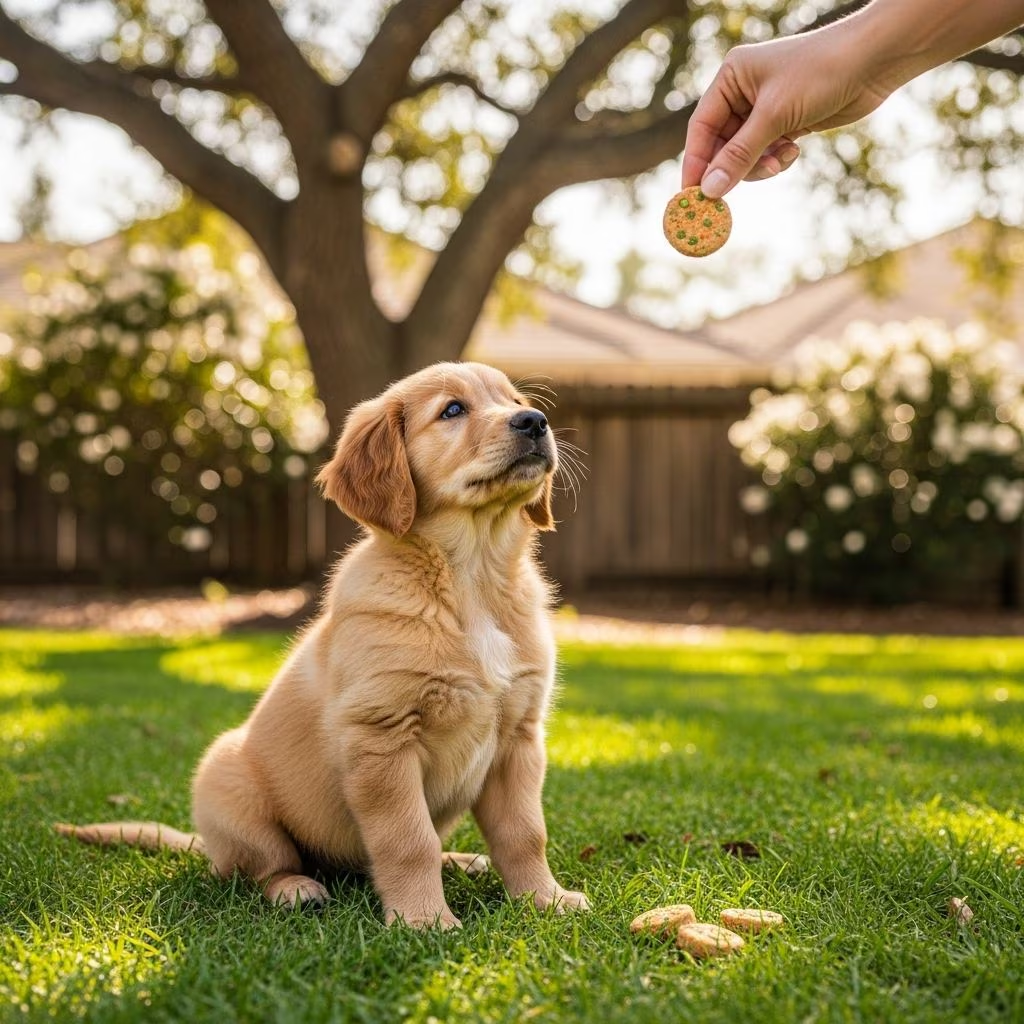
When you decide to train your dog using positive reinforcement methods, one of the most effective tools at your disposal is food-based rewards. Unlike punishment-based approaches that rely on creating fear or discomfort, reward-based training harnesses your dog’s natural motivation to earn something they desire. This approach not only produces faster learning but also strengthens your relationship with your canine companion by associating training sessions with positive experiences.
Understanding How Food Motivates Canine Learning
Dogs are primarily motivated by survival needs, and food sits at the top of that hierarchy. When you use treats as training rewards, you’re tapping into one of the most powerful biological drives in your dog’s brain. The act of earning food through performing a specific action creates neural pathways that reinforce the connection between the behavior and the reward.
The effectiveness of food rewards lies in the principle of operant conditioning, where a behavior followed by a pleasant consequence becomes more likely to occur in the future. This isn’t about bribing your dog; it’s about clearly communicating that certain actions lead to positive outcomes. Over time, your dog learns to actively participate in training by offering behaviors that they believe will earn them rewards.
The Critical Role of Timing in Treat Delivery
One of the most important factors in successful food-reward training is the timing of when you present the treat. Dogs experience the world in the present moment, and their ability to connect a reward with a behavior depends on how quickly that reward appears after the desired action. When you delay the reward by even a few seconds, your dog may associate the treat with whatever behavior they happened to be performing at that moment rather than the action you intended to reinforce.
To maximize the effectiveness of your training:
- Deliver treats within one to two seconds of the desired behavior occurring
- Use the treat as a marker that indicates exactly which action earned the reward
- Avoid fumbling with treat containers or bags during training sessions
- Keep high-value treats easily accessible in your pocket or training pouch
The immediacy of reward delivery creates a clear cause-and-effect relationship in your dog’s mind, making the training process more efficient and accelerating the learning curve.
Consistency: The Foundation of Effective Training Protocols
Consistency serves as the bedrock upon which successful food-reward training is built. This principle operates on two distinct levels: consistency in what you reward and consistency in how you reward it.
When you’re initially teaching a behavior, your dog needs to experience success repeatedly and predictably. During these early stages, reward your dog every single time they demonstrate the desired behavior correctly. This creates a strong association between the action and the positive outcome. Only as your dog becomes proficient at the behavior should you begin spacing out rewards, gradually transitioning to intermittent reinforcement where treats are given less frequently but remain consistent in their timing.
Equally important is consistency across all household members. If one family member rewards your dog for jumping up while another discourages the same behavior, your dog receives contradictory messages that undermine training progress. All caregivers should use identical commands, reward the same behaviors consistently, and apply the same timing principles.
Selecting and Varying Your Training Treats
Not all treats hold equal value for every dog. Your dog ultimately decides what is reinforcing and what is not, and this decision may surprise you. While some dogs become excited at the mention of a carrot, others consider it unworthy of effort. Effective training requires you to discover what your individual dog finds most motivating.
When selecting training treats, consider the following characteristics:
| Treat Characteristic | Importance for Training |
|---|---|
| High Value | Use special treats reserved only for training sessions, not everyday snacks |
| Quick to Consume | Choose treats your dog can eat in one or two bites to maintain training momentum |
| Soft Texture | Soft treats break easily and don’t require extensive chewing |
| Distinctive Smell | Aromatic treats capture attention more effectively than bland options |
| Appropriate Size | Treats should be small enough to prevent rapid satiation during sessions |
Varying your treat selection throughout training sessions maintains your dog’s engagement and enthusiasm. If you always use the same treat, its novelty diminishes and your dog’s motivation may wane. Consider rotating between different high-value options, which keeps training sessions fresh and exciting for your canine learner.
Structuring Training Sessions for Optimal Learning
The environment and structure of your training sessions significantly impact their effectiveness. A well-designed session sets your dog up for success and maximizes the reinforcement value of your treats.
Key structural elements include:
- Location selection: Begin training in quiet, low-distraction environments where your dog can focus entirely on you and the training task
- Session duration: Keep individual sessions brief, typically five to ten minutes, to maintain your dog’s interest and prevent fatigue
- Single-focus approach: Work on one specific behavior per session rather than attempting multiple skills
- Ending on success: Always conclude training sessions while your dog is still enjoying the experience and performing well
- Break frequency: Include brief breaks within sessions to allow your dog’s brain to process information
Shorter, more frequent training sessions typically produce better results than longer, sporadic sessions, and the use of food rewards makes these sessions inherently enjoyable for your dog.
Progressive Learning Through Behavioral Shaping
Some behaviors cannot be taught in a single step. Complex actions require what trainers call “shaping,” a technique where you reward progressively closer approximations of the final desired behavior.
For example, teaching your dog to shake hands might involve:
- Rewarding any upward movement of the paw
- Rewarding higher paw lifts
- Rewarding paw contact with your hand
- Rewarding paw contact while holding your hand
- Rewarding complete shaking motion
At each stage, your dog earns food rewards that mark their progress. This incremental approach prevents frustration and demonstrates to your dog that they’re making the right decisions, even before achieving the complete final behavior. Food rewards make this gradual process clear and motivating.
The Secondary Reinforcer: Clicker Training Integration
While food provides the primary reinforcement, many trainers incorporate a secondary reinforcer—typically a clicker or specific verbal marker—to enhance communication precision. The clicker serves as a distinct sound that marks exactly which action earned the reward, and this marker becomes meaningful only because it’s consistently followed by food treats.
The clicker training process works as follows:
- When your dog performs the desired behavior, click immediately
- Follow the click with a food treat within one to two seconds
- Repeat this sequence multiple times to establish the association
- Eventually, the click itself becomes rewarding because your dog knows it predicts food
This system provides a bridge between the behavior and the food reward, making the timing of communication even more precise and enabling more nuanced training progress.
Transitioning Away From Constant Food Rewards
While food rewards are essential during initial training, your long-term goal involves reducing dependency on treats while maintaining reliable behavior performance. This transition should occur gradually rather than abruptly.
Once your dog demonstrates proficiency with a behavior, begin offering rewards intermittently rather than continuously. You might reward every second or third successful performance, eventually spacing rewards even further apart. Throughout this transition, maintain verbal praise and physical affection to remind your dog that good behavior continues to earn positive consequences—they’ve simply become less predictable and more variable.
The key distinction is that your dog’s behavior should become more reliable, not less reliable, even as food treats decrease in frequency. If behavior deteriorates when you reduce rewards, you’ve transitioned too quickly.
Monitoring Progress and Adjusting Strategies
Effective training requires objective assessment of whether your reward system is actually producing results. Simply offering treats doesn’t guarantee successful positive reinforcement; the behavior must demonstrably increase in frequency, reliability, or quality.
Track your training progress by noting:
- Whether your dog performs the behavior more reliably when commanded
- How quickly your dog responds to your cue
- Whether the behavior occurs more frequently in various environments
- Whether your dog demonstrates the behavior with less prompting
If you don’t observe measurable improvement over time, reassess your approach. Common issues include treats that lack sufficient value for your particular dog, timing that’s too delayed, or inconsistent application of rewards across different situations and handlers.
Avoiding Common Mistakes in Treat-Based Training
Several pitfalls can undermine even well-intentioned food-reward training efforts. Awareness of these common mistakes helps you maintain training effectiveness:
Mistaking Treat-Feeding for Training: Occasionally giving your dog a treat is not the same as using food rewards strategically within a training framework. True positive reinforcement requires intentional timing and consistency.
Overfeeding During Sessions: Using too many or too-large treats during training can lead to excessive calorie intake and potential weight gain. Use tiny, bite-sized pieces that satisfy your dog without creating nutritional problems.
Inconsistent Communication: If different family members use different command words or rewarding different variations of a behavior, your dog receives confusing signals that slow learning progress.
Ignoring Unwanted Behaviors: While positive reinforcement focuses on rewarding desired actions, you cannot simply ignore undesired behaviors and expect them to disappear. Combine food rewards for correct actions with clear communication about what behaviors you won’t tolerate.
Frequently Asked Questions About Food-Reward Training
Can I use regular dog food kibble as training treats?
Yes, though many dogs find kibble less motivating than special training treats. If your dog is highly food-motivated and readily responds to kibble, using regular food can help manage overall calorie intake. However, reserve higher-value treats for teaching new or challenging behaviors.
What if my dog isn’t food-motivated?
Some dogs respond more strongly to play, praise, or physical affection. You can still use positive reinforcement principles with these alternative rewards. However, nearly all dogs have at least some food they find rewarding; finding that specific food may require experimentation.
How do I prevent my dog from becoming overweight through training?
Use small treats and account for training calories within your dog’s total daily food allowance. Consider using portion of regular meals as training rewards. Short training sessions with appropriate treat sizes prevent excessive calorie consumption while maintaining training effectiveness.
Should I always have treats during training?
Initially, yes. As your dog becomes proficient, gradually reduce treat frequency while maintaining other positive reinforcement like verbal praise and physical affection. Eventually, many behaviors become reliable through intermittent treat rewards combined with consistent praise.
References
- How To Train a Dog With Positive Reinforcement — PetMD, Erika Lessa, CBST, CDBT, CDBC, CPDT-KA. https://www.petmd.com/dog/behavior/how-to-train-a-dog-with-positive-reinforcement
- Positive Reinforcement Dog Training: Understanding Operant Conditioning — American Kennel Club (AKC). https://www.akc.org/expert-advice/training/operant-conditioning-positive-reinforcement-dog-training/
- Puppy 101: Positive Reinforcement Dog Training — Small Door Veterinary, SmallDoor Inc. https://www.smalldoorvet.com/learning-center/puppies-kittens/positive-reinforcement-training
- How to Reward Dogs With Positive Reinforcement Training — Humane World, The Humane Society of the United States. https://www.humaneworld.org/en/resources/positive-reinforcement-training
- The Power of Positive Reinforcement: 5 Effective Dog Training Tips — 3 Dog Ranch Montana. https://www.3dogranchmt.com/post/positive-reinforcement-tips



