

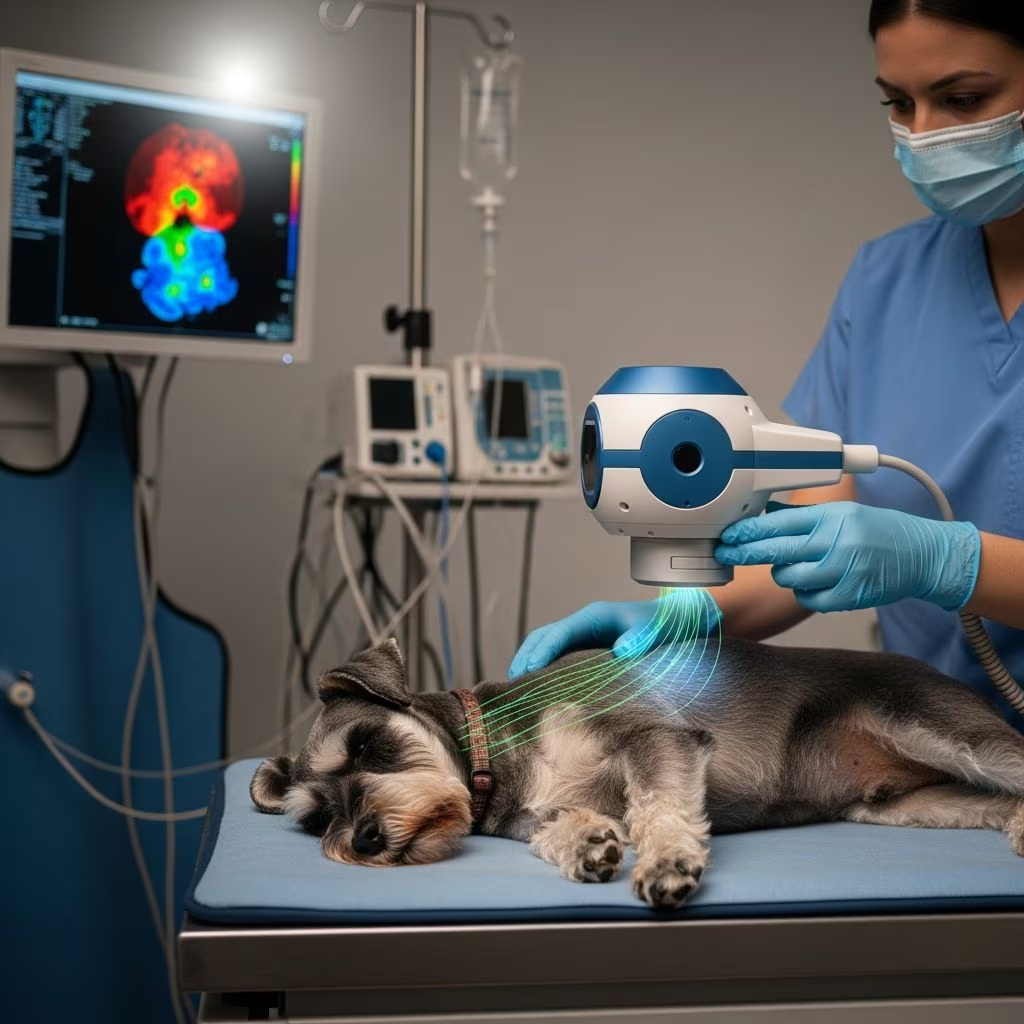
Nuclear imaging, particularly scintigraphy, represents a powerful yet underutilized tool in veterinary diagnostics. By administering trace amounts of radioactive tracers, veterinarians can visualize organ function and detect abnormalities earlier than with traditional X-rays or ultrasounds. This functional approach excels in identifying metabolic changes, blood flow issues, and early disease stages in animals ranging from cats and dogs to horses.
Fundamentals of Radionuclide-Based Diagnostics
At its core, nuclear medicine involves introducing a radiopharmaceutical—a compound tagged with a gamma-emitting isotope—into the animal’s body. These tracers are selected for their affinity to specific tissues or physiological processes. Once injected, inhaled, or ingested, the isotope decays, releasing gamma rays that a specialized gamma camera captures. The resulting images reveal not just anatomy but dynamic processes like blood perfusion, cellular metabolism, and tissue uptake patterns.
Unlike structural imaging modalities such as CT or MRI, which excel at detailing size and shape, nuclear methods prioritize function. For instance, a bone scan can highlight areas of increased metabolic activity indicative of infection, fracture, or tumor before structural changes appear on radiographs. Data from the gamma camera is processed by computers to generate quantitative maps, allowing vets to measure uptake rates and compare regions of interest.
Key Techniques in Small Animal Nuclear Medicine
In small animals like dogs and cats, several scintigraphic protocols stand out for their diagnostic precision.
- Bone Scintigraphy: Technetium-99m-labeled diphosphonates accumulate in areas of active bone remodeling. This detects occult fractures, osteomyelitis, arthritis, and metastases with sensitivity far surpassing plain films. Whole-body scans efficiently survey the skeleton.
- Thyroid Scintigraphy: Iodine-123 or technetium pertechnetate targets thyroid tissue, aiding hyperthyroidism diagnosis in cats and thyroid neoplasia staging in both dogs and cats. Uptake patterns distinguish functional nodules from carcinomas.
- Portal Scintigraphy: Trans-splenic injection visualizes blood flow from spleen to liver, confirming portosystemic shunts—congenital or acquired vascular anomalies causing hepatic encephalopathy. Real-time imaging differentiates single shunts from diffuse ones.
These procedures typically require mild sedation for patient comfort and IV catheter placement. Risks are minimal, including rare bleeding from splenic puncture or sedation reactions, mitigated by pre-screening. Post-scan, animals are monitored until radiation levels drop safely before discharge.
Advanced Modalities: SPECT and PET in Vet Applications
Evolving beyond planar scintigraphy, single-photon emission computed tomography (SPECT) reconstructs 3D images by rotating the gamma camera around the patient. This enhances lesion localization and specificity.
Positron emission tomography (PET) takes sensitivity further using positron-emitting isotopes like fluorine-18. Positrons annihilate with electrons, producing detectable gamma pairs for millimeter-precision mapping. PET excels in oncology, tracking glucose metabolism in tumors via FDG (fluorodeoxyglucose), and neurology for amyloid plaques. In small animals, hybrid PET/CT or PET/MRI fuses metabolic and anatomical data, revolutionizing cancer staging and treatment planning.
| Modality | Strengths | Common Uses in Vets | Limitations |
|---|---|---|---|
| Planar Scintigraphy | High sensitivity, whole-body coverage | Bone, thyroid scans | Poor spatial resolution |
| SPECT | 3D imaging, better specificity | Organ perfusion studies | Longer scan times |
| PET | Ultra-sensitive, quantitative | Oncology, metabolism | Expensive isotopes, regulatory hurdles |
Large Animal Applications: Focus on Equine PET
Horses benefit immensely from nuclear imaging, especially distal limb PET since 2016. Portable scanners image feet and pasterns, quantifying avidity—tracer uptake—in 3D. This pinpoints stress fractures, navicular disease, or osteoarthritis hotspots invisible on X-rays. Asynchronous PET/CT protocols correlate hot spots with anatomy, guiding precise interventions.
Quantitative metrics like standardized uptake values (SUV) assess lesion activity, predicting clinical relevance. This modality’s growth promises refined lameness diagnostics and personalized therapies for performance horses.
Equipment and Procedural Workflow
Gamma cameras, often mobile, collimate gamma rays into scintillation crystals, converting them to light flashes amplified and digitized. Modern systems integrate AI for noise reduction and automated region analysis.
- Tracer administration (IV bolus for most).
- Dynamic phase: Immediate imaging for vascular flow.
- Blood pool phase: Soft tissue perfusion (10-30 min post-injection).
- Delayed phase: Tissue-specific uptake (2-4 hours).
Images are stored digitally for serial comparison and telediagnosis by board-certified radiologists.
Regulatory and Practical Barriers
Despite accessibility of used cameras, radiopharmaceuticals pose challenges. Strict licensing, documentation, and decay monitoring are required. Veterinary patients must remain hospitalized until background radiation levels are reached, unlike human outpatient protocols.
Interpretation demands specialized training, as physiological “hot spots” mimic pathology. Spatial resolution lags behind CT/MRI, necessitating multimodality integration. Costs, including isotopes and disposal, limit routine use to referral centers.
Safety Considerations for Animals and Staff
Doses are microcurie levels, yielding effective exposures akin to a few chest X-rays—safe for oncologic benefits. Personnel use shielding, dosimetry badges, and ALARA (as low as reasonably achievable) principles. Owners receive precautions post-discharge.
Environmental impact is managed via decay-in-storage, with lead shielding for waste.
Future Horizons in Veterinary Nuclear Medicine
Innovations like theranostics—combining diagnostics with targeted radiotherapy—and novel tracers for inflammation (e.g., gallium-68 DOTATATE) are emerging. AI-enhanced image analysis and cyclotron-produced isotopes could democratize PET. Equine whole-body PET looms, expanding beyond limbs.
Hybrid systems proliferate in academia, with small animal PET/CT now standard for translational research mirroring human oncology trials.
FAQs
What preparation is needed for a nuclear scan?
Fasting may be required; sedation is common. Pre-procedure bloodwork screens for risks.
How long does radiation persist in my pet?
Technetium-99m half-life is 6 hours; discharge typically after 12-24 hours when levels <0.5 mR/hr.
Is nuclear imaging safe for breeding animals?
Avoid in pregnancy due to fetal sensitivity; consult vets for alternatives.
Can it replace surgery for shunt diagnosis?
Non-invasive confirmation often suffices, guiding surgical planning.
What’s the cost range?
$1,000-$3,000 USD depending on protocol and location; referral-based.
References
- Nuclear Medicine Imaging in Animals — Merck Veterinary Manual. 2023. https://www.merckvetmanual.com/clinical-pathology-and-procedures/diagnostic-imaging/nuclear-medicine-imaging-in-animals
- Veterinary Nuclear Medicine Services — VICSD. 2024. https://www.vicsd.com/services/nuclear-scintigraphy/
- Nuclear Medicine – Scintigraphy — VCA Animal Hospitals. 2023. https://vcahospitals.com/orange-county-veterinary-specialists/departments/diagnostic-imaging/nuclear-medicine—scintigraphy
- Small Animal Nuclear Medicine — Animal Imaging. 2024. https://animalimaging.net/small-animal-nuclear-medicine/
- Nuclear Scintigraphy — UC Davis School of Veterinary Medicine. 2023. https://www.vetmed.ucdavis.edu/hospital/diagnostic-imaging/small-animal/nuclear-scintigraphy
- Veterinary Nuclear Medicine: A Look into the Future — CABI Digital Library. 2021. https://www.cabidigitallibrary.org/doi/pdf/10.5555/20210258394



