

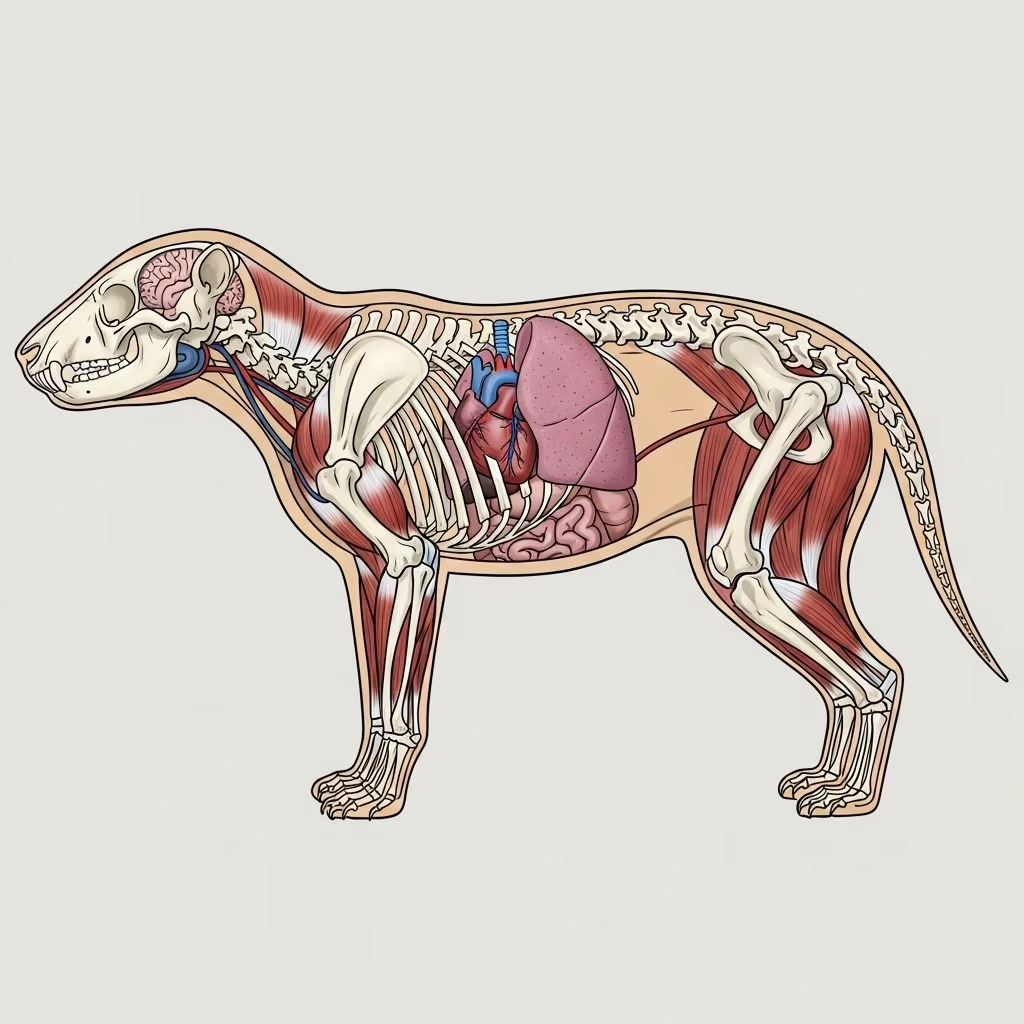
The human nose serves as the gateway to the respiratory system, performing critical tasks like air filtration, humidification, warming, and olfaction. Its external structure, often described from the **nasion** at the top to the **ala** at the base, forms a complex pyramid of bone, cartilage, muscle, and skin that defines facial aesthetics and functionality.
Overview of External Nose Morphology
The external nose projects prominently from the mid-face, shaped like an inverted pyramid with its apex at the tip and base encompassing the nostrils. Key landmarks include the **root** (upper narrow portion), **bridge** (dorsal surface), **tip** (lowest free end), **supratip** (area just above the tip), **rhinion** (bony-cartilaginous junction), and **nares** (nostrils bounded by alar wings). These features not only contribute to appearance but also influence airflow dynamics.
The nose divides into thirds: the upper bony third supported by nasal bones, the middle cartilaginous third by upper lateral cartilages, and the lower third by lower lateral (alar) cartilages. This tripartite division is essential for surgical planning in procedures like rhinoplasty.
Skeletal Framework: Bone and Cartilage
The nose’s rigidity and form rely on an osteocartilaginous skeleton. The upper third features paired **nasal bones**, rectangular and midline-fused, articulating with the frontal bone superiorly at the nasion and maxilla laterally. These bones form the bridge and protect underlying structures.
Transitioning inferiorly, the **rhinion** marks where nasal bones meet cartilages. The middle vault includes **upper lateral cartilages (ULCs)**, which articulate with the nasal bones superiorly, septum medially, and flare laterally toward the piriform aperture. They maintain mid-dorsal support and contribute to the nasal valve—a narrowest airflow point bordered by ULCs, septum, and inferior turbinate head.
The lower third comprises **major alar cartilages** with medial and lateral crura. Medial crura form the columella (dividing nostrils), while lateral crura create alar rims, reinforced by a **nasal scroll** for collapse resistance during inspiration. A **minor alar cartilages** and sesamoid cartilages provide additional contouring.
| Region | Primary Components | Function |
|---|---|---|
| Upper Third | Nasal bones | Bridge support, protection |
| Middle Third | Upper lateral cartilages | Mid-vault stability, valve formation |
| Lower Third | Alar cartilages (major/minor) | Nostril shape, airflow regulation |
Muscular System of the Nose
Nasal muscles, innervated by the facial nerve (CN VII), enable dynamic movements for expression, nostril control, and breathing modulation. They categorize into elevators, depressors, compressors, and dilators.
- Elevators: Procerus (wrinkles glabellar skin), levator labii superioris alaeque nasi (lifts upper lip and ala), and anomalous nasi elevate the nasal tip and dilate valves.
- Depressors: Depressor septi nasi (pulls columella down) and alar nasalis lower the tip.
- Compressors: Transverse nasalis (compressor naris) narrows nares.
- Dilators: Dilator naris posterior/anterior (alar part of nasalis) flares nostrils during exertion.
These muscles overlay the skeletal framework, allowing adaptive responses to airflow demands.
Skin and Soft Tissue Layers
Nasal skin varies regionally: thin and mobile over the bony vault for contour flexibility, thickening over the tip and alae with abundant sebaceous glands. This glandular hypertrophy can lead to **rhinophyma**, a lobulated swelling seen in rosacea. The **vestibule**, skin-lined entry to the nasal cavity, features vibrissae (coarse hairs), sweat glands, and sebaceous glands for particle filtration. Its superior limit, the limen nasi (nasal valve), is surgically significant.
Vascular Supply and Lymphatics
The external nose receives dual arterial supply from external (angular, superior labial, infraorbital) and internal (anterior ethmoidal) carotid systems, forming a rich anastomosis prone to epistaxis.
- Dorsum/tip: Lateral nasal (angular), external nasal (anterior ethmoidal).
- Sidewall: Infraorbital branches.
- Alar/columella: Angular, superior labial.
Venous drainage parallels arteries, with risk of embolism via ophthalmic veins. Lymphatics drain to submandibular, submental, and facial nodes.
Innervation: Sensory Pathways
Sensory supply derives from trigeminal nerve branches (V1/V2). Ophthalmic division (V1) covers superior aspects via supra/infratrochlear and anterior ethmoidal nerves; maxillary (V2) handles lateral/base via infraorbital. This informs local anesthesia for nasal procedures.
Functional Roles Beyond Aesthetics
Beyond appearance, the nose conditions air: turbinates (ethmoidal/middle/superior, independent inferior) on lateral walls humidify/warm via mucosa. The nasal valve regulates 50% of resistance. Olfactory epithelium in the roof detects odors.
Clinical Implications and Surgical Considerations
Understanding nose-to-tail anatomy aids fracture repair (nasal bones common), rhinoplasty (preserving valve/support), and addressing obstructions. Deviated septa or weak alae impair function.
Frequently Asked Questions (FAQs)
What defines the rhinion in nasal anatomy?
The rhinion is the junction between nasal bones and upper lateral cartilages, critical for middle vault integrity.
How do nasal muscles affect breathing?
Dilators expand nares during exercise; compressors close them voluntarily.
Why is nasal skin thicker at the tip?
To house sebaceous glands, influencing rhinoplasty skin redraping.
What is the nasal valve’s role?
It’s the narrowest airway segment, vital for airflow; collapse causes obstruction.
Which nerves block for rhinoplasty?
Infratrochlear, anterior ethmoidal, infraorbital for comprehensive anesthesia.
References
- Anatomy of External Nose – Nasion, Rhinion, Supratip — EntLecture. 2023. https://www.entlecture.com/anatomy-of-external-nose/
- Anatomy, Head and Neck, Nose — StatPearls, NCBI Bookshelf. 2023-10-29. https://www.ncbi.nlm.nih.gov/books/NBK532870/
- Human nose — Wikipedia. 2024. https://en.wikipedia.org/wiki/Human_nose
- Nasal and Paranasal Sinus Anatomy and Embryology — EntoKey. 2022. https://entokey.com/nasal-and-paranasal-sinus-anatomy-and-embryology/
- Nose: Anatomy, Function & Related Conditions — Cleveland Clinic. 2023-08-21. https://my.clevelandclinic.org/health/body/21778-nose



