

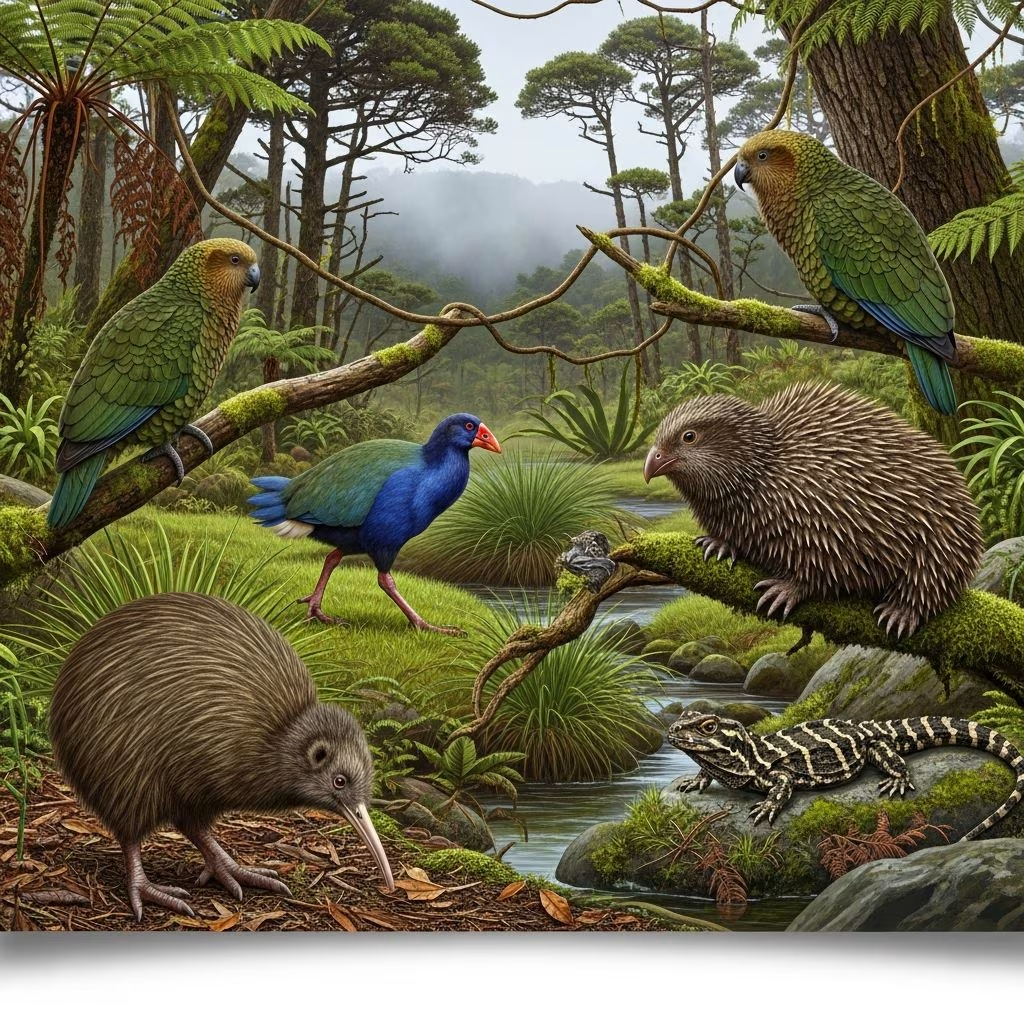
New Zealand stands as a global hotspot for flightless avian diversity, hosting approximately 16 extant species of non-flying birds—more than any other region on Earth. This exceptional concentration of grounded birds represents one of nature’s most compelling evolutionary experiments, shaped by millions of years of geographic isolation and the absence of terrestrial mammalian predators. The country’s unique flightless fauna encompasses diverse groups including five kiwi species, the world’s only flightless parrot, several penguin varieties, and specialized waterfowl adapted to island environments.
The Evolutionary Foundation of Flightlessness
The development of flightlessness in New Zealand’s avian population stems from extraordinary environmental circumstances spanning approximately 80 million years of isolation. During this extended period, the archipelago remained separated from continental landmasses and, critically, contained no native land mammals that could threaten ground-dwelling birds. This predator-free environment created selective pressure favoring the loss of metabolically expensive flight capabilities in favor of traits better suited to terrestrial existence.
The absence of mammalian predators fundamentally altered the survival calculus for New Zealand’s birds. Energy conservation became advantageous, as maintaining powered flight requires substantial physiological investment. Over successive generations, natural selection favored individuals whose genetic heritage included reduced wing size and modified skeletal structures. The consequences of this adaptation are visible in modern flightless species through distinctive anatomical features: diminished wing bones and the absence or significant reduction of the keel on the breastbone—structures essential for powering flight in their airborne relatives.
Ecological Niches and Functional Diversity
New Zealand’s flightless birds diversified to fill ecological roles typically occupied by mammals in other terrestrial ecosystems. This remarkable adaptive radiation demonstrates how avian species can completely restructure their existence to exploit available resources when competition from mammals is eliminated. The distribution of feeding strategies and habitat preferences across flightless taxa reveals sophisticated ecological organization developed over millennia.
Browsing and grazing niches were dominated by the moa and kakapo, large herbivorous species that exploited forest vegetation and lower-story plants. Grass-eating roles fell to the takahe, a large rail species, while ground-level invertebrate hunting was executed by kiwis and various wren species. This functional partitioning allowed multiple species to coexist without direct resource competition, enabling the evolution of a stable, diverse biological community.
The Kiwi Family: Icons of Flightlessness
The kiwi represents perhaps New Zealand’s most emblematic flightless bird, comprising five distinct species that embody the evolutionary principles enabling life without flight. These nocturnal creatures possess several derived characteristics setting them apart from their flying relatives. Their wings have reduced to vestigial stumps concealed beneath fur-like feathers, creating an appearance fundamentally different from typical bird morphology.
Brown Kiwi Characteristics and Behavior
The brown kiwi (Apteryx mantelli) represents the most abundant kiwi species, measuring 40-42 centimeters in length. Despite their modest size, brown kiwis demonstrate considerable behavioral complexity. They exhibit strong territorial behavior and have evolved potent defensive mechanisms, delivering powerful kicks to potential predators such as stoats. These birds maintain primarily nocturnal activity patterns, emerging under cover of darkness to forage for invertebrate prey. Their social organization involves monogamous pairing, with the unusual characteristic that males undertake primary responsibility for incubating eggs.
Conservation efforts have classified brown kiwis as endangered, with approximately 35,000 individuals remaining in the wild. This population figure, while substantial relative to other kiwi species, represents a dramatic decline from pre-human abundance when brown kiwis likely inhabited vast forested regions across the North and South Islands.
Little Spotted Kiwi Recovery
The little spotted kiwi (Apteryx owenii) demonstrates how targeted conservation can reverse near-extinction events. By the twentieth century’s beginning, mainland populations had essentially disappeared, with the species reduced to critically low numbers. A pivotal management decision relocated a small population to Kapiti Island near Wellington, an offshore location offering predator-reduced conditions. This translocation proved remarkably successful, allowing the population to rebound from near-total extinction to approximately 800 individuals with near-threatened conservation status.
Little spotted kiwis possess an extraordinary biological characteristic: the proportion of their body allocated to egg production exceeds that of any other bird species. Their eggs represent 23 percent of their body weight, a remarkable reproductive investment reflecting the intense selection pressures operating in New Zealand’s isolated ecosystem.
Great Spotted Kiwi Distribution and Diet
The great spotted kiwi (Apteryx haastii) holds the distinction of being the largest among its congeners, measuring 45-47 centimeters in length. Despite their prominence in the flightless bird assemblage, great spotted kiwis remain poorly studied compared to their relatives, with research gaps extending to many aspects of their behavior and ecology. Their distribution is geographically restricted to forests surrounding Nelson and along the South Island’s west coast.
Dietary analysis reveals ecological flexibility, with great spotted kiwis consuming freshwater crayfish alongside more typical prey items including insects, earthworms, and forest fruits. This varied diet likely reflects opportunistic foraging strategies adapted to seasonal availability of different prey categories across their montane forest habitat.
The Kakapo: World’s Heaviest and Longest-Living Parrot
The kakapo (Strigops habroptila) occupies a unique position among global avifauna as the world’s only flightless parrot and simultaneously the heaviest parrot species. Endemic exclusively to New Zealand, this remarkable bird combines nocturnal habits with herbivorous feeding specializations unusual among its family. Their speckled yellow-green plumage provides effective ground-level camouflage, enabling these terrestrial parrots to forage concealed among forest vegetation.
Perhaps most extraordinarily, kakapos possess unparalleled longevity among avian species, with life expectancies averaging 95 years and potentially extending beyond a century. This exceptional lifespan emerges from the predator-free environment of New Zealand, where reproductive pressures and predation risks that typically curtail bird lifespans remained absent throughout evolutionary history until human arrival.
Reproduction and Lek Behavior
Kakapo breeding systems operate according to a lek mating arrangement more commonly observed in galliform birds such as turkeys and grouse. Males excavate shallow bowl-shaped depressions in the ground where they produce distinctive vocalizations—low-frequency booming sounds and higher-pitched ching calls—designed to attract receptive females. This behavioral system represents a remarkable instance of convergent evolution, where parrot breeding strategies evolved to resemble those of distantly related bird families.
Following successful mating, female kakapos assume complete responsibility for egg incubation and chick rearing without male participation. The breeding cycle occurs infrequently, with considerable intervals separating successful reproductive episodes. These reproductive characteristics—infrequent breeding combined with small clutch sizes and extended parental care—render kakapo populations particularly vulnerable to anthropogenic pressures and population fluctuations.
Rails and Waterfowl: Specialized Island Adaptations
Beyond the iconic kiwis and charismatic kakapo, New Zealand’s flightless avifauna includes diverse rail species and modified waterfowl populations. These less-celebrated groups demonstrate how evolutionary processes operate across different ecological contexts to produce flightlessness through varying developmental pathways.
The Takahe: Resurrected from Presumed Extinction
The takahe (Porphyrio hochstetteri) holds an extraordinary conservation narrative. Presumed extinct and subsequently rediscovered in 1948, this large flightless rail has become a symbol of hope for species recovery efforts. Adult takahe display striking coloration featuring deep purple-blue plumage complemented by red frontal shields and reddish-pink bills, with pink-colored legs completing their distinctive appearance.
These monogamous birds maintain intensely territorial behavior, with pairs establishing exclusive ranges that they defend vigorously against intruders. Breeding occurs in concealed nests positioned beneath protective bushes, offering some protection from avian predators despite the birds’ terrestrial existence. Conservation managers have strategically relocated takahe populations to offshore islands including Kapiti, Maud, Mana, and Tiritiri Matangi, where predator-reduced conditions enhance survival probability.
Weka: Fleet-Footed Rails
The weka (Gallirallus australis, measuring 53 centimeters, represents an anomalous flightless species possessing disproportionately large wings relative to their terrestrial existence. Despite retaining substantial wing structures, weka have evolved flightlessness, likely reflecting the selective advantage of rapid terrestrial locomotion over flight capability in New Zealand’s predator-free environment. Population estimates suggest 107,000 to 177,000 individuals remain, though mainland populations have contracted while island populations continue to thrive.
Weka demonstrate behavioral versatility rarely observed among specialized flightless species. Beyond rapid running ability, they function as effective swimmers, expanding their ecological capabilities beyond typical ground-dwelling constraints. Their omnivorous diet encompasses small mammals, chicks of other species, invertebrates, lizards, seeds, foliage, and fruits, indicating adaptable feeding strategies enabling survival in variable resource conditions.
Island Teal Populations
Two distinct teal species exemplify how island isolation promotes flightlessness through evolutionary modification of ancestral flying populations. The Auckland Island teal (Anas aucklandica) survives on mammal-free islands of the subantarctic Auckland Islands group, extinct on Auckland Island itself but persisting on Ewing, Enderby, Rose, Ocean, Adams, Disappointment, and Dundas Islands. Their chestnut coloration provides effective shoreline camouflage among kelp beds where they forage.
Environmental pressures including strong prevailing westerly winds in island habitats create selective advantage for flightlessness—birds capable of powered flight risk permanent displacement seaward by powerful air currents. Campbell Island teal underwent even more dramatic population fluctuations, declining to mere 25 breeding pairs by the late 1990s before captive breeding and reintroduction programs restored populations to over 200 individuals.
Penguin Diversity and Marine Specialization
New Zealand waters support six penguin species, representing a distinct adaptive lineage where flightlessness serves locomotor efficiency underwater rather than terrestrial habitat specialization. These birds trade aerial flight for aquatic propulsion, utilizing modified wings as flippers enabling rapid pursuit of fish prey underwater. Penguin flightlessness represents convergent evolution with ratite lineages, as both groups lost flight capability but through entirely separate evolutionary pathways and for fundamentally different ecological reasons.
Human Impact and Conservation Challenges
The arrival of human populations and their accompanying fauna fundamentally altered New Zealand’s flightless bird assemblage. Archaeological and paleontological evidence documents approximately 15 flightless species now extinct, including 11 moa species, three rails, and a wren species. Contemporary populations reflect this catastrophic loss, with surviving species facing ongoing pressures from habitat modification, introduced predators, and climate change impacts.
Conservation initiatives have become essential for species persistence. Management strategies include predator eradication on offshore islands, captive breeding programs, and habitat restoration efforts targeting forest regeneration. These interventions require substantial resource commitments and sustained institutional support to prevent further species loss and facilitate population recovery where feasible.
Conclusion: Living Evolutionary Experiments
New Zealand’s flightless birds represent extraordinary evolutionary outcomes shaped by unique historical and environmental circumstances. Their existence challenges assumptions about avian biology and demonstrates how extreme geographic isolation can fundamentally restructure ecological communities. As climate change and invasive species continue reshaping New Zealand’s environment, conservation of these irreplaceable species becomes increasingly urgent. The survival of flightless birds depends on recognizing their ecological significance and implementing protective measures adequate to counter modern threats to their persistence.
References
- The weird, flightless birds of New Zealand — Australian Geographic. 2017. https://www.australiangeographic.com.au/nature-wildlife/2017/10/the-weird-flightless-birds-of-new-zealand/
- Flightless Birds of New Zealand — Birds.com. https://www.birds.com/blog/flightless-birds-of-new-zealand/
- New Zealand ecology – Flightless birds — TerraNature. https://terranature.org/flightlessbirds.htm
- Flightless Birds and Flying Mammals: New Zealand’s Unique Wildlife — My New Zealand Campervan Trip. https://www.mynewzealandcampervantrip.com/about-new-zealand/flightless-birds-and-flying-mammals-new-zealands-unique-wildlife/
- Grounded! Why do some birds walk? — New Zealand Geographic. https://www.nzgeo.com/stories/grounded-why-do-some-birds-walk/
- Kiwi (bird) — Wikipedia. https://en.wikipedia.org/wiki/Kiwi_(bird)
- Kākāpō: New Zealand native land birds — Department of Conservation. https://www.doc.govt.nz/nature/native-animals/birds/birds-a-z/kakapo/



