

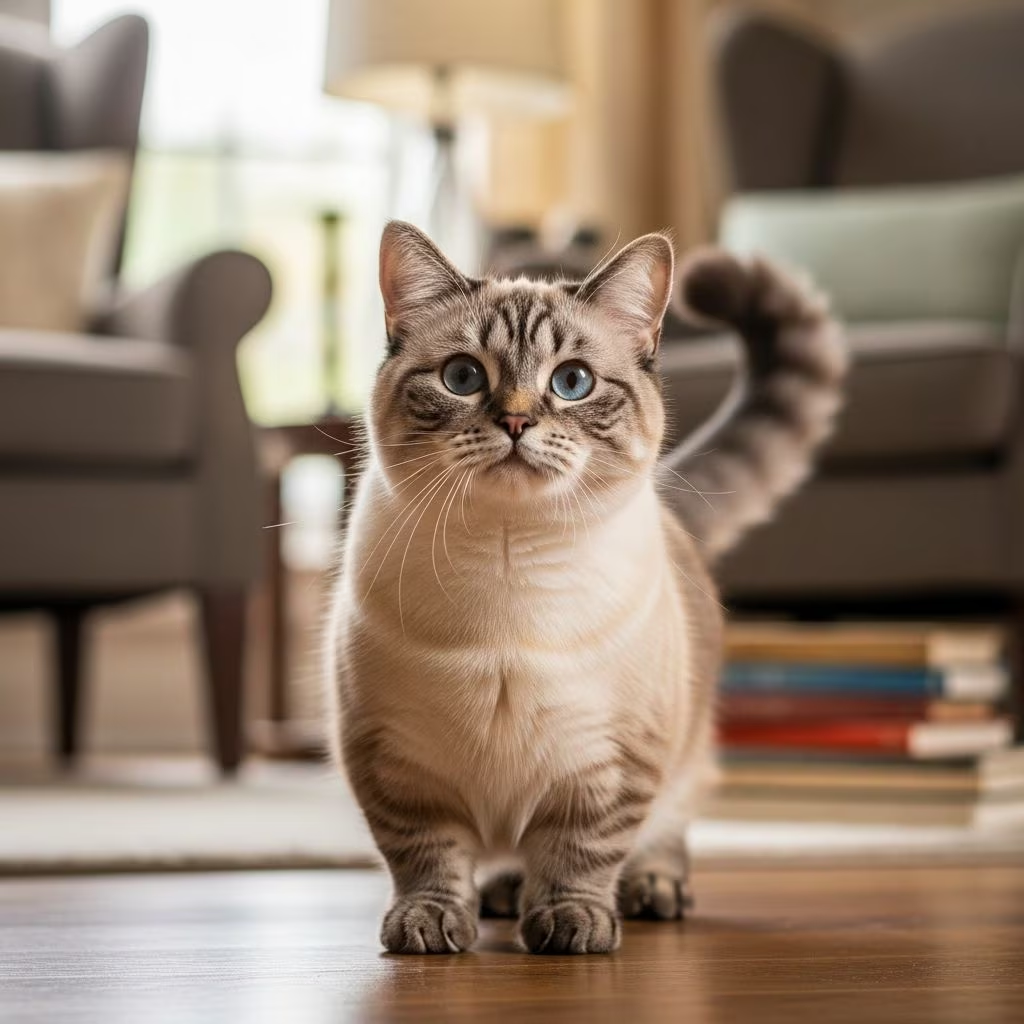
The Napoleon cat, alternatively recognized as the Minuet, stands out as a captivating hybrid breed resulting from the crossbreeding of Munchkin and Persian cats. This combination yields a feline with notably short legs, a plush coat, and an endearing, sociable demeanor that endears it to families worldwide.
Origins and Development of the Breed
The story of the Napoleon cat begins in the mid-1990s in the United States, spearheaded by breeder Joseph Smith, who had prior experience with Basset Hounds. Inspired by a 1995 Wall Street Journal article highlighting Munchkin cats, Smith sought to create a distinctive breed where both short-legged and long-legged variants would possess uniform, appealing traits. He selected the Persian for its luxurious long fur to pair with the Munchkin’s characteristic short limbs caused by a dwarfism mutation.
Initial breeding efforts faced hurdles, including health complications from the genetic mutation responsible for the short legs, which is autosomal dominant but lethal when homozygous. Early litters often suffered from defects, prompting resistance from some feline registries. Undeterred, subsequent breeders like Terry Harris, Margie Gardner, and Sam Tate continued the work, refining the breed’s standards.
By 2001, The International Cat Association (TICA) listed it as an experimental breed, advancing to registration-only status in 2002, preliminary recognition in 2011, and full championship eligibility by 2016 under the name Minuet—a change from Napoleon in 2015 to avoid cultural sensitivities. The Cat Fanciers’ Federation still uses Napoleon, while others like the Cat Fanciers’ Association have not yet granted recognition.
Distinctive Physical Traits
Napoleon cats exhibit a harmonious blend of parental breed features: the Munchkin’s compact stature and the Persian’s rounded head and dense coat. Their legs are proportionally short, typically 3-7 inches long, granting a low-to-the-ground profile without compromising mobility.
The body is medium-sized, muscular yet sturdy, weighing 6.5-16.5 pounds, resembling a perpetual kitten in build. The face features a gently flattened muzzle, large expressive eyes, and small ears set wide apart, contributing to a baby-like charm. Coats vary from silky longhair to shorter variants, available in solid, tabby, pointed, or bi-color patterns with no color restrictions.
| Trait | Description |
|---|---|
| Leg Length | Short (Munchkin-derived), non-long-legged variants also exist |
| Coat | Long, silky; medium to high grooming needs |
| Size | Medium; 3-7.5 kg |
| Head | Round with flattened face, large eyes |
Two subtypes emerge: standard Napoleon (slightly larger paws and build) and extreme dwarf (smaller overall, pricier). Disqualifying faults include uneven legs, excessive lacrimation, or pronounced brow ridges.
Temperament and Daily Behavior
Renowned for their affectionate nature, Napoleon cats merge the Munchkin’s playfulness with the Persian’s lap-loving tendencies. They thrive on human interaction, often following owners room-to-room and curling up for cuddles, sensing emotional states intuitively.
- Social Butterflies: Excel in multi-pet homes and with children; lack aggression, making them safe around toddlers.
- Playful Energy: Agile on ground level, adept at chasing toys despite limited jumping ability; high activity suits interactive play.
- Gentle Disposition: Friendly to strangers but overly trusting—supervise outdoors to prevent mishaps.
Intelligence shines in puzzle-solving and learning tricks, though vocalization remains moderate. They coexist peacefully with dogs and other cats, avoiding dominance disputes.
Essential Care and Grooming Routines
Maintaining a Napoleon cat’s coat demands weekly brushing to prevent matting, especially for longhairs. Bathe monthly if needed, focusing on paw tufts and tail plume.
Diet is crucial; their tendency toward obesity requires portion-controlled, high-protein food. Aim for 200-300 calories daily, split into meals, with fresh water always available. Monitor weight to avert joint strain from short legs.
- Litter and Hygiene: Prefer low-sided boxes due to leg length; clean daily.
- Exercise: Encourage horizontal play like feather wands; vertical spaces adapted low.
- Nail Trims: Bi-weekly; check ears monthly.
Health Considerations and Lifespan
Average lifespan spans 12-15 years with proper care, though the Munchkin gene introduces risks like lordosis (spinal curvature), pectus excavatum, and osteoarthritis. Responsible breeding minimizes these via health testing.
Common issues include polycystic kidney disease from Persian lineage and dental problems from brachycephalic faces. Annual vet checkups, vaccinations, and dental cleanings are vital. Spay/neuter prevents breeding-related complications.
| Health Concern | Prevalence | Prevention |
|---|---|---|
| Lordosis | Moderate | Genetic screening |
| Osteoarthritis | High in seniors | Weight management, joint supplements |
| PKD | From Persian side | Ultrasound testing |
Acquiring a Napoleon Kitten
Rarity drives prices from $400-$2000+, with dwarf extremes costlier. Source from TICA-registered breeders emphasizing health clearances. Kittens thrive post-12 weeks; prepare with scratching posts, toys, and safe zones.
Adoption from rescues grows as popularity rises, though purebreds remain scarce.
Ideal Living Environments
Best as indoor cats, Napoleon thrive in apartments or homes with families. Their ground-level agility suits flat layouts; provide ramps for furniture access. Outdoor time requires leashes due to naivety.
Comparing Napoleon to Parent Breeds
| Feature | Napoleon | Munchkin | Persian |
|---|---|---|---|
| Legs | Short | Short | Normal |
| Coat | Long/Silky | Short/Medium | Long/Dense |
| Activity | High | High | Low |
| Affection | Very High | High | High |
Frequently Asked Questions
Are Napoleon cats good with kids?
Yes, their patient, gentle nature makes them excellent for children.
Do Napoleon cats jump well?
Limited by short legs, they excel in running and pouncing but not high jumps.
How often should I groom a Napoleon cat?
Daily brushing for longhairs; weekly for others to manage shedding.
Is the short leg gene harmful?
It carries risks like joint issues, but ethical breeding mitigates them.
Can Napoleon cats go outside?
Prefer indoors; supervised outdoor play is safer due to trusting personality.
Why Choose a Napoleon Cat?
This breed offers a unique mix of whimsy and warmth, perfect for those seeking a devoted, low-maintenance (in activity, not grooming) companion. Their kitten-like appearance and loving hearts ensure endless joy.
References
- Napoleon Cats | Cat Breeds — Omlet. Accessed 2026. https://www.omlet.us/breeds/cats/napoleon/
- Minuet cat — Wikipedia. Accessed 2026. https://en.wikipedia.org/wiki/Minuet_cat
- Napoleon. Pros and cons, price, how to choose, facts, care, history — YouTube. Accessed 2026. https://www.youtube.com/watch?v=VsKveP2eRxk



