

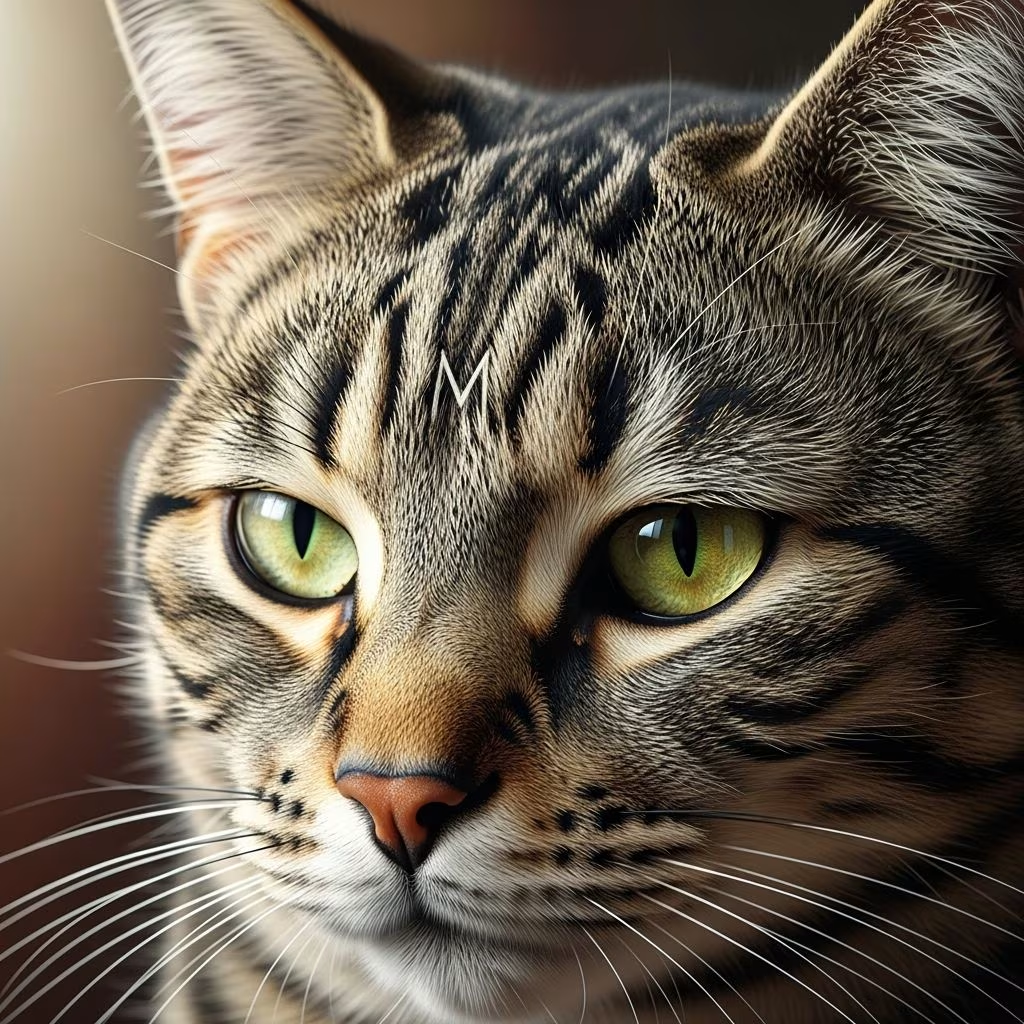
Tabby cats captivate with their bold stripes, swirls, and spots, but no feature stands out more than the prominent **M-shaped marking** on their foreheads. This distinctive pattern appears across various tabby types and has sparked curiosity for centuries, inspiring folklore and scientific inquiry alike.
Understanding Tabby Cats and Their Signature Patterns
Tabby refers not to a breed but a coat pattern found in domestic cats worldwide. Nearly all cats carry tabby genes, though some are masked by solid colors or other patterns. The four main tabby varieties include:
- Mackerel tabby: Narrow stripes resembling fish bones, with bold lines on the face forming the M.
- Classic tabby: Thick swirls and marbled designs on the body, but the forehead M remains consistent.
- Spotted tabby: Circular spots instead of stripes, yet the M persists.
- Ticked tabby: Subtle banding on hairs, often seen in breeds like the Abyssinian, with a faint M.
This M is a universal trait, visible even in kittens and persisting lifelong. It results from pigment concentration on the face, where space constraints create the letter-like shape.
Ancient Legends Explaining the Sacred M
Long before genetics, cultures wove magical stories around the tabby M, viewing cats as divine intermediaries.
Egyptian Moon Worship and the Mau Connection
In ancient Egypt, cats symbolized protection and the moon’s glow. The word “mau” meant “cat” or “to see,” linking felines to nocturnal vision. Legend holds that the goddess Bastet blessed tabby cats with the M as a lunar emblem, honoring their eyes that mirrored moonlight. The Egyptian Mau breed preserves this pattern vividly, its spots and M evoking starry nights. Egyptians mummified millions of cats, burying them with reverence, cementing their spiritual status.
The Prophet Muhammad and the Heroic Muezza
Islamic tradition tells of Prophet Muhammad’s beloved cat, Muezza, a tabby who saved him from a venomous snake hidden in his robe. As Muhammad prepared for prayer, Muezza slept on the sleeve; rather than disturb her, he cut it off. In gratitude for her bravery—earning cats the gift of landing on their feet—Muhammad stroked her forehead, imprinting the eternal M. This tale underscores cats’ roles as guardians in Middle Eastern lore.
Christian Folklore: Mary’s Warmth for the Christ Child
A European legend ties the M to the Nativity. Baby Jesus shivered in the cold stable until a tabby cat curled beside him, purring warmth. Mary stroked the grateful cat’s head, leaving the M as a mark of divine favor. This story spread through medieval tales, portraying tabbys as symbols of compassion.
These myths highlight humanity’s enduring bond with tabby cats, attributing supernatural meaning to a natural trait.
The Science Behind the Tabby M: Genetics Unveiled
While legends enchant, genetics provides the factual basis. The tabby pattern stems from dominant genes inherited simply—one tabby parent suffices for offspring to show markings.
Key genes include:
- Agouti (A) gene: Creates banded hairs (yellow-black-yellow), enabling pattern visibility over solid coats.
- Tabby (Ta) locus: Dictates mackerel, classic, spotted, or ticked variants.
- Dkk4 and other regulators: Influence pigment distribution in fetal skin, forming stripes and the facial M, though full mechanisms remain under study.
The M forms because facial space limits patterns to thin, converging lines mimicking the letter. It’s not a separate gene but an emergent property of tabby expression. All agouti tabbies display it, regardless of color (brown, red, silver, etc.). Research from veterinary genetics labs continues decoding these pathways.
| Tabby Type | Body Pattern | Forehead M Visibility |
|---|---|---|
| Mackerel | Stripes | Very bold |
| Classic | Swirls/Blotches | Prominent |
| Spotted | Spots | Clear |
| Ticked | Banded hairs | Faint but present |
This table illustrates pattern consistency. No health issues link to the M; it’s purely cosmetic.
Tabby Cats Across Breeds and History
Tabby patterns trace to wild ancestors like the African wildcat (Felis lybica), domesticated 10,000 years ago. Cave art depicts striped felines, suggesting ancient admiration. Today, breeds like the American Shorthair, British Shorthair, and Ocicat showcase tabby coats, with the M as a breed standard hallmark.
In mixed-breed cats—most household pets—the tabby gene dominates, explaining its ubiquity. Even “solid” cats may reveal hidden tabby traits when sunlit or shaved.
Caring for Your Tabby Cat’s Coat and Markings
The M and patterns thrive with proper care:
- Grooming: Brush weekly to distribute oils, highlighting the M.
- Diet: Omega-3-rich food supports coat shine.
- Health checks: Monitor for fading patterns signaling issues like hyperthyroidism, though rare.
Kittens sport vivid Ms that may soften with age but rarely vanish.
Common Questions About the Tabby M
Frequently Asked Questions
Do all tabby cats have the M marking?
Yes, it’s a defining tabby trait across patterns, resulting from genetics.
Is the M linked to specific cat breeds?
No, it appears in mixed breeds and purebreds alike; it’s pattern-based, not breed-specific.
Can the M fade or change over time?
Typically stable, though lighter coats or aging may subtle it; consult a vet if sudden changes occur.
Why do some cats without stripes have an M?
Hidden tabby genes surface as the M even in diluted or masked coats.
Does the M indicate anything about personality?
No scientific link; myths add charm, but behavior varies individually.
Appreciating the Timeless Appeal of Tabby Cats
The tabby M bridges myth and science, embodying cats’ wild heritage and human imagination. Next time you spot one, ponder the lunar blessings, heroic strokes, or genetic artistry behind that forehead signature. Tabby cats remain beloved for their striking looks and affectionate natures, their Ms a window into millennia of companionship.
References
- Why Do Tabby Cats Have an “M” on Their Forehead? Myth Vs … — Catster. 2023. https://www.catster.com/lifestyle/why-do-tabby-cats-have-m-on-their-forehead/
- Why do Tabby Cats Have an ‘M’ on their forehead? #tabbycat — Ziggy And Zelda (YouTube). 2023-05-31. https://www.youtube.com/watch?v=871owNNz_po
- Why do tabby cats have that distinct M marking on their foreheads? — Dial A Vet. N/A. https://www.dialavet.com/vet-answers/post/tabby-cat-m-marking-story-53118
- Why Do Tabby Cats Have an “M” on Their Foreheads? — Cats.com. N/A. https://cats.com/why-do-tabby-cats-have-an-m-on-their-foreheads
- Why Do Tabbies Have the “M” Marking On Their Foreheads? — Athena Cat Goddess. 2015-01. https://www.athenacatgoddess.com/2015/01/why-do-tabbies-have-m-marking-on-their.html
- Tabby cat — Wikipedia. N/A. https://en.wikipedia.org/wiki/Tabby_cat



