

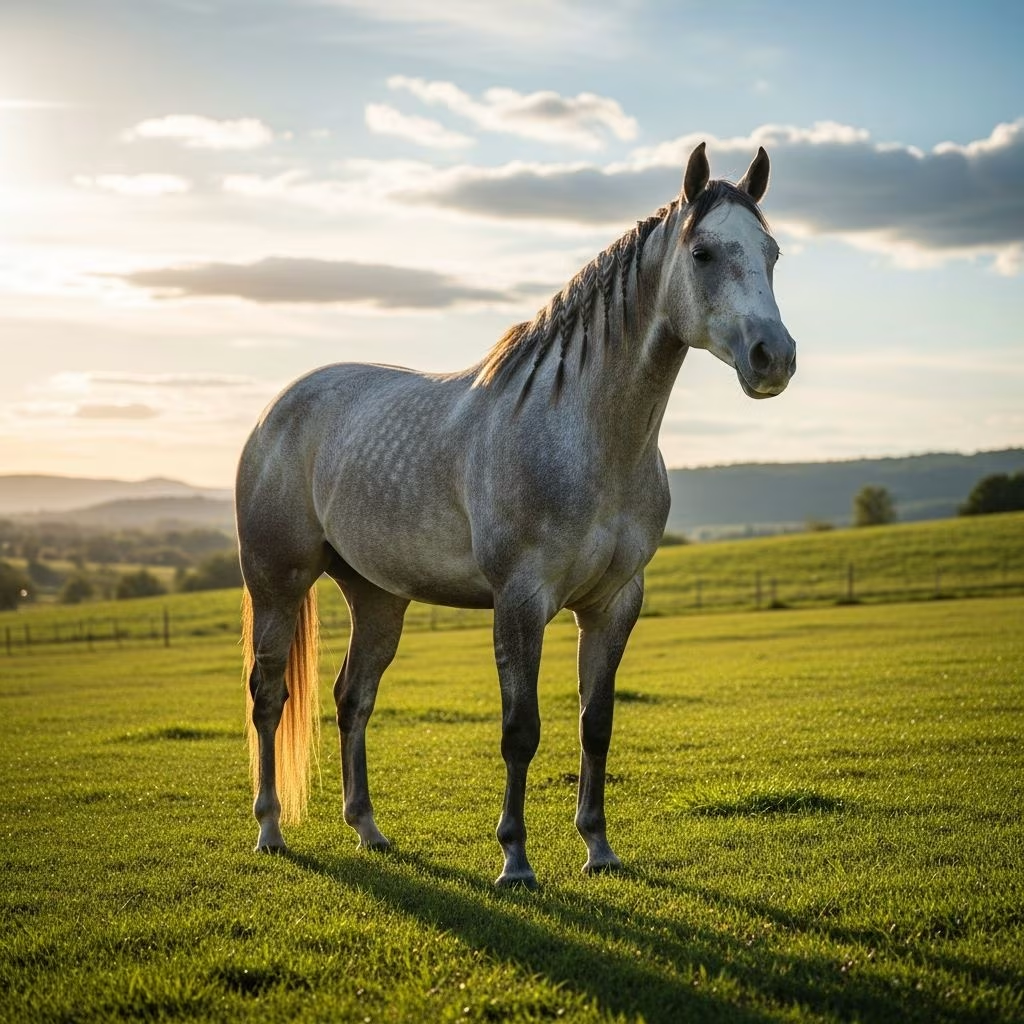
Myotonic disorders represent a group of neuromuscular conditions in horses characterized by delayed muscle relaxation following contraction or stimulation. These issues stem from abnormalities in muscle membrane excitability, leading to stiffness, hypertrophy, and impaired movement. Understanding these disorders is crucial for timely intervention and improving affected horses’ quality of life.
Understanding Muscle Function in Horses
Horses rely on precise muscle coordination for locomotion, balance, and performance. Skeletal muscles contract rapidly in response to nerve signals and relax smoothly afterward. In myotonic conditions, this relaxation phase is prolonged due to hyperexcitability of muscle cell membranes. This can manifest as visible dimpling when muscles are percussed or voluntary stiffness during gait.
Key physiological disruptions include altered ion channel function, particularly chloride channels, which normally stabilize the muscle membrane after depolarization. Genetic mutations or secondary factors can impair this, resulting in sustained contractions.
Primary Types of Myotonia in Equine Species
Several distinct forms of myotonia affect horses, each with unique onset, progression, and histological features.
Congenital Myotonia
This inherited form appears in young foals, often within months of birth. Affected animals exhibit well-muscled appearances initially, with stiffness primarily in pelvic limbs. Percussion of rump or thigh muscles induces prolonged dimpling and bulging, persisting for seconds to minutes.
In breeds like New Forest Ponies, a specific mutation in the CLCN1 gene (c.1775A>C, p.D592A) disrupts chloride conductance, confirming its genetic basis. Foals may struggle with rising, showing recurrent recumbency episodes. Unlike progressive types, signs stabilize after 6-12 months and may lessen with warm-up exercise.
Myotonia Dystrophica
A more severe variant, this progresses over 1-2 years, combining myotonia with muscle wasting. Early hypertrophy in proximal limbs gives way to atrophy, fibrosis, and weakness exacerbated by exercise. Associated anomalies include retinal dysplasia, lens opacities, and gonadal hypoplasia, noted in Quarter Horses and Appaloosas.
Biopsies reveal dystrophic patterns: ringed fibers, central myonuclei displacement, sarcoplasmic masses, and connective tissue proliferation. Type I and II fiber atrophy with grouping indicates chronic denervation-reinnervation.
Hyperkalemic Periodic Paralysis (HyPP)
Linked to the Impressive stallion lineage in Quarter Horses, HyPP causes episodic fasciculations, weakness, and paralysis triggered by potassium-rich diets, stress, or fasting. Heterozygous carriers show milder signs from foalhood to age 3; homozygotes face severe respiratory issues.
Attacks feature third eyelid prolapse, muscle tremors starting on flanks, progressing to recumbency. Hyperkalemia (6-9 mEq/L) accompanies episodes, resolving post-attack. DNA testing confirms the SCN4A mutation.
Clinical Presentation and Observation Tips
- Stiffness and Gait Abnormalities: Hindlimb rigidity, short-striding, or bunny-hopping gait, worsening in cold or after rest.
- Percussion Response: Dimpling in epaxial, gluteal, or semimembranosus muscles lasting >5 seconds.
- Muscle Changes: Hypertrophy in some areas (e.g., trapezius, splenius), atrophy in others (e.g., longissimus).
- Associated Signs: Myokymia (rippling), fasciculations, no fever or systemic illness typically.
- Triggers for HyPP: Alfalfa, molasses, supplements >1.1% potassium; transport or anesthesia.
Owners often notice these during weaning or early training. Video documentation aids veterinary assessment.
Diagnostic Approaches
Diagnosis integrates history, exam, and advanced tests.
| Method | Key Findings | Utility |
|---|---|---|
| Physical/Neurologic Exam | Dimpling, myokymia, stiffness | Initial screening |
| Electromyography (EMG) | Myotonic potentials, CRDs, dive-bomber discharges | Confirms membrane instability |
| Muscle Biopsy | Dystrophic changes, fiber atrophy | Differentiates congenita vs. dystrophica |
| DNA Testing | CLCN1, SCN4A mutations | Genetic confirmation, breeding advice |
| Serum Analysis (Attacks) | Hyperkalemia, hyponatremia | HyPP-specific |
EMG reveals high-frequency discharges (50-150 Hz), fibrillations, and complex repetitive discharges (CRDs). Between HyPP episodes, fibrillation potentials persist.
Differential Diagnoses
Rule out polysaccharide storage myopathy (PSSM), exertional rhabdomyolysis, botulism, or tetanus. PSSM shows gait stiffness but no dimpling; elevated CK distinguishes rhabdomyolysis. Genetic panels clarify overlaps.
Genetic Foundations and Breeding Implications
Many myotonias are autosomal dominant. Congenital myotonia in ponies traces to CLCN1 variants affecting chloride channels. HyPP’s SCN4A sodium channel mutation heightens excitability. Homozygous HyPP horses risk fatal laryngoplasty needs.
Breeding registries like UC Davis VGL offer testing. Avoid mating carriers to prevent propagation, especially in performance lines.
Management and Therapeutic Strategies
No cures exist, but supportive care mitigates impacts.
- Diet for HyPP: Low-potassium (<0.8%) feeds; avoid alfalfa, beet pulp. Acetazolamide (2-4 mg/kg BID) stabilizes membranes.
- Exercise Regimen: Warm-up routines reduce congenital stiffness; avoid triggers.
- Monitoring: Regular CK, electrolyte checks; euthanasia considered for progressive dystrophy.
- Neuromyotonia Cases: Symptomatic relief; long-term survival possible as in 8-year-old cases.
Prognosis varies: congenita allows light work; dystrophica progresses to debilitation.
Research Advances and Future Directions
Ongoing studies explore channelopathies via equine models. Gene therapies targeting CLCN1/SCN4A hold promise. EMG refinements distinguish neuromyotonia (continuous high-frequency bursts) from true myotonia.
Frequently Asked Questions (FAQs)
What causes muscle dimpling in my foal?
Typically congenital myotonia, where muscle membranes fail to repolarize quickly. Genetic testing confirms.
Can HyPP horses be ridden safely?
With diet control and medication, heterozygotes often perform; monitor for attacks.
Is myotonia contagious?
No, it’s genetic or sporadic, not infectious.
How do I test for these disorders?
Mane/tail hair for DNA; consult labs like UC Davis VGL.
Does myotonia shorten lifespan?
Non-progressive forms do not; dystrophica may via weakness complications.
References
- Neuromyotonia in a horse — Aleman M, et al. PMC – NIH. 2018-12-31. https://pmc.ncbi.nlm.nih.gov/articles/PMC6335518/
- Myotonic Disorders in Horses — Valberg SJ. Merck Veterinary Manual. 2023-01-01. https://www.merckvetmanual.com/musculoskeletal-system/myopathies-in-horses/myotonic-disorders-in-horses
- Congenital Myotonia (CM) in the New Forest Pony — Veterinary Genetics Laboratory, UC Davis. 2023-06-15. https://vgl.ucdavis.edu/test/congenital-myotonia-cm-new-forest-pony



