

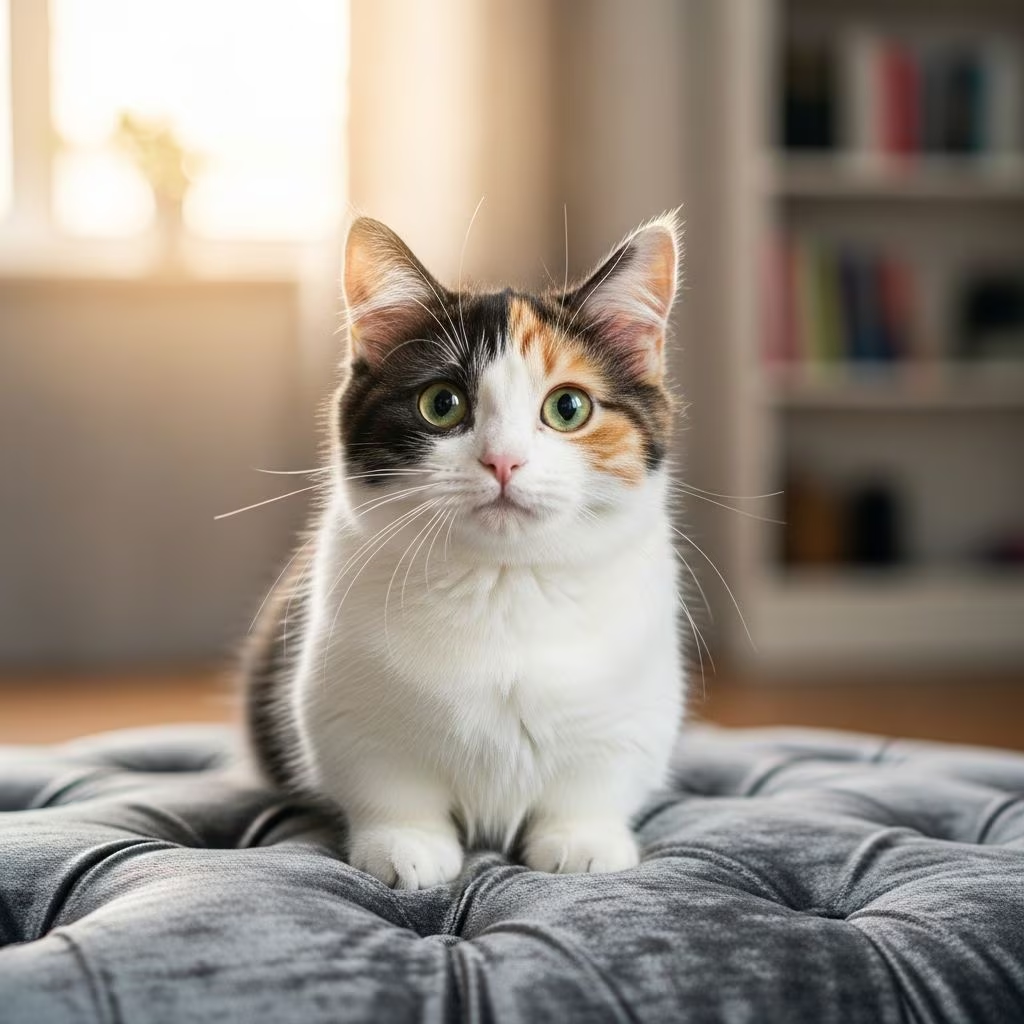
The Munchkin cat captivates with its distinctive short legs, a trait stemming from a natural genetic mutation that sets it apart from standard domestic cats. This relatively new breed combines a low-slung body with boundless energy, making it a favorite for many pet owners despite ongoing discussions about its health implications.
Origins of the Munchkin Breed
Records of short-legged cats date back to the 1940s, with a British veterinary report documenting four generations of such felines that otherwise resembled typical cats. These early examples vanished during World War II, but similar traits reemerged in Russia in the 1950s and the United States in the 1970s.
The modern Munchkin traces its lineage to 1983 in Rayville, Louisiana, where music teacher Sandra Hochenedel rescued a pregnant stray named Blackberry. Half of Blackberry’s kittens inherited the short legs, surprising their rescuer. Hochenedel shared a short-legged male kitten, named Toulouse, with her friend Kay LaFrance in Monroe, Louisiana. The offspring of Blackberry and Toulouse formed the foundation of today’s Munchkin population.
Breeders deliberately outcrossed these cats with domestic shorthairs to establish genetic diversity. The name “Munchkin” draws inspiration from the small-statured inhabitants of the Munchkinland in L. Frank Baum’s The Wizard of Oz, reflecting their diminutive stature.
Genetic Basis Behind the Short Legs
The Munchkin’s signature feature results from an autosomal dominant mutation in the M gene, where a single copy (genotype Mm) produces short legs. Cats inheriting two copies (MM) face lethality, as embryos do not survive to term. This dominant-lethal inheritance necessitates breeding Munchkins only with non-Munchkin cats to avoid fatal outcomes.
When a Munchkin (Mm) mates with a normal-legged cat (mm), litters yield approximately 50% short-legged (Mm) and 50% normal-legged (mm) kittens. The normal-legged offspring serve as vital outcrosses to maintain breed health and vigor.
- Dominant trait: One mutated gene suffices for expression.
- Lethal homozygous state: MM genotype is non-viable.
- Breeding rule: Always pair with non-carrier cats.
Physical Characteristics and Variations
Munchkins possess a medium-sized body with a broad chest, well-muscled neck, and a plumed tail thicker at the base tapering to a rounded tip. Their legs, though short and muscular, allow front legs to appear slightly shorter than hind ones, aiding a ferret-like gait.
The head forms a gentle wedge with rounded contours, medium-sized ears set wide apart, and walnut-shaped eyes in any hue except amber for certain patterns. Coats vary from short to medium length, displaying all colors and patterns except lilac and chocolate in some registries.
| Feature | Description |
|---|---|
| Body | Medium to large, rounded chest, muscular build |
| Legs | Short, strong; hind slightly longer than front |
| Head | Wedge-shaped with rounded edges |
| Eyes | Walnut-shaped, any color |
| Coat | Short or medium; diverse colors/patterns |
Related breeds like the Minskin combine Munchkin legs with hairlessness from Sphynx and Devon Rex influences, recognized preliminarily by some associations.
Temperament and Daily Behavior
Far from fragile, Munchkins brim with curiosity, agility, and playfulness. They excel at leaping to surprising heights despite leg length, often perching on counters or chasing toys with dachshund-like speed. Their inquisitive nature leads to hide-and-seek games, favoring shiny objects or feather wands.
Social and affectionate, they bond deeply with families, including children and dogs, displaying dog-like devotion. Independent yet loving, Munchkins vocalize softly and enjoy lap time without clinginess. Their adaptability suits apartments, provided vertical spaces accommodate their jumping prowess.
Health Considerations and Potential Risks
While many Munchkins thrive into their mid-teens, the short-leg mutation raises concerns akin to those in dachshunds: lordosis (spinal curvature), pectus excavatum (sunken chest), and osteoarthritis. Critics argue breeding perpetuates these risks, likening it to genetic disease exploitation.
Veterinary oversight is crucial, emphasizing weight control to ease joint stress. Regular exams monitor for mobility issues, with no evidence of inherently shortened lifespans when properly managed. Ethical breeders prioritize health testing and outcrossing.
- Maintain ideal weight to protect joints.
- Provide low-impact exercise like swimming.
- Screen for skeletal deformities annually.
Recognition and Global Controversies
The International Cat Association (TICA) pioneered recognition, introducing Munchkins publicly in 1991 at an Oklahoma show, entering new breed status in 1994, and granting championship in 2003. Protests arose, including judge resignations over ethical qualms.
Many organizations reject the breed: Governing Council of the Cat Fancy (GCCF), Fédération Internationale Féline (FiFé), and laws in regions like parts of Europe ban dwarf cat breeding citing welfare. TICA remains the primary endorser, defending the mutation as naturally occurring.
Grooming, Nutrition, and Lifestyle Needs
Short or medium coats require weekly brushing to minimize shedding, with baths infrequent due to self-grooming efficiency. Dental care, nail trims, and ear checks prevent common issues. High-quality, portion-controlled diets combat obesity risks heightened by reduced mobility.
Enrich environments with cat trees, tunnels, and puzzles to channel energy. Litter boxes should feature low sides for easy access, and ramps aid high perches. Average litter size mirrors domestics at 4-6 kittens, with vigilant neonatal care for potential leg-related vulnerabilities.
Bringing Home a Munchkin: Adoption Tips
Seek reputable breeders adhering to TICA standards, emphasizing health clearances and non-Munchkin outcrosses. Rescues increasingly feature Munchkins or mixes, offering screened companions. Costs range from $500-$2,500, reflecting pedigree and testing.
Prepare for a spry, engaging pet: stock interactive toys, secure cabinets against their explorer instincts, and commit to lifelong joint monitoring. Munchkins reward with loyalty and mirth, their low center of gravity enabling endearing antics.
Common Myths Debunked
- Myth: Munchkins can’t jump. Fact: They bound to cabinet tops routinely.
- Myth: All suffer severe health woes. Fact: Many live healthy, long lives with care.
- Myth: Breeding is unethical universally. Fact: TICA approves with safeguards; others prohibit.
Frequently Asked Questions (FAQs)
Are Munchkin cats hypoallergenic?
No, their coats shed moderately like most cats, though short fur may suit some allergy sufferers better.
Can Munchkins climb stairs?
Yes, their strong muscles enable stair navigation, albeit slower than long-legged peers.
What’s the lifespan of a Munchkin?
Typically 12-15 years, comparable to averages with proper care.
Do Munchkins get along with other pets?
Excellent companions for dogs and cats, thanks to sociable temperaments.
Is breeding Munchkins to Munchkins allowed?
No ethical breeders do so, as it risks lethal double-mutant kittens.
References
- The Unexpected Rise of Munchkin Cats — Purebred Kitties. 2023. https://purebredkitties.com/blogs/munchkin-cat/the-unexpected-rise-of-munchkin-cats
- Munchkin cat — Wikipedia. 2024-01-15. https://en.wikipedia.org/wiki/Munchkin_cat
- Munchkin Cat Breed Profile — Litter-Robot. 2023. https://www.litter-robot.com/blog/munchkin-cat/
- All about Munchkin cat breed — Animalia.bio. 2024. https://animalia.bio/pets/munchkin-cat
- Munchkin Facts — Wisdom Panel. 2023. https://www.wisdompanel.com/en-us/cat-breeds/munchkin
- Munchkin cat’s genetics — Nikolay’s Genetics Lessons (YouTube). 2016-03-07. https://www.youtube.com/watch?v=N600BPVJQLU



