

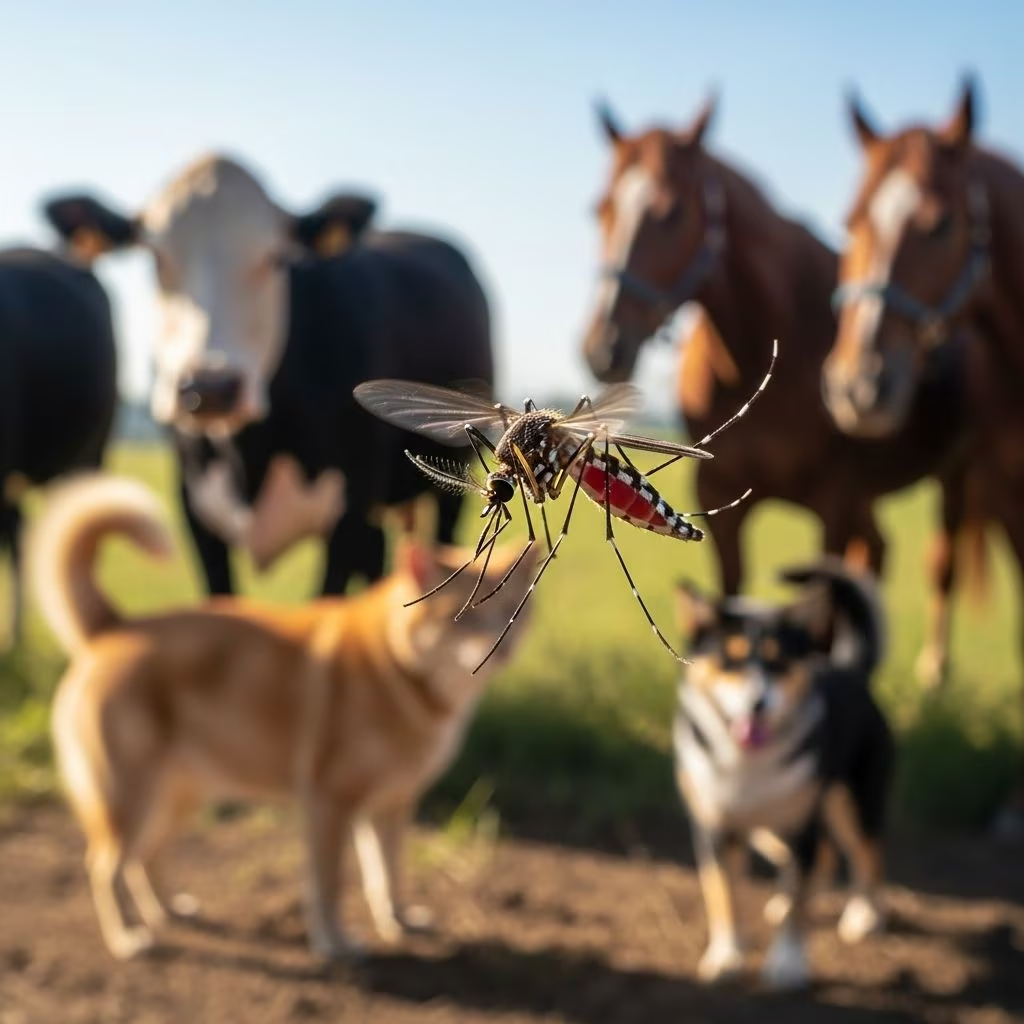
Mosquitoes pose significant challenges to animal health by feeding on blood from livestock and companion animals, leading to irritation, allergic responses, and transmission of serious pathogens. Belonging to the Culicidae family, these insects include genera such as Aedes, Anopheles, Culex, Culiseta, and Psorophora, each with species adapted to specific environments and hosts.
Biology and Identification of Key Species
Mosquitoes undergo complete metamorphosis, progressing from egg to larva, pupa, and adult. Females require blood meals for egg production, using a proboscis to pierce skin and extract blood. Identification requires expertise due to over 3,500 species worldwide, with distinct resting postures and scale patterns on wings and bodies.
- Aedes aegypti: Known as the yellow fever vector, it thrives in urban areas and transmits dengue and Zika to humans but also bites animals.
- Anopheles quadrimaculatus: Primary malaria carrier in primates, with potential animal impacts.
- Culex tarsalis: Vectors Western equine encephalitis in the western US, affecting horses and birds.
- Aedes vexans: Causes severe nuisance in Midwest floodplains, swarming livestock.
- Psorophora columbiae: Aggressive biter in rice fields, targeting cattle and humans.
- Aedes albopictus: Invasive Asian tiger mosquito spreading yellow fever, dengue, and filariasis.
These species vary in breeding sites, from temporary pools to containers, influencing their distribution.
Bite Mechanisms and Animal Reactions
Female mosquitoes inject saliva containing anticoagulants during feeding, which can trigger hypersensitivity in animals. In horses, this leads to hypersensitivity dermatitis with summer flares of pruritus and crusting. Cattle experience significant blood loss from heavy infestations, compounded by anemia risks. Dogs may develop localized swelling or exacerbated allergic dermatitis.
| Animal | Common Reactions | Severity Factors |
|---|---|---|
| Horses | Pruritus, crusting, hair loss | Seasonal, high populations |
| Cattle | Blood loss, weight reduction | Flooded pastures |
| Dogs | Allergic dermatitis, nodules | Frequent exposure |
| Other Livestock | Irritation, reduced productivity | Swarming events |
Such reactions reduce animal comfort and productivity, particularly in humid regions.
Diseases Transmitted to Animals
Mosquitoes vector filarial worms, viruses, and protozoa. Dirofilaria immitis (heartworm) develops in canine and feline pulmonary arteries after microfilariae ingestion by Culex or Aedes species. Transmission blocks between treated dogs and mosquitoes using macrocyclic lactones and repellents. Dirofilaria repens causes subcutaneous nodules, with dogs as reservoirs.
Viral diseases include Western equine encephalitis via Culex tarsalis, affecting equines neurologically. West Nile virus, carried by Culex pipiens, impacts birds primarily but spills over to mammals. In North Africa, Cx. pipiens transmits West Nile and Rift Valley fever.
- Heartworm disease: Prevalent in southeastern US dogs, occasionally zoonotic.
- Encephalitides: Equine and avian losses from Aedes and Culex.
- Filariasis: Lymphatic and subcutaneous forms in endemic areas.
Geographic Distribution Patterns
In the US, Aedes vexans dominates Midwest prairies, while Culex tarsalis prevails west of the Mississippi. Invasive Ae. albopictus expands eastward, enhancing disease risks. Globally, North African Cx. pipiens hybrids vector multiple pathogens, with climate change favoring Cx. quinquefasciatus spread. Livestock in flood-prone areas like Louisiana rice fields face Psorophora onslaughts.
Prevention Strategies for Farms
Eliminate breeding sites by draining standing water and using larvicides. Adult control involves space sprays during swarms, targeting pastures at dawn and dusk when mosquitoes peak[10].
- Environmental management: Fill puddles, stock fish in ponds.
- Chemical larvicides: Bacillus thuringiensis israelensis (BTI) safe for animals.
- Barrier treatments: Permethrin fogging on premises.
For horses and cattle, pour-ons with pyrethroids reduce bites during peak seasons.
Pet Protection Methods
Dogs benefit from monthly topical repellents combining permethrin (36-44%) with imidacloprid, fipronil, dinotefuran, or pyriproxyfen. Products like K9 Advantix II, Vectra 3D, and Effitix kill and repel, blocking heartworm transmission. Never apply to cats due to permethrin toxicity.
| Product Example | Active Ingredients | Duration | Target Pests |
|---|---|---|---|
| K9 Advantix II | Permethrin 44%, Imidacloprid | 1 month | Mosquitoes, ticks, fleas |
| Vectra 3D | Dinotefuran, Permethrin, Pyriproxyfen | 1 month | Mosquitoes, flies |
| Effitix | Permethrin 44.88% | 1 month | Mosquitoes, ticks |
Combine with oral heartworm preventives for comprehensive defense. Indoor nets and fans deter entry.
Advanced Monitoring Techniques
Modern tools like loop-mediated isothermal amplification (LAMP) and MALDI-TOF mass spectrometry enable rapid species ID in fields. Image-based AI via convolutional neural networks aids surveillance. Genetic assays detect hybrids like Cx. pipiens/quinquefasciatus, predicting vector competence.
Zoonotic Risks and Public Health
While primarily animal pathogens, heartworm causes human pulmonary nodules, treated surgically. Zika lacks animal reservoirs but warrants mosquito control. Enhanced urban programs protect vulnerable groups.
Frequently Asked Questions
Can mosquitoes transmit heartworm to cats?
Yes, though less common than in dogs; use cat-safe preventives.
Are permethrin products safe for puppies?
Check labels; most approved for dogs over 7 weeks.
How to reduce mosquitoes around barns?
Remove water sources, apply larvicides, use fans[10].
Do all mosquitoes bite animals?
Only females; males feed on nectar.
Is climate change worsening outbreaks?
Yes, expanding ranges like Ae. albopictus.
This guide equips owners with knowledge for proactive management, minimizing health and economic losses from mosquitoes.
References
- Mosquitoes of Animals – Integumentary System — Merck Veterinary Manual. 2023. https://www.merckvetmanual.com/integumentary-system/flies/mosquitoes-of-animals
- Mosquitoes — Companion Animal Parasite Council. 2023. https://capcvet.org/guidelines/mosquitoes/
- Culicidae and Mosquito-Borne Diseases in North Africa — PMC (NCBI). 2022-10-20. https://pmc.ncbi.nlm.nih.gov/articles/PMC9604161/
- Mosquito-borne diseases and their vectors — Target Malaria. 2023. https://targetmalaria.org/latest/blog/mosquito-borne-diseases-and-their-vectors/
- Mosquitoes: More Than Just an Annoyance — Michigan State University College of Veterinary Medicine. 2023. https://cvm.msu.edu/vetschool-tails/mosquitoes-more-than-just-an-annoyance
- Mosquitoes Affecting Animal Health — Center for Food Security and Public Health, Iowa State University. 2023. https://www.cfsph.iastate.edu/vectors/mosquitoes/



