Mississippi Flyway: Vital Bird Highway
Discover the Mississippi Flyway, North America's premier bird migration corridor, hosting millions of avian travelers annually on their epic journeys.
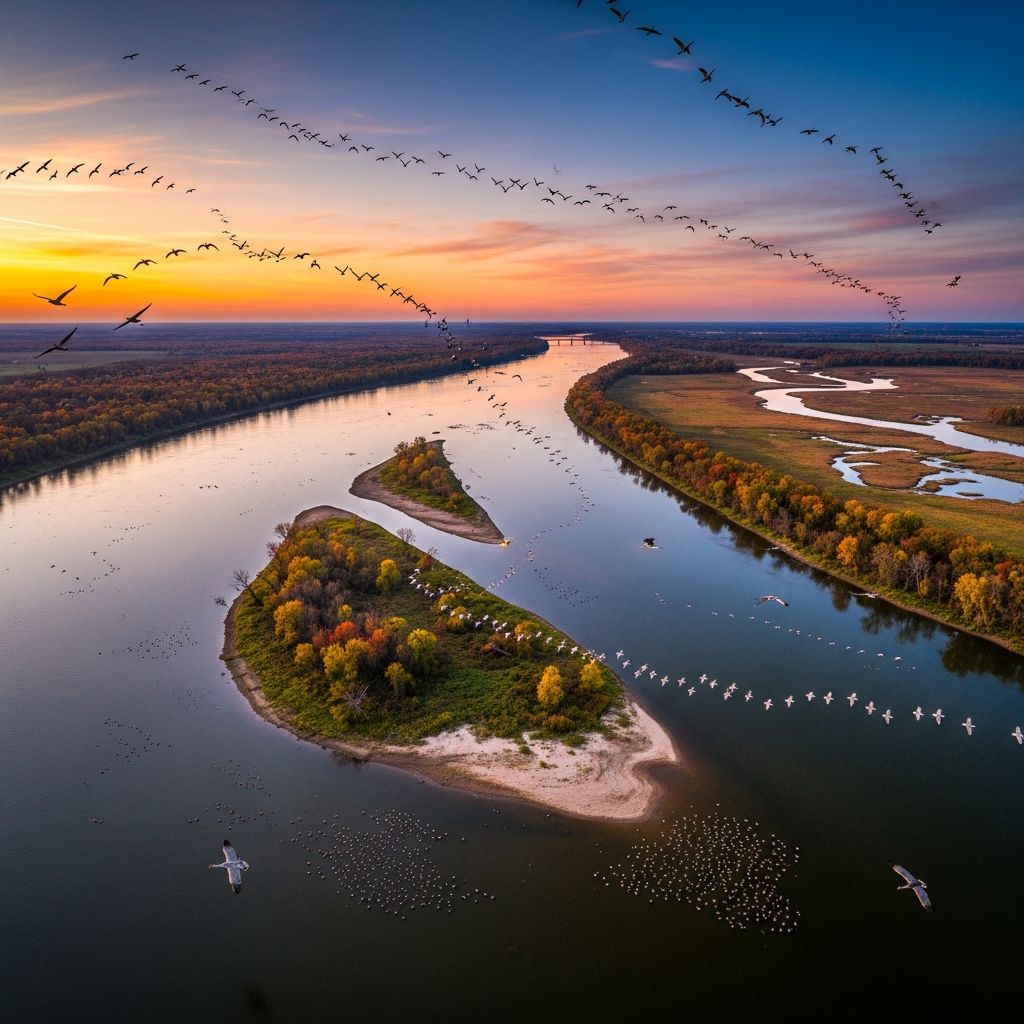
The Mississippi Flyway stands as one of North America’s most crucial bird migration pathways, channeling vast numbers of birds along a natural corridor shaped by major rivers and favorable landscapes. This route supports approximately 40% of the continent’s migrating waterfowl and shorebirds, making it indispensable for avian populations.
Geographical Scope and Path
Stretching over 2,500 miles, the Mississippi Flyway traces the Mississippi, Missouri, and Lower Ohio Rivers, extending from central Canada—reaching toward the Mackenzie River and Hudson Bay—across the western Great Lakes, and southward to the Gulf of Mexico. In its southern stretch, particularly through Missouri, Arkansas, Mississippi, and Louisiana, the pathway narrows dramatically, creating a bottleneck that concentrates bird activity and boosts biodiversity in these regions.
Unlike rugged terrains elsewhere, this flyway remains unobstructed by mountains or significant hill ridges, with elevations rarely exceeding 2,000 feet, allowing seamless passage for low-flying species. Abundant water sources, food-rich wetlands, and protective cover line the entire length, providing essential refueling stops.
The flyway encompasses a broad swath of territory, including U.S. states such as Alabama, Arkansas, Illinois, Indiana, Iowa, Kentucky, Louisiana, Michigan, Minnesota, Mississippi, Missouri, Ohio, Tennessee, and Wisconsin, plus Canadian provinces like Saskatchewan, Manitoba, and Ontario. It occasionally overlaps with the Central Flyway in areas like eastern Nebraska and western Missouri.
Diversity of Avian Travelers
Hundreds of bird species rely on the Mississippi Flyway, representing nearly half of North America’s total bird diversity—between 320 and 350 species. Waterfowl dominate, with mallards, Canada geese, and American coots commonly observed, alongside shorebirds and raptors.
Iconic long-distance migrants include the Whooping Crane, Peregrine Falcon, and Bald Eagle, while songbirds like warblers, thrushes, sparrows, and blackbirds add vibrant choruses. Extreme travelers, such as the Arctic Tern and Red Knot, may traverse from the Arctic Ocean to Patagonia using this route.
| Bird Category | Examples | Key Traits |
|---|---|---|
| Waterfowl | Mallard, Canada Goose | Migrate in large flocks; use wetlands for resting. |
| Shorebirds | Red Knot, Arctic Tern | Ultra-long journeys; narrow funnel in south. |
| Raptors | Peregrine Falcon, Bald Eagle | Soar on thermals; hunt along river corridors. |
| Songbirds | Warblers, Sparrows | Melodious; feeder-friendly near human areas. |
Seasonal Migration Dynamics
Spring migrations peak from March to June, with birds arriving in the Mississippi Alluvial Valley for breeding in hardwood forests. Cold fronts in late summer or early fall propel southward journeys, aiding tailwinds to Central America, the Caribbean, or South America.
Fall migrations reverse the flow, funneling birds through the valley’s pinch point before dispersing along the Gulf Coast. This biannual spectacle transforms skies into living tapestries, especially vivid in spring and fall.
Premier Observation Hotspots
- Driftless Area (Upper Mississippi): Northern congregation point for waterbirds.
- Lower Mississippi Valley: Narrowing corridor in AR, MS, LA; 60% of species pass through.
- Mississippi Alluvial Valley: Funnel-like habitat for breeding and staging.
- Gulf Coast Islands (LA, TX): Prime viewing for cross-Gulf migrants.
- State Parks and Refuges: Numerous sites host festivals for optimal sightings.
These locations offer sheltered viewing platforms, trails, and guided events, ideal for enthusiasts capturing the flyway’s grandeur.
Ecological Importance and Challenges
The flyway’s flat, watered expanse sustains massive flocks, preventing exhaustion during grueling trips. Wetlands and forests provide berries, insects, and fish, critical for energy replenishment.
However, habitat loss from development, agriculture, and climate shifts threatens this balance. The U.S. Fish and Wildlife Service and partners emphasize restoration to maintain the corridor’s viability.
Conservation Efforts in Action
Organizations like Ducks Unlimited target the Mississippi Flyway with habitat projects across its 1.5 million square mile watershed. Joint Ventures coordinate breeding, migration, and wintering ground protections.
Community involvement through bird festivals, feeder programs, and land easements bolsters resilience. Monitoring via radar and banding tracks population health, informing policies.
Prime Times for Birdwatching
Dawn and dusk yield the best views, as birds feed and roost. Spring (April-May) and fall (September-October) align with peaks; binoculars and apps enhance identification.
Weather plays a role—post-front movements surge visibility. Ethical watching maintains distance to avoid disturbance.
Frequently Asked Questions
What defines the Mississippi Flyway?
It follows major rivers from Canada to the Gulf, unobstructed by barriers, hosting 40% of waterfowl migrations.
Which birds use it most?
Waterfowl like ducks and geese, plus shorebirds, raptors, and songbirds; up to 350 species.
Why is the lower valley critical?
It narrows, concentrating birds for rest and feeding in a natural bottleneck.
How can I contribute to conservation?
Support refuges, plant natives, reduce pesticides, and join cleanups or festivals.
When is migration peak?
Spring: March-June; Fall: August-November, varying by species and weather.
Broader Implications for Biodiversity
Beyond birds, the flyway influences ecosystems by dispersing seeds and controlling insects. Protecting it safeguards continental health, underscoring interconnectedness.
As climate patterns shift routes, adaptive strategies grow urgent, positioning the flyway as a barometer for environmental change.
References
- Mississippi Flyway — Wikipedia. 2023-10-15. https://en.wikipedia.org/wiki/Mississippi_Flyway
- The Grandeur of Mississippi Flyway Migration — Lyric Bird Food. 2023-01-01. https://www.lyricbirdfood.com/birding-hub/migration/the-grandeur-of-mississippi-flyway-migration/
- The Mississippi Flyway — Louisiana Landcan. 2020-05-20. http://www.louisianalandcan.org/article/The-Mississippi-Flyway/39
- Mississippi Flyway — Mississippi Encyclopedia. 2022-08-10. https://mississippiencyclopedia.org/entries/mississippi-flyway/
- Bird Migration: Birds of the Mississippi Flyway — Perky Pet. 2023-05-12. https://www.perkypet.com/articles/mississippi-flyway-migration
- DU Projects: Mississippi Flyway — Ducks Unlimited. 2024-02-28. https://www.ducks.org/conservation/where-ducks-unlimited-works/waterfowl-migration-flyways/mississippi-flyway
- Cruising Along the Flyways of the Mississippi Alluvial Valley — Arbor Day Foundation. 2023-11-05. https://www.arborday.org/perspectives/cruising-along-flyways-mississippi-alluvial-valley
Similar Articles








Read full bio of Sneha Tete