

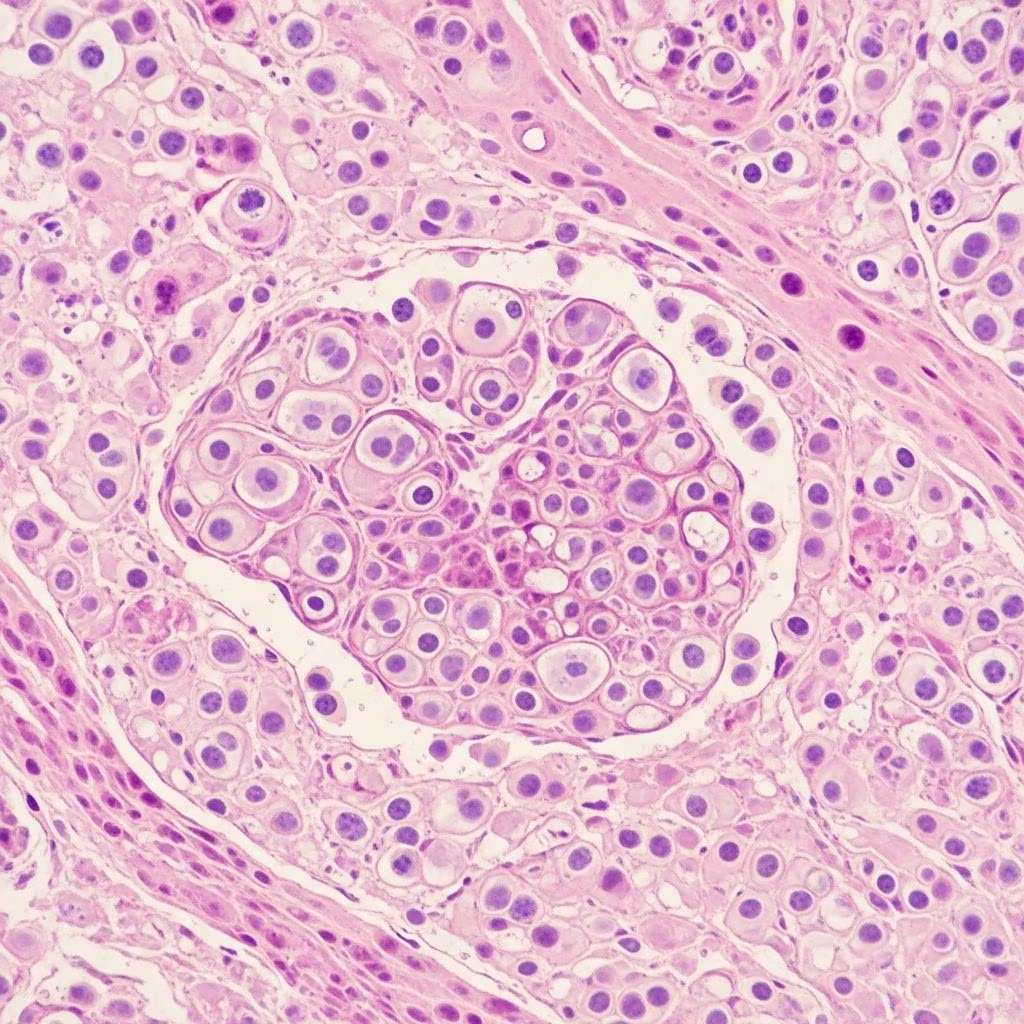
Merkel cell tumors, also known as Merkel cell carcinomas (MCC), represent a rare but significant category of neuroendocrine skin cancers in veterinary medicine. Primarily affecting cats, these tumors arise from cells resembling Merkel cells, which are specialized touch receptors in the skin. While extremely uncommon in other species, cases have been documented in dogs and occasionally livestock, highlighting the need for veterinarians to recognize their distinct features.
Understanding the Biology of Merkel Cell Tumors
These tumors originate from neuroendocrine cells and exhibit aggressive behavior, particularly in felines. In cats, MCC often manifests as dome-shaped, red lesions on the skin, sometimes eroded or ulcerated. Research indicates a strong association with Felis catus papillomavirus type 2 (FcaPV2), where viral integration into the host genome drives oncogenesis by suppressing key tumor suppressors like p53 and Rb through E6 and E7 oncoproteins.
Unlike human MCC, which is predominantly linked to Merkel cell polyomavirus, feline cases show parallels in clinical pathology but differ in viral etiology. The virus promotes cellular proliferation, leading to malignant transformation. Whole-genome sequencing has confirmed FcaPV2 integration specifically in tumor cells, distinguishing it from episomal replication in benign plaques.
Species-Specific Presentations and Prevalence
Cats: Feline MCC is the most frequently reported, often presenting as solitary or multiple cutaneous masses. About 80% of cases coincide with other FcaPV2-related lesions like viral plaques or bowenoid in situ carcinomas, suggesting a field cancerization effect.
Dogs: Canine cases are scarce, with around 10 documented instances. Lesions appear in skin, oral cavity, or unspecified sites, sometimes multiple. Notably, many canine MCCs display benign traits, with surgical excision often curative, contrasting the malignancy in cats.
Other Animals: A single bovine case exists, underscoring the rarity beyond companion animals.
| Species | Common Sites | Behavior | Viral Link | Prognosis |
|---|---|---|---|---|
| Cats | Skin (often multiple) | Malignant, metastatic | FcaPV2 (common) | Poor, median survival 243 days |
| Dogs | Skin, oral cavity | Often benign | None established | Good post-surgery |
| Cows | Rare, unspecified | Unknown | None | Limited data |
Clinical Signs and Early Detection
- Solitary or multifocal raised, red nodules on the skin, prone to ulceration.
- In cats, frequent coexistence with plaques or squamous lesions from papillomavirus.
- Dogs may show oral masses mimicking other round cell tumors.
- Systemic signs like weight loss or lymph node enlargement indicate metastasis to lungs, nodes, or distant skin.
Early detection hinges on fine-needle aspiration (FNA), though cytology often misidentifies MCC as lymphoma due to round cell morphology. Histology reveals nests or trabeculae of uniform round cells with fibrovascular stroma, necrosis, and high mitotic rates (up to 25 per high-power field in cats).
Diagnostic Approaches: From Cytology to Advanced Testing
Definitive diagnosis requires immunohistochemistry (IHC). Key markers include cytokeratin 20 (CK20) with perinuclear dot-like positivity, synaptophysin, and chromogranin A, confirming neuroendocrine origin. Lymphoid markers like CD3 and PAX-5 are negative, ruling out lymphoma.
Polymerase chain reaction for antigen receptor rearrangements (PARR) further excludes lymphoid clonality. In FcaPV2-positive cases, PCR detects viral DNA, with in situ hybridization showing integration patterns.
Staging involves lymph node biopsies, thoracic radiographs, and abdominal ultrasound to assess metastasis, crucial given the high recurrence risk even with clean margins.
Pathological Features and Histological Insights
Microscopically, feline MCC displays solid nests of round cells with scant cytoplasm, hyperchromatic nuclei, and palisading at stroma interfaces. Vascular invasion and necrosis are common. Canine tumors show lower mitotic activity (<10 per HPF), correlating with better outcomes.
Concurrent lesions in cats, such as basal cell or squamous carcinomas, complicate pathology, often linked to the same viral trigger. Epidermotropism, rare in felines, features vacuolar basal cytoplasm in 40% of cases.
Treatment Modalities and Management Strategies
Surgery: Primary approach for localized disease, advocating wide excision with 2 cm margins. However, feline recurrence persists despite histologically clean edges, necessitating sentinel lymph node evaluation.
Adjunct Therapies: Radiation or chemotherapy shows limited efficacy data. PD-L1 expression in feline tumors suggests immunotherapy potential, mirroring human trials with PD-1 inhibitors.
Monitoring: Post-treatment surveillance includes regular dermatologic exams and imaging, given metastatic tendencies.
Prognostic Factors and Survival Outcomes
Feline MCC carries a guarded prognosis, with median survival of 243 days and 55% recurrence rate. Metastasis to regional nodes or lungs worsens outlook. Viral status lacks prognostic differentiation currently, though p53/Rb suppression indicates aggressive biology.
Canine cases fare better, often cured by excision, though larger series are needed.
Research Frontiers and Viral Etiology
Recent studies elucidate FcaPV2’s role: viral oncogenes inhibit p53/Rb, akin to human polyomavirus mechanisms. Whole-genome integration confirms causality, opening avenues for antiviral strategies or vaccines.
Comparative analyses across species reveal conserved IHC profiles but divergent behaviors, urging species-specific research. PD-1/PD-L1 pathways in feline tumors promise immunotherapies.
Preventive Measures and Owner Education
Limit UV exposure in light-skinned cats, though FcaPV2 predominates in haired areas. Routine skin checks aid early intervention. Owners should monitor for non-healing nodules, especially in multi-lesion contexts.
Frequently Asked Questions (FAQs)
What causes Merkel cell tumors in cats?
Primarily FcaPV2 infection, leading to oncogene-driven suppression of tumor suppressors.
How is MCC distinguished from lymphoma?
IHC for neuroendocrine markers (CK20, synaptophysin) and negative lymphoid panels.
Can Merkel cell tumors be cured in dogs?
Often yes, via surgery, unlike the aggressive feline form.
Is immunotherapy an option for feline MCC?
Promising due to PD-L1 expression, based on human parallels.
How common are these tumors?
Rare; mostly cats, with few canine and one bovine report.
Conclusion
Merkel cell tumors challenge veterinary oncologists with their rarity and feline aggressiveness, yet viral insights offer hope for targeted therapies. Vigilant diagnosis and multimodal management improve pet welfare.
References
- Feline papillomavirus-associated Merkel cell carcinoma — PMC – NIH. 2023. https://pmc.ncbi.nlm.nih.gov/articles/PMC10686778/
- Feline and canine Merkel cell carcinoma: A case series and… — PMC. 2021. https://pmc.ncbi.nlm.nih.gov/articles/PMC8248026/
- Involvement of Felis catus papillomavirus type 2 in the… — Seminars in Pathology, UNAM. 2022. https://seminariospatologia.fmvz.unam.mx/wp-content/uploads/2022/01/03009858211045440.pdf
- Merkel Cell Tumors: What can Jimmy Buffett’s Cancer Tell Us… — Animal Medical Center NY. 2023-09-13. https://www.amcny.org/blog/2023/09/13/merkel-cell-tumors-jimmy-buffett-cancer-pets-dogs-cats/
- Feline and canine Merkel cell carcinoma: A case series and… — Wiley Online Library. 2021. https://onlinelibrary.wiley.com/doi/abs/10.1111/vco.12672
- Comparative In Vitro and In Vivo Studies on Feline, Canine, and… — SAGE Journals. 2021. https://journals.sagepub.com/doi/abs/10.1177/0300985820976097



