

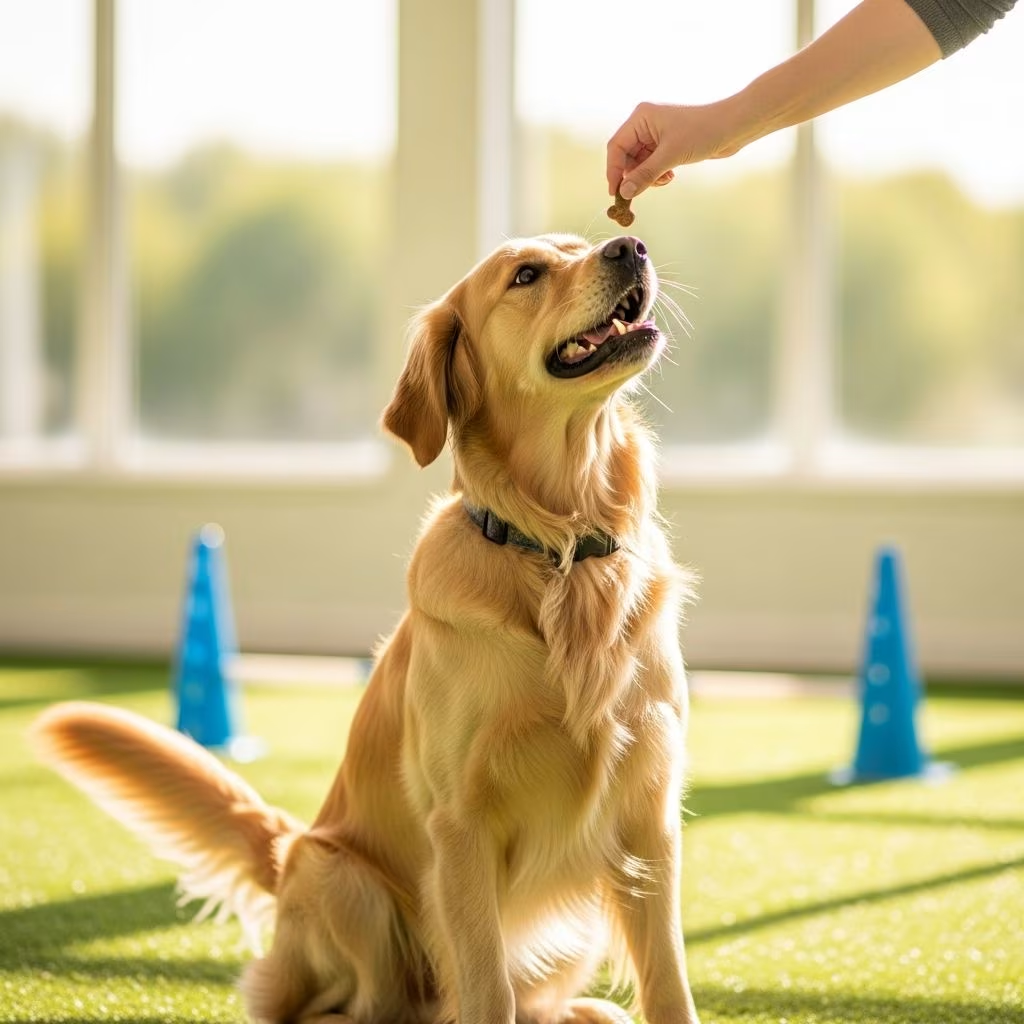
Contemporary dog training has undergone significant transformation over recent decades, shifting away from punitive approaches toward methods grounded in behavioral science and animal psychology. The foundation of this modern philosophy centers on rewarding desired behaviors rather than punishing unwanted ones—a shift that has proven dramatically more effective for both immediate results and long-term behavioral development. This approach recognizes that dogs learn through associations between their actions and consequences, making positive outcomes the most powerful teacher in any training scenario.
Understanding the Foundation of Reward-Based Training
Reward-based training operates on a straightforward principle: dogs repeat behaviors that result in positive outcomes. When your canine companion performs a desired action and receives something valuable in return—whether treats, verbal praise, physical affection, or playtime—the neural pathways associated with that behavior are reinforced. This creates a learner who is genuinely motivated to comply, rather than one who merely avoids punishment.
The psychological mechanism behind this approach is rooted in operant conditioning, where animals learn that specific behaviors produce specific consequences. Unlike punishment-based methods, which teach dogs what not to do, reward-based systems teach dogs precisely what behaviors are expected and desirable. This fundamental difference transforms training from a adversarial process into a collaborative communication system between handler and dog.
Research consistently demonstrates that dogs trained through positive reinforcement show fewer behavioral problems, less anxiety, and stronger bonds with their handlers compared to those trained through aversive methods. The training environment becomes a space of mutual trust rather than fear or apprehension, allowing dogs to explore new behaviors with confidence.
Identifying and Utilizing Effective Motivators
Successful training begins with understanding what genuinely motivates your individual dog. While treats are commonly the first tool trainers reach for, motivation varies significantly between individual dogs based on breed, temperament, age, and personal preference. Some dogs are food-motivated and will work enthusiastically for a single piece of kibble, while others value play, social interaction, or physical affection equally or more than food rewards.
Effective trainers develop a hierarchy of motivators for each dog, learning which rewards produce the strongest engagement. High-value treats—those particularly desirable to your specific dog—become tools for marking and reinforcing major behavioral breakthroughs. Mid-tier rewards maintain consistent performance during routine training sessions. Lower-value motivators can be used for easier tasks or as variable reinforcement to prevent predictability.
Beyond food-based rewards, consider these alternative motivators:
- Verbal praise delivered with genuine enthusiasm and specific language
- Physical affection such as petting, ear scratches, or massage
- Access to favored toys or play sessions
- Environmental rewards like opening doors or initiating car rides
- Social time with other dogs or preferred humans
- Exploration opportunities in new environments
The timing of reward delivery is equally critical as the reward itself. Dogs make associations between their behavior and consequences based on temporal proximity. Delivering a reward within one to two seconds of the desired behavior allows your dog to clearly connect the action with the positive outcome. Delays beyond this window diminish the effectiveness of the reinforcement significantly.
Precision Communication Through Clicker Training
Clicker training represents one of the most elegant advances in dog training methodology, offering a mechanism for extremely precise communication between handler and canine. The clicker—a small handheld device that produces a consistent, distinct sound—serves as a temporal marker that identifies the exact moment your dog performs correctly. This marker bridges the gap between behavior and reward, creating unmistakable clarity about what action produced the positive outcome.
The training sequence using a clicker follows a predictable pattern: First, establish the clicker as meaningful by consistently pairing the click sound with immediate delivery of a reward. This typically requires 10-20 repetitions before dogs understand that the click predicts something valuable is coming. Once the clicker is established as meaningful, it becomes possible to mark behaviors with split-second accuracy.
During actual training, the handler observes the dog and clicks precisely when the desired behavior occurs, immediately followed by delivery of the reward. This clarity allows dogs to understand complex behaviors much more quickly than traditional training methods. For example, teaching a dog to offer a specific behavior like touching a target with their nose becomes straightforward when the handler can mark the exact moment the nose makes contact.
Clicker training offers several distinct advantages in advanced training scenarios:
- Enables training of subtle behavioral nuances that would be difficult to capture without precise marking
- Reduces confusion during training of complex multi-step behaviors
- Provides consistent communication across multiple handlers
- Works effectively in situations where immediate treat delivery is logistically challenging
- Helps dogs understand the connection between action and reward even when distracted
Building Behaviors Through Systematic Shaping
Shaping is the process of progressively reinforcing successive approximations toward a final desired behavior. Rather than waiting for a dog to perform a complete behavior perfectly before offering reward, trainers identify and reinforce small steps that move the dog incrementally closer to the goal. This method makes learning achievable for dogs, as they never face the frustration of repeated failure.
Consider teaching a down command through shaping methodology. Rather than requiring the complete down before any reward, you might first reward the dog for simply lowering their head while standing. Next, you reward for lowering the elbows slightly. Then reward for a deeper crouch. Eventually, through many small successful steps, the dog naturally progresses to a full down position. At each stage, the dog experiences success and receives immediate reinforcement, maintaining motivation throughout the learning process.
Effective shaping requires the handler to carefully observe the dog’s natural movements and behaviors, identifying incremental progress toward the goal. This demands patience and the ability to recognize small behavioral shifts rather than expecting complete performance immediately. Breaking complex behaviors into manageable steps also allows dogs of any age, ability level, or temperament to experience learning success.
The shaping process includes several critical components:
- Clear identification of the final desired behavior
- Breaking the behavior into logical, achievable intermediate steps
- Recognizing and reinforcing progression toward the goal
- Gradually increasing criteria for rewards as the dog masters each step
- Maintaining session engagement and motivation throughout
- Adjusting pace based on individual dog progress
Managing Emotional States and Impulse Control
Advanced training extends beyond teaching specific commands to include development of emotional regulation and impulse control. Dogs that possess strong impulse control are safer, more reliable in unpredictable situations, and generally welcome in more social environments. Building these capabilities requires systematic training that teaches dogs to manage their emotional responses and choose controlled behaviors even when excitement or anxiety pulls them toward reactive alternatives.
Impulse control training often begins with teaching dogs to wait calmly for resources or permission before accessing things they desire. This might include waiting at doorways before exiting, remaining still while food is placed on the ground, or maintaining position while another dog walks past. Through consistent practice, dogs learn that their controlled behavior directly results in access to valued resources—creating powerful motivation for self-regulation.
Common impulse control training focuses include:
- Calm greetings without jumping on people or other animals
- Polite waiting for meals, treats, or play sessions to begin
- Maintaining position on designated resting areas during household activity
- Responding reliably to the “leave it” cue when encountering tempting items
- Managing frustration when desired activities are delayed
- Staying settled during doorbell rings or other exciting stimuli
Emotional regulation during training sessions themselves becomes increasingly important as dogs advance their skills. Dogs that feel rushed, pressured, or anxious perform poorly and learn inefficiently. Creating a training environment where dogs remain relaxed and confident ensures optimal learning conditions. This may involve training in calming environments, using lower-value treats during stressful tasks, taking breaks when dogs show signs of frustration, or simplifying criteria temporarily if the dog becomes overwhelmed.
Expanding Reliability Through Environmental Variation
A common mistake in dog training is assuming that once a dog performs a behavior reliably in one context, they automatically understand it applies everywhere. In reality, dogs learn that behaviors are tied to specific contexts—the training room, the backyard, or the park where they practice. Teaching a dog to sit reliably means little if they fail to sit on busy streets, in distracting environments, or around other dogs.
Advanced training deliberately exposes dogs to varied environments, distractions, and situations while maintaining high behavioral standards. This process, often called “generalization,” requires gradually introducing variables while maintaining reward density that reinforces consistent performance regardless of context. A dog trained exclusively in quiet home environments may require extensive retraining to perform reliably in public settings where stimulation levels are dramatically higher.
Building environmental reliability involves introducing challenges systematically:
- Begin training in controlled environments with minimal distractions
- Gradually introduce mild environmental challenges while maintaining success rates
- Practice in increasingly distracting locations as reliability improves
- Introduce different handler voices, training partners, and timing variations
- Practice behaviors in varying weather conditions and times of day
- Rehearse commands around other dogs, novel animals, and unfamiliar people
This systematic exposure ensures that dogs develop robust behavioral patterns that persist across diverse real-world scenarios rather than context-specific behaviors that disappear when environmental conditions change.
Mental Enrichment and Continued Engagement
Advanced training recognizes that mental stimulation and engagement are critical components of overall canine wellbeing. Dogs that lack sufficient cognitive engagement often develop behavioral problems, destructive tendencies, and anxiety. Training and learning provide essential mental exercise that complements physical activity and contributes to a balanced, contented dog.
Enrichment activities that maintain cognitive engagement include:
- Puzzle toys that require problem-solving to access food rewards
- Scent work games that challenge dogs to locate hidden treats or objects
- Training sessions focused on teaching novel tricks and commands
- Interactive play that involves decision-making and learning
- Name recognition exercises where dogs learn to identify specific toys
- Environmental exploration in novel locations and settings
Maintaining consistent mental engagement prevents behavioral regression, keeps dogs interested in training, and contributes to longer-term behavioral reliability. Dogs that enjoy ongoing learning and enrichment activities remain more engaged with their handlers, more responsive to training, and generally happier in their day-to-day lives.
Building Long-Term Training Success
The transition from basic obedience to advanced training represents a commitment to ongoing development rather than achievement of a final endpoint. Successful advanced trainers recognize that maintenance is as critical as initial instruction. Dogs that don’t practice learned behaviors regularly experience skill decay, sometimes reverting to previous behavioral patterns if training lapses.
Establishing sustainable training routines involves short, consistent practice sessions that integrate training into daily life rather than relegating it to isolated training blocks. Brief 5-10 minute sessions multiple times weekly maintain skills more effectively than sporadic longer sessions. This approach also allows trainers to address emerging behavioral challenges quickly before they become established patterns.
Effective long-term training strategies include:
- Establishing weekly training goals that align with overall behavioral objectives
- Practicing in varied contexts to maintain generalization
- Introducing new challenges progressively to maintain engagement
- Varying rewards and reinforcement patterns to prevent predictability
- Celebrating accomplishments and progress to maintain handler motivation
- Remaining flexible and responsive to individual dog needs and preferences
Advanced dog training ultimately serves to deepen the relationship between handler and canine, creating partnerships built on clear communication, mutual understanding, and shared success. Dogs trained through reward-based methods develop genuine confidence, stronger behavioral reliability, and deeper bonds with their handlers compared to those trained through punitive approaches. The investment in systematic, science-based training pays dividends throughout the dog’s lifetime through fewer behavioral problems, better social integration, and a happier, more mentally engaged companion.
References
- 5 Tips for Successful Dog Training — Virginia Tech College of Veterinary Medicine. 2023. https://vetmed.vt.edu/news/2023/dog-training-tips.html
- Positive Training Techniques That Set Dogs Up for Success — Dog Dynamics. https://dogdynamics.org/training-tips/positive-dog-training-success/
- Advanced Dog Training: Techniques, Tips and Tricks — K-9 Companions. https://k-9companions.com/blog/advanced-dog-training-1/
- Advanced Training Techniques for Experienced Dogs — Gingr. https://www.gingrapp.com/blog/advanced-training-techniques-for-experienced-dogs
- Advanced Canine Obedience Training Techniques — WagMates Academy. https://www.wagmatesacademy.com/post/advanced-canine-obedience-training-techniques



