

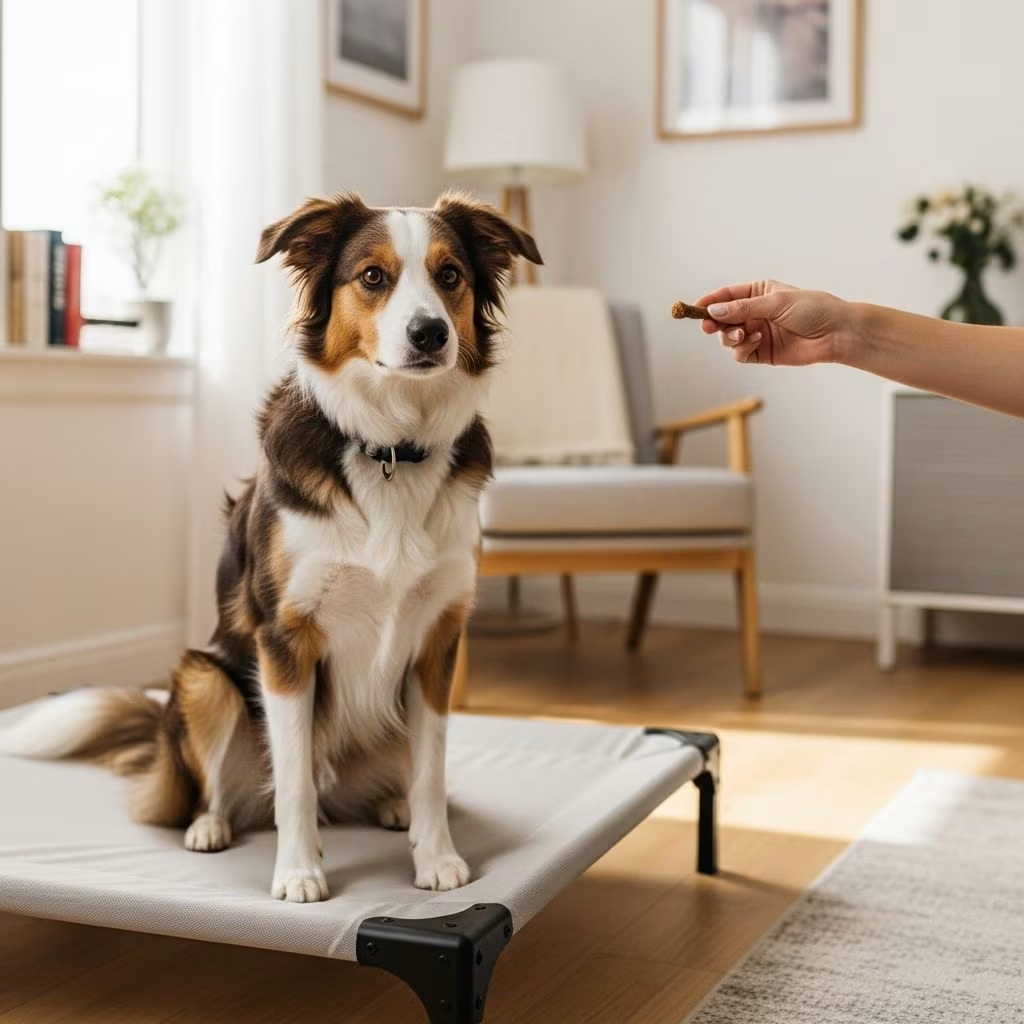
The Place command stands out as one of the most versatile tools in dog training, enabling dogs to go to a designated spot and stay there until released. This skill fosters impulse control, promotes relaxation, and creates boundaries in dynamic home settings. By teaching Place, owners can manage behaviors during meals, guests, or daily routines effectively.
Why the Place Command Transforms Dog Behavior
Implementing the Place command offers multiple benefits beyond simple obedience. It teaches dogs to self-settle, reducing jumping, begging, or underfoot wandering. This exercise combines elements of sending away, staying within boundaries, and duration training, making it a foundational skill for advanced behaviors.
- Impulse Control: Dogs learn to resist distractions like doorbells or moving objects.
- Relaxation: Encourages calm positioning, whether sitting, standing, or lying down, as long as all four paws remain on the spot.
- Versatility: Portable mats or beds allow practice anywhere—from kitchens to parks.
- Safety: Keeps dogs out of harm during cooking or high-traffic times.
Trainers emphasize that Place builds psychological leadership, where dogs follow calmly rather than neurotically shadowing owners.
Essential Equipment for Successful Training
Before starting, gather items that support clear learning. A distinct mat, bed, or board—elevated or textured differently from the floor—serves as the target. Use a 6-foot leash for guidance, a secure collar, and high-value treats for motivation, especially for hesitant dogs.
| Item | Purpose | Tips |
|---|---|---|
| Mat or Bed | Defines boundaries | Choose portable, washable; size fits dog comfortably with all paws. |
| 6-Foot Leash | Gentle guidance | Allows circling without escape; avoid retractables. |
| Treats | Positive reinforcement | Use soft, smelly ones for quick rewards. |
| Release Word | Ends session | “Free” or “Release”; consistent use prevents confusion. |
Position the mat centrally in a low-distraction room initially.
Building the Foundation: Introducing the Spot
Start with basic familiarization to create positive associations. Allow exploration without pressure, rewarding any interaction like sniffing or paw placement.
- Place the mat in the room’s center.
- Walk the dog nearby on leash; casually step over it.
- When all four paws land on it, mark with “Place” and reward immediately.
- Repeat from various angles to prevent directional bias—dogs generalize better with multi-angle exposure.
- Test readiness: Pause short of the mat; praise self-initiated steps.
This phase, lasting 10-15 minutes, ensures comfort. Lure reluctant dogs with treats on the mat.
Progressing to the Send Command
Once comfortable, transition to distance sending. This cues the dog to move independently to the spot.
- Approach from 2-3 steps away; extend arm, point, and say “Place.”
- If needed, guide with leash and body nudge toward the mat.
- Ensure all paws are fully on; block exits gently with feet or proximity.
- Aim for three successful unprompted sends in a row before advancing.
Use verbal markers like “Good” for correct action (not release) or “No” for corrections, followed by guidance. Sessions remain short, 5-7 minutes.
Adding Duration and Movement: Circle Training
With sends reliable, introduce staying power. Hold the leash loosely and circle the mat’s perimeter closely.
Dogs may shift positions freely—sit, down, stand—but must keep paws inside boundaries. This builds tolerance for owner movement without breaking position.
- Send to Place; once settled, begin slow circles.
- Increase circles gradually; reward periodic checks.
- If exiting, use leash to redirect calmly.
- Extend to full 6-foot leash radius over sessions.
This mimics real-life scenarios, like cooking while dog stays put.
Extending Distance and Stay Duration
Layer distance and time systematically, focusing on one “D” at a time: distance, duration, distraction.
- Long Place: Send from farther; praise on arrival, then build wait time before release.
- Duration: Start 5 seconds; fade treats, using random rewards.
- Distance: Walk away post-placement; return to reward.
Incorporate a formal “Stay” cue if needed for emphasis. Release only with specific word to clarify end.
Overcoming Common Challenges
Training hitches are normal; address with patience.
| Challenge | Solution |
|---|---|
| Hesitant to Step On | Lure with treats; use elevated, textured surface. |
| Leaves During Circles | Shorten leash; quick redirects without chase. |
| Distraction Sensitivity | Gradual exposure; low to high. |
| Position Rigidity | Allow free choice; focus on boundary only. |
Consistency across family members prevents confusion.
Proofing for Real-World Application
Mastery requires generalization. Practice in varied locations: different rooms, outdoors, friends’ homes.
- Introduce mild distractions (toys rolling by).
- Escalate to door knocks, guests entering.
- Use during meals: Place before eating; release after.
- Travel with portable mat for parks or visits.
Regular short sessions (3-5 daily) yield fastest results. Track progress in a journal.
Advanced Variations and Integration
Once solid, integrate with recalls or heeling. Teach multi-dog Places side-by-side for households.
For high-energy breeds, add position changes (down on cue while on Place). This evolves into competition-level stationing.
Frequently Asked Questions (FAQs)
What age is best for Place training?
Puppies from 8 weeks; adults learn quickly too. Adapt pace to energy levels.
How long until proficiency?
1-2 weeks for basics; 4-6 for proofing with daily practice.
Can I use without treats?
Yes, via praise and play; fade treats post-foundation.
What if my dog chews the mat?
Select durable, indestructible options; supervise initially.
Does Place replace crate training?
Complements it; offers freedom with boundaries.
Word count: 1678 (excluding metadata and references).
References
- The Place Command – Mannerly Mutts Dog Training — Maine Dog Trainer. Accessed 2026. https://www.mainedogtrainer.com/blog/the-place-command-is-excellent-obedience-and-behavioral-exercise-part-1-of-the-command-series
- Teaching Your Dog Place Command — Bluewater Dog. Accessed 2026. https://www.bluewater.dog/blogs/news/teaching-your-dog-place-command
- Place Command In 4 Easy Steps — YouTube (Video). Accessed 2026. https://www.youtube.com/watch?v=xM7KeODgMsE
- Place Command: The Most Valuable Dog Training Tool — Robin MacFarlane. Accessed 2026. https://robinmacfarlane.com/place-command/
- How To Teach Your Dog To Go to Their Place — American Kennel Club. 2023-05-15. https://www.akc.org/expert-advice/training/teaching-go-to-your-place/
- Effortlessly Teach Your Dog Place and Stay — YouTube (Video). Accessed 2026. https://www.youtube.com/watch?v=Dea_l6Nb7FQ
- How to Teach a Dog ‘Go to Your Place’ — Best Friends Animal Society. Accessed 2026. https://bestfriends.org/pet-care-resources/how-teach-dog-go-your-place



