

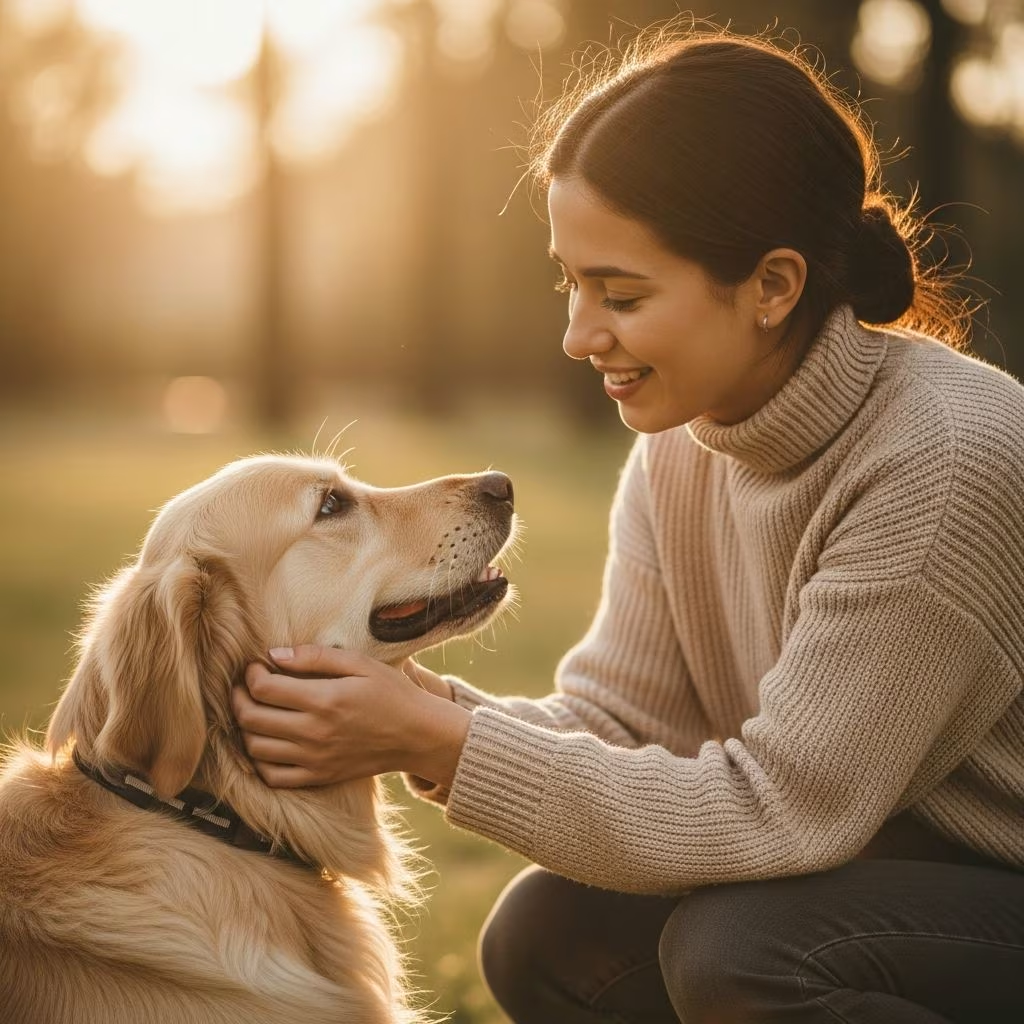
Effective communication forms the foundation of a successful relationship between dogs and their owners. Dogs rely on subtle cues from humans just as they use their own body language to express needs and emotions. By adopting clear, consistent methods, owners can bridge the species gap, leading to better obedience, reduced frustration, and deeper mutual understanding.
Understanding the Basics of Canine Perception
Dogs process information differently from humans. They excel at reading visual signals and tone variations rather than complex sentences. Most verbal chatter is ignored, so focus on precision. Owners who speak less and signal more often see quicker responses from their pets.
- Dogs prioritize body posture and facial expressions over words.
- Tone of voice conveys emotion more effectively than vocabulary.
- Consistency in signals builds reliability in responses.
Observing pack dynamics reveals how dogs naturally interact. They use every body part—from ears to tail—for nuanced messaging. Humans can mimic this by incorporating gestures alongside words.
Core Principles for Clear Commands
Start every interaction with intent. When issuing a command, deliver it once and enforce it. Repetition teaches dogs that compliance is optional, undermining authority. Use a distinct start cue, like a specific word or whistle, to signal training mode and eliminate distractions.
| Command Principle | Why It Works | Example |
|---|---|---|
| Single Delivery | Establishes expectation of immediate action | Say “sit” once; wait or guide if needed |
| High-Pitch for Urgency | Grabs attention in critical moments | Use for recalls near traffic |
| Silence Post-Command | Prevents confusion from extra talk | No chatting during sessions |
During sessions, maintain focus by avoiding side conversations. Your posture and energy influence the dog’s attentiveness.
Leveraging Marker Signals for Reinforcement
A marker pinpoints exact moments of correct behavior, bridging the timing gap between action and reward. Verbal markers like “yes” or clickers provide instant feedback, far superior to delayed praise. Deliver treats within 1-3 seconds to solidify associations.
- Clickers offer unwavering consistency unlike varying voices.
- Hand claps or thumbs-up serve as visual markers for deaf dogs.
- Pair markers with high-value rewards for motivation.
Trainers note ear twitches or head turns as signs the dog registers the marker. This method accelerates learning across all ages and breeds.
Integrating Hand Signals and Body Language
Canines are visual masters, making hand signals indispensable, especially in noisy environments. Combine them with verbs for dual reinforcement. Over time, dogs respond to gestures alone, proving invaluable in emergencies.
Common signals include:
- Open palm upward for “sit”.
- Hand chop for “down”.
- Arm sweep for “come”.
- Finger to lips for “quiet”.
Your entire demeanor matters. Relaxed posture invites play; tense stance signals caution. Dogs mirror human energy, so stay calm to promote composure.
Advanced Tools: Teaching Talking Buttons
Innovative systems like recordable buttons expand communication beyond basic commands. Dogs learn to press buttons labeled with words like “outside,” “play,” or “food” to express desires. This fosters initiative and reduces unwanted behaviors like whining.
- Observe Natural Cues: Note patterns like door-staring for walks.
- Select Motivating Words: Begin with 2-3 high-interest terms.
- Model Consistently: Press and say the word during relevant activities.
- Respond Promptly: Honor requests to build trust.
- Avoid Force: Never push paws; demonstrate casually.
Start near buttons when dogs signal needs, giving 10 seconds to engage. If not, model gently. This respects the dog’s pace, preventing aversion.
Addressing Common Communication Pitfalls
Many owners unknowingly sabotage progress. Chattering dilutes commands, while inconsistent enforcement erodes trust. Punishment without clarity confuses rather than corrects.
- Pitfall: Over-Talking – Dogs tune out noise; use concise cues.
- Pitfall: Mixed Signals – Varying words or tones frustrate learners.
- Pitfall: Delayed Rewards – Timing is critical for association.
- Solution: Reward Desired, Ignore Undesired – Positive focus yields faster results.
For shelter or anxious dogs, prioritize calm observation. Watch play sessions to decode calming signals like yawns or lip licks, indicating stress.
Building Long-Term Communication Habits
Sustained success requires daily practice. Engage enthusiastically, repeating key phrases in context. Track progress in a journal to refine techniques.
Benefits extend to behavior issues:
| Issue | Communication Fix |
|---|---|
| Leash Reactivity | Preemptive “calm” signal + rewards |
| Separation Anxiety | Button for “alone” to predict absences |
| Door Dashing | Hand signal + marker for “wait” |
Service dog teams report enhanced partnerships through button use post-formal training, craving ongoing skill-building.
Frequently Asked Questions (FAQs)
Can any dog learn hand signals?
Yes, all breeds and ages respond well, especially with patience. Start simple and fade verbal cues gradually.
How long to teach talking buttons?
Varies by dog; weeks for basics, months for fluency. Consistency speeds progress.
What if my dog ignores commands?
Revisit foundations: single cues, markers, and enforcement without repetition.
Are clickers better than verbal markers?
Clickers provide precision; voices work if consistent. Test both.
Does body language affect training?
Absolutely—dogs read it instinctively. Stay aligned with your message.
Practical Training Schedule
Implement a weekly plan:
- Days 1-2: Basic commands with hand signals.
- Days 3-4: Introduce markers and rewards.
- Days 5-6: Model buttons for daily needs.
- Day 7: Review in distractions; adjust as needed.
Short, frequent sessions (5-10 minutes) prevent burnout. Celebrate milestones to keep motivation high.
Refining communication transforms challenges into harmony. Patient application of these strategies yields a responsive, joyful companion attuned to your every cue.
References
- How to Communicate With Your Dog – AKC Pet Insurance — AKC Pet Insurance. 2023-05-15. https://www.akcpetinsurance.com/blog/7-tips-for-better-communication-with-your-canine
- The Complete Guide To Teaching Dogs To Talk with Buttons — FluentPet. 2024-02-10. https://fluent.pet/pages/getting-started-with-talking-buttons
- A List of Dog Commands & Hand Signals for Beginners — Taste of the Wild Pet Food. 2023-11-20. https://www.tasteofthewildpetfood.com/articles/training-and-behavior/list-of-dog-commands-hand-signals-for-beginners/
- Canine Communication Skills for Working with Shelter Dogs — ASPCA Pro. 2022-08-05. https://www.aspcapro.org/resource/canine-communication-skills-working-shelter-dogs
- Basics of Dog Communication Training — YouTube (Training Video). 2023-01-12. https://www.youtube.com/watch?v=m5mAiQMNi8k



