Dog Height Measurement: 2 Simple Methods For Accurate Results
Discover precise techniques to measure your dog's height at the withers for health tracking, gear fitting, and breed standards—essential for every pet owner.
Mastering Dog Height Measurement
Accurately determining your dog’s height is a fundamental skill for pet owners, enabling better care decisions from selecting the right crate to monitoring developmental progress. Standard measurements focus on the
withers
, the highest point between the shoulder blades where the neck meets the back, providing a consistent benchmark across breeds and ages.Why Measuring Your Dog’s Height Matters
Height data serves multiple practical purposes in canine care. It helps select appropriately sized bedding, clothing, and carriers to prevent discomfort or injury. For competitive showing, precise heights ensure compliance with breed standards set by organizations like the American Kennel Club. Vets rely on growth charts comparing height against age and breed averages to detect nutritional issues or growth abnormalities early.
Owners of mixed breeds or rescues benefit from baseline measurements to track maturity, as height plateaus signal skeletal completion around 12-18 months depending on size. Incorrect sizing leads to ill-fitting harnesses that rub skin or fail during walks, emphasizing the need for reliable techniques.
Understanding the Withers: The Key Landmark
The
withers
represent the dog’s structural high point, excluding the head, and form the reference for all official height assessments. Located at the ridge formed by the spinal processes of the thoracic vertebrae, this area remains stable even when the dog shifts posture. Feel for the pronounced ridge by running fingers along the back just behind the neck—short-coated breeds like Labradors make it obvious, while long-haired types like Golden Retrievers require parting fur.Measuring to the head misrepresents true size, as ear length or alert posture inflates figures. Standards exclude head height to maintain fairness in breed judging and equipment design.
Essential Tools for Precise Measurements
Gather these common household items or invest in dog-specific gear for repeatable results:
- Tape measure or tailor’s tape: Flexible for contours, essential for initial attempts.
- Yardstick or straight edge: Ensures perpendicular alignment against walls.
- Carpenter’s level: Guarantees horizontal accuracy when marking heights.
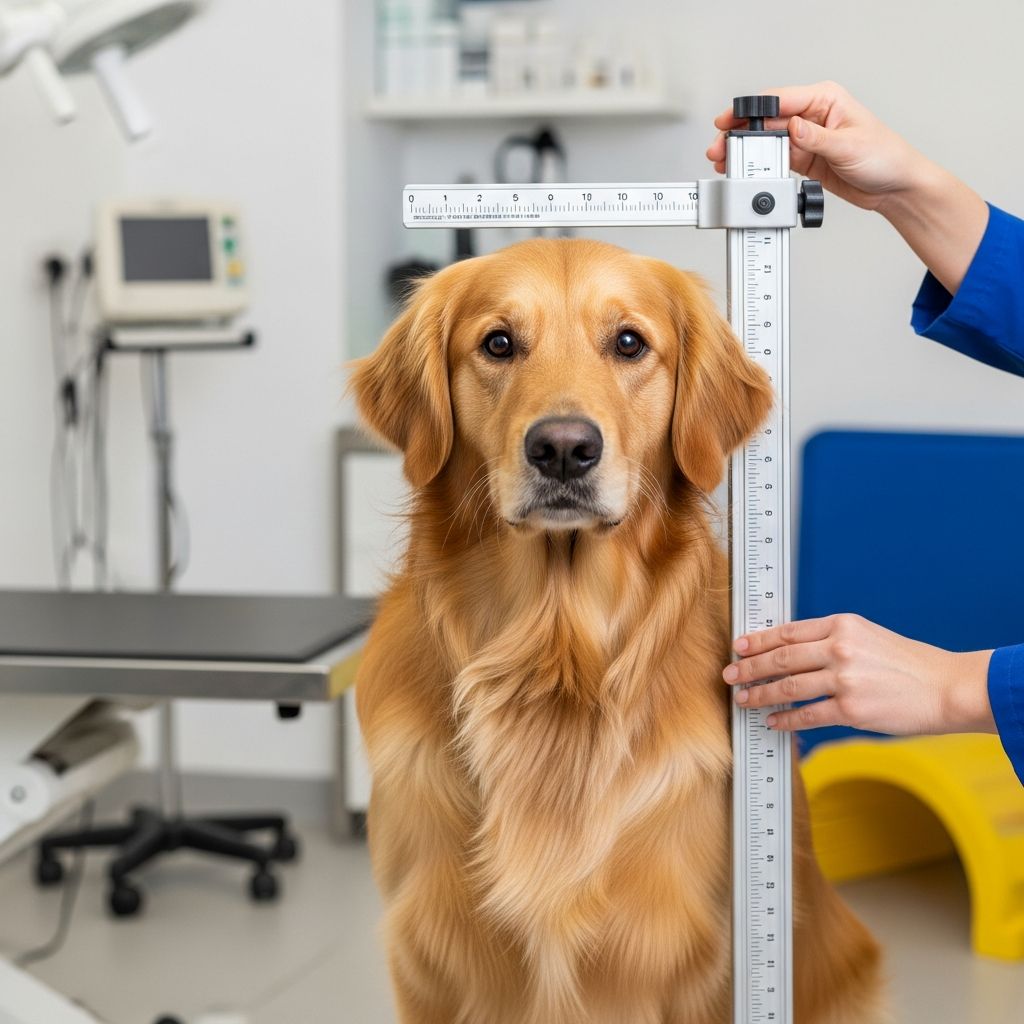
- Wicket or height stick: Professional U-shaped tools with adjustable crossbar for shows.
- Helper: Critical for wiggly pups to maintain stance.
For tables or elevated surfaces, use non-slip mats to steady small dogs.
Step-by-Step Guide: Basic Tape Measure Method
Follow this straightforward process on a flat, firm floor like tile:
- Coax your dog to stand squarely with feet shoulder-width apart, weight evenly distributed. Use treats for motivation without inducing sit.
- Position against a wall if available, back flush, head level gazing forward—not tilted up or down.
- Kneel at eye level to locate withers; gently press if fur obscures.
- Anchor tape base at floor beside front paw, extend vertically to withers top, keeping taut and plumb.
- Record in inches or centimeters; repeat 2-3 times averaging results.
Avoid carpet, as it compresses under paws skewing lows.
Advanced Technique: Wall and Level Method
For superior precision, especially with fidgety dogs:
- Stand dog against wall or doorframe on level floor.
- Place yardstick or level atop withers, press lightly to align horizontally against wall.
- Mark wall at level’s edge with thin pencil line.
- Move dog away; measure from floor to mark using tape or yardstick.
This eliminates tape sag errors common in freehand methods.
Adapting for Small, Large, and Restless Dogs
| Dog Type | Challenges | Solutions |
|---|---|---|
| Small Breeds (e.g., Chihuahuas) | High energy, short stance | Lift to table; two-person hold with treats |
| Large Breeds (e.g., Great Danes) | Height reach, strength | Stool for measurer; firm commands |
| Puppies | Growth spurts, uncooperative | Weekly tracking; play-based positioning |
| Senior Dogs | Arthritis, reluctance | Gentle support; short sessions |
Enlist assistance for breeds like Pugs, notorious for playfulness during measurements.
Professional Tools: Wickets and Measuring Sticks
Dog show officials use
wickets
, portable frames with sliding bars that straddle the dog, dropping precisely on withers for instant reads. Home versions cost under $50 online.Measuring sticks
feature vertical posts with rulers and horizontal sliders, ideal for breeders tracking litters.Calibration ensures accuracy; store flat to prevent warping. These outperform tapes for consistency in growth logs.
Common Mistakes and How to Avoid Them
- Incorrect posture: Head up inflates height—keep natural.
- Uneven floor: Use spirit level to verify.
- Tape angle: Ensure 90 degrees to ground visually or with plumb line.
- Single reading: Average three for reliability.
- Fur interference: Compress gently at withers.
Errors up to 2 inches occur from slouching; patience yields pros.
Beyond Height: Full Body Sizing Guide
Comprehensive measurements include:
- Length: Base of tail to neck base along spine.
- Chest girth: Widest rib area, two-finger snug.
- Neck girth: Mid-shoulder blades around to chest top.
These fit harnesses, collars preventing chafing.
Applications in Daily Care and Shows
Height informs crate selection (add 6 inches overhead), custom ramps for arthritis, airline compliance. In conformation, divisions split by height brackets, e.g., under 15.5 inches for Beagles. Track longitudinally plotting versus breed medians from AKC charts for health insights.
Frequently Asked Questions
How often should I measure my puppy’s height?
Monthly until 12 months, then quarterly to adulthood. Plot against breed curves.
What’s the average height for popular breeds?
Labrador: 21.5-24.5 inches; French Bulldog: 11-12 inches. Consult breed clubs.
Can I measure a wiggly dog alone?
Use wall mark method post-positioning or table for smalls.
Does height change after maturity?
Minimal; focus on weight fluctuations.
Metric vs. imperial?
Both valid; consistent units matter for records.
Conclusion
Mastering dog height measurement empowers informed guardianship, from gear choices to health vigilance. Practice refines technique, turning routine into reliable data for thriving pets.
References
- How to Measure Your Dog’s Height — Spark Paws. 2023. https://www.sparkpaws.com/blogs/community/how-to-measure-your-dog-s-height
- How to Measure the Height of a Dog – All You Need To Know — Woof Frills. 2023. https://wooffrills.com/blogs/news/how-to-measure-the-height-of-a-dog
- How To Measure a Dog — PetMD. 2024-01-15. https://www.petmd.com/dog/general-health/how-to-measure-dog
- A Tail of Measurement: How to Accurately Measure Your Dog’s Height — Orea Teai. 2023. http://oreateai.com/blog/a-tail-of-measurement-how-to-accurately-measure-your-dogs-height/3878ed738421949da0cb0df9140fa236
- How to Measure Your Dog — The Ultimate Guide — Django Brand. 2023. https://djangobrand.com/blogs/news/how-to-measure-your-dog-the-ultimate-guide
Similar Articles





Read full bio of medha deb