

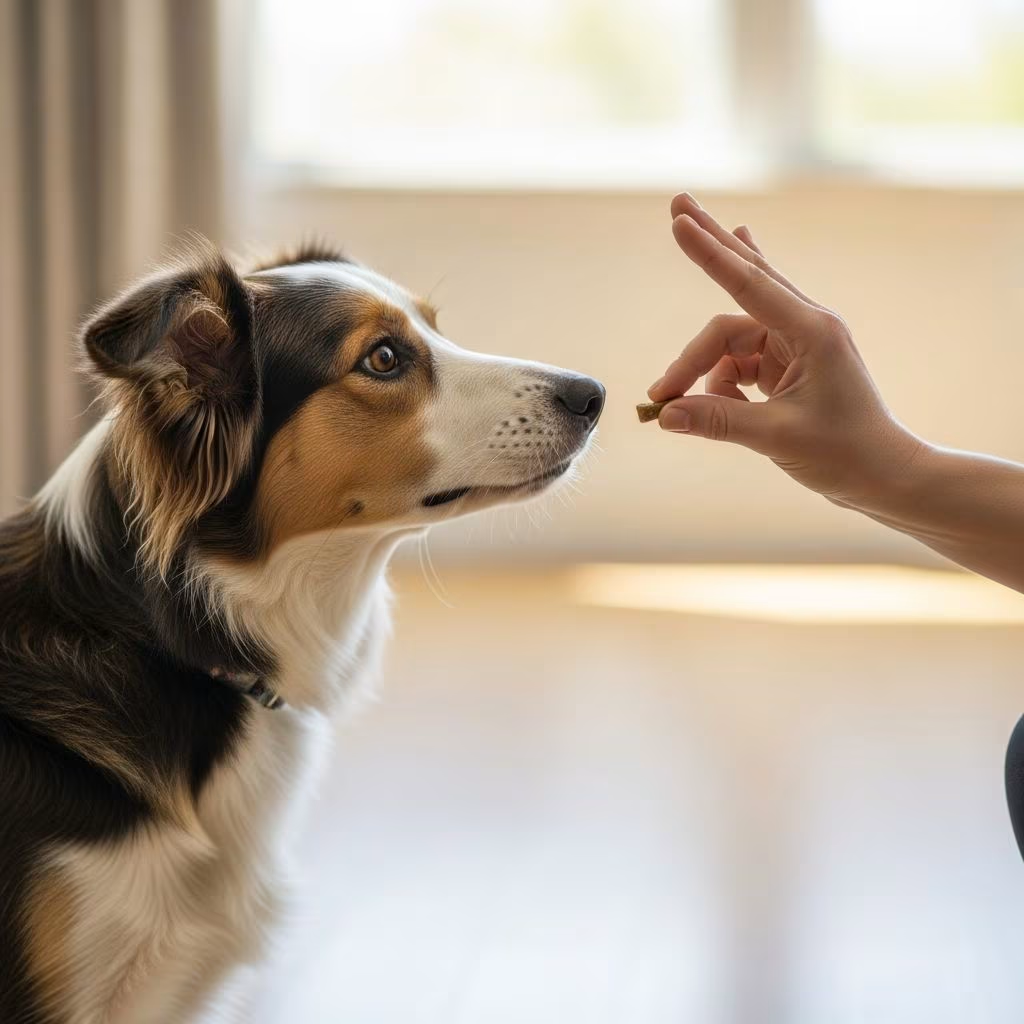
Effective dog training hinges on clear communication between you and your canine companion. Adding a **cue**—whether verbal or visual—to a behavior transforms random actions into reliable responses. This process requires the dog to consistently perform the behavior first, followed by precise introduction of the cue just before the action occurs. Positive reinforcement, often paired with a marker like a clicker, solidifies the association, making cues powerful tools for everyday control and advanced training.
Foundations of Behavior Before Cues
Before introducing any cue, ensure the dog offers the behavior reliably without prompts. This baseline prevents confusion and builds confidence. For instance, in **capturing**, reward spontaneous sits; in **shaping**, incrementally reinforce approximations toward a down-stay; or use **targeting** for nose touches on objects. Luring with food or toys can jumpstart learning but must fade quickly to avoid dependency.
Timing your marker—click or verbal ‘yes’—is critical: it must occur the instant the behavior completes, predicting the treat. This creates a conditioned reinforcer, making the dog eager for success. Practice delivering it consistently across 10-20 repetitions until prediction is rock-solid.
Optimal Moments to Introduce Cues
Introduce cues only when success is predictable—you’d bet on the behavior happening 90% of the time. Common pitfalls include adding too early, leading to ‘poisoned’ cues where dogs ignore them due to inconsistent reinforcement. Ask: Does the dog perform flawlessly in low-distraction settings? Is the form crisp? Can you predict it every time?.
- Capturing: Wait for natural offers, then cue just prior.
- Shaping: Once in a ‘behavior loop’ (e.g., returning to mat repeatedly), insert cue before next repeat.
- Luring: Say cue as lure prompts action, then fade lure.
- Targeting: Cue before nose contacts target.
Stationary behaviors like sit need a ‘reset’ toss after treats to reposition the dog.
Step-by-Step Cue Addition Process
Follow this structured approach for verbal or hand signal cues:
- Prime the Behavior: Get 10 clean repetitions with old method (e.g., hand signal).
- Insert New Cue: Say or signal new cue just before dog acts, then old cue if needed. Reward immediately.
- Repeat Pairs: 5-10 times, fading old cue gradually.
- Test Solo: Use new cue alone; if falters, revert briefly.
- Short Sessions: 3-5 minutes, 20+ reps for efficiency.
For dual cues, train opposites simultaneously: cue ‘come’ while stepping back, ‘sit’ advancing—doubling efficiency.
Verbal vs. Visual Cues
| Cue Type | Pros | Cons | Best For |
|---|---|---|---|
| Verbal | Works in low light; hands-free | Harder to fade; accent-dependent | Distance commands |
| Hand Signal | Clear, visual; easy to minimize | Line-of-sight needed | Close-range, distractions |
| Combined | Versatile; backups | Training complexity | Advanced obedience |
Start with signals for precision, add verbals later via ‘last behavior’ game: repeat old cue 10x, then new before old.
Proofing Cues for Real-World Reliability
A cue isn’t mastered until it generalizes. Begin in quiet rooms, progress to outdoors, crowds, other dogs. Use ‘two-fers’: chain sit-touch for fluency under mild distraction.
- Click tentative offers in new spots; generous treats for wins.
- Only reward cued behaviors—no freebies.
- If anticipation occurs, wait out offers before recueing.
Practice across days, locations, times. Once three cues are solid in varied contexts, new ones attach faster.
Common Errors and Fixes
Avoid these to prevent cue degradation:
| Error | Why It Happens | Fix |
|---|---|---|
| Adding Too Soon | Unpredictable behavior | Build 90% reliability first |
| Poor Marker Timing | Miss instant behavior end | Practice on video; slow-mo review |
| No Reset for Stays | Dog stays put post-treat | Toss treat away |
| Ignoring Distractions | Cue fails in wild | Gradual proofing |
| Poisoned Cues | Inconsistent rewards | Retrain with clean loops |
Protect cues via engagement games: recall games, impulse control drills build default focus.
Advanced Strategies: Chaining and Multi-Cues
Chain behaviors into sequences: cue sit, then down, rewarding end. For multi-cues, layer gradually—hand first, verbal second. Change cues seamlessly: new + old 10x, then solo. In agility or tricks, cues predict fun outcomes, boosting motivation.
Unique twist: Train reciprocal behaviors together for rapid cue attachment, like come/sit alternates.
Tools and Reinforcement Essentials
Clickers excel for precise marking; verbal markers work sans tools. High-value treats (chicken, cheese) fuel early stages; fade to praise/life rewards later. Keep sessions fun—end on highs.
Frequently Asked Questions (FAQs)
What if my dog ignores the new cue?
Revert to old cue briefly, ensure 100% prediction, then re-pair slowly. Check for distractions or low motivation.
How long until a cue is reliable?
Minutes for basics with clean loops; weeks for proofing across environments.
Can I use cues for puppies?
Yes, start simple; short sessions match attention spans.
Verbal or hand signal first?
Hand signals often clearer initially; add verbal for versatility.
What about correcting errors?
Positive methods: withhold reward, manage environment—no punishment, preserves trust.
Building a Cue-Savvy Dog
Consistent cue training yields polite, responsive dogs thriving in homes, parks, competitions. Patience and precision pay off—celebrate milestones. Track progress in a journal: behaviors, success rates, locations. Share sessions with friends for real-world tests.
Integrate cues into daily life: cue ‘wait’ at doors, ‘leave it’ for distractions. This fluency reduces frustration, strengthens bonds. For challenges like reactive dogs, consult pros blending cues with counter-conditioning.
Experiment with cue words: unique terms avoid real-word confusion (e.g., ‘park’ vs. ‘go-park’). Visuals: flat palm for stay, circle for spin. Variety keeps training dynamic.
References
- Adding the Cue: A Unique Approach — Karen Pryor Clicker Training. Accessed 2026. https://clickertraining.com/adding-the-cue-a-unique-approach/
- Training How-To: Adding a Cue — Crossbones Dog Academy. Accessed 2026. https://crossbonesdog.com/training-how-to-adding-a-cue/
- How to ADD a CUE (command) to a BEHAVIOR — YouTube (Dog Training Foundations). Accessed 2026. https://www.youtube.com/watch?v=ZyCT17pJJDA
- Adding a verbal cue or changing a cue — Dogmantics Dog Training (Emily Larlham). Accessed 2026. https://dogmantics.com/adding-a-verbal-cue-or-changing-a-cue/
- Dog Training Question ~ When Do I Add a Cue? — Susan Garrett Dog Agility. 2018-09. https://susangarrettdogagility.com/2018/09/when-do-i-add-a-cue/
- Dog Training Basics: How to Teach a Cue — Whole Dog Journal. Accessed 2026. https://www.whole-dog-journal.com/behavior/dog-training-basics-how-to-teach-a-cue/



