

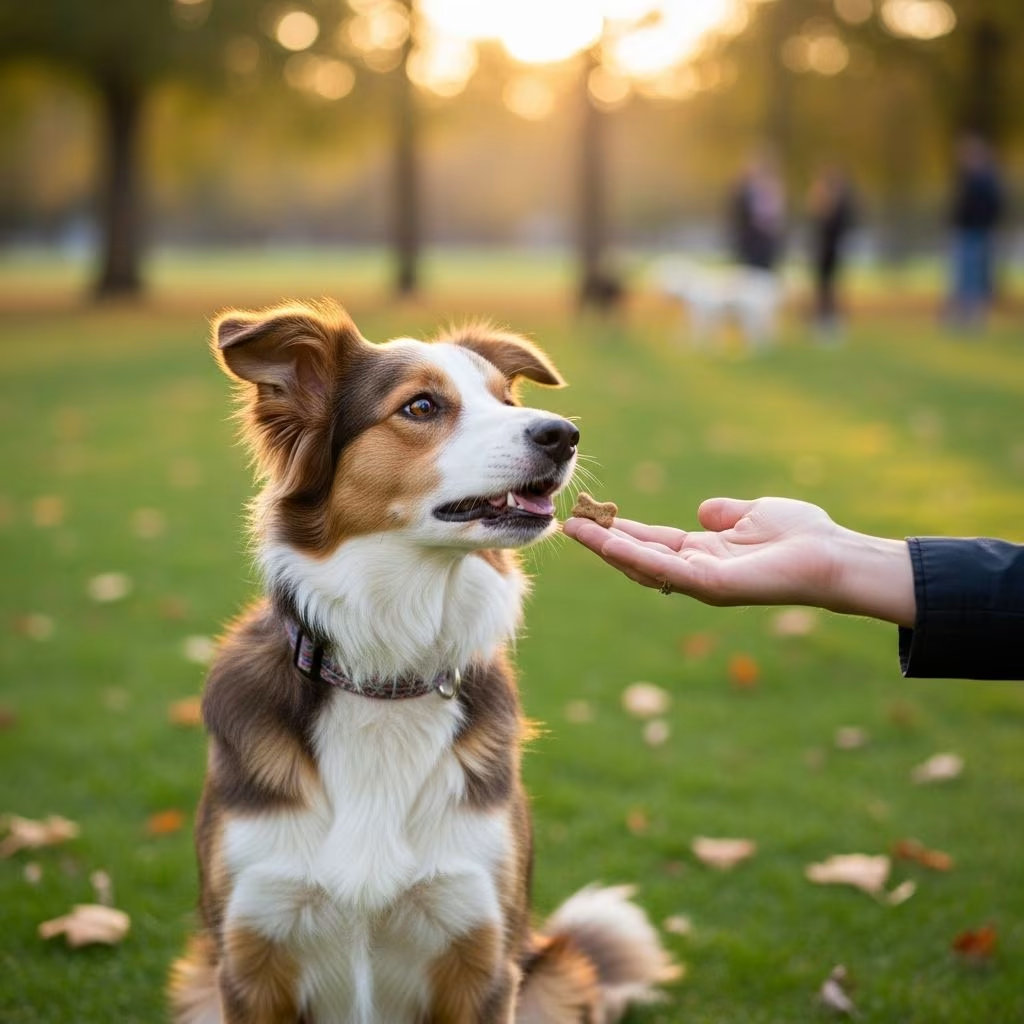
Positive dog training empowers owners to guide their pets toward reliable behaviors by associating specific cues with rewarding outcomes. This approach fosters a strong bond while promoting self-control in dogs, allowing them to perform actions only when signaled, rather than reacting impulsively to every stimulus.
Understanding the Foundations of Canine Response Training
At its core, effective dog training revolves around teaching animals to link verbal or visual signals with particular actions. This process, often called stimulus control, ensures a dog executes a command like ‘sit’ precisely when given, but refrains otherwise. Unlike robotic obedience, this method respects the dog’s natural inclinations, encouraging voluntary compliance through motivation rather than fear.
Reward-based systems leverage the dog’s innate drive for treats, toys, or praise. By consistently pairing a cue with a desirable result, dogs learn to anticipate and prioritize owner-directed behaviors. This contrasts sharply with outdated punitive techniques that suppress actions through discomfort, potentially leading to anxiety or shutdown responses.
Core Techniques for Building Precise Behaviors
Several proven methods help initiate and refine dog behaviors without coercion. Each technique builds progressively toward full cue association.
- Capturing: Observe your dog performing a natural action, such as lying down, and immediately mark it with a clicker or verbal ‘yes,’ followed by a reward. Over repetitions, the dog associates the behavior with positive outcomes.
- Luring: Guide the dog into position using a treat held in front of its nose, then mark and reward once achieved. Gradually fade the lure by delivering the treat from your hand without movement prompts.
- Shaping: Reward incremental approximations toward the target behavior. For instance, to teach ‘spin,’ first reward a head turn, then a partial circle, building to a full rotation.
These methods allow trainers to ‘elicit’ virtually any conceivable canine action, from basic sits to complex tricks, setting the stage for cue integration.
Step-by-Step Guide to Establishing Cue Reliability
Achieving dependable responses requires a structured progression. Begin with high-frequency rewards during acquisition, then transition to intermittent reinforcement for endurance.
- Acquire the Behavior: Use capturing, luring, or shaping until the dog offers it consistently (at least 80% success rate). Introduce the cue just before the action occurs.
- Fade Prompts: Reduce reliance on lures or body gestures. If needed, cue first, pause, then gently prompt to bridge the association.
- Test Discrimination: Once cued responses hit 80% without aids, withhold rewards for unprompted or incorrect behaviors. Only reinforce exact matches to the cue.
- Implement Intermittent Rewards: Shift to variable reinforcement schedules, mimicking real-world unpredictability, to solidify long-term adherence.
During sessions, intersperse known behaviors with new ones to verify discrimination. For example, after cueing ‘down,’ request ‘sit’ to confirm the dog doesn’t default to the prior action.
Addressing Common Challenges in Behavior Discrimination
Dogs often offer spontaneous or mismatched behaviors, especially early on. Consistency is key: ignore or neutrally mark (‘oops’) deviations, then recue correctly. Turning away briefly removes attention, extinguishing undesired offers without punishment.
Anticipation—guessing cues prematurely—can be curbed by varying session order and introducing a ‘wait’ command post-behavior. This pauses the dog until released, preventing chains of unsolicited actions.
| Challenge | Symptom | Solution |
|---|---|---|
| Spontaneous Offering | Dog sits without cue | Withhold reward; recue after pause |
| Anticipation | Dog downs on ‘sit’ cue | Use NRM, test with known cues |
| Distraction Pull | Dog ignores cue for scents | Start low-distraction; build gradually |
| Frantic Offering | Multiple behaviors thrown | Teach release cue; intersperse requests |
Enhancing Control with Impulse Management Strategies
Impulse control underpins stimulus mastery. Integrate daily practices like meal-time waits or door pauses to teach patience. Use the Premack Principle: defer access to high-value activities (e.g., sniffing) until lower-priority tasks complete.
For reactive dogs, gradually introduce distractions at low intensity, rewarding focus with alternative high-value tasks. This maintains positive emotional responses (CER) while building tolerance.
Real-World Applications and Proofing
Once basics solidify, proof in varied environments: quiet rooms to parks, with escalating distractions. Test by requesting behaviors amid toys or passersby, ensuring the cue overrides impulses.
Advanced stimulus control enables chaining, like ‘sit-stay-wait-release,’ vital for agility or service work. Conservation detection dogs exemplify this, responding to cues despite novel scents.
Why Positive Methods Outperform Coercive Alternatives
Force-based training often yields ‘learned helplessness,’ where dogs freeze unless commanded, stifling natural exploration. Positive approaches preserve enthusiasm, yielding eager learners who generalize skills broadly without fear.
Research links reactivity to stimuli with aggression risks across breeds, underscoring proactive control training’s preventive value.
FAQs on Positive Stimulus Control Training
What is stimulus control in dog training?
It means a dog performs a behavior solely in response to a specific cue and withholds it otherwise, achieved through positive reinforcement.
How long does it take to achieve reliable control?
Varies by dog and behavior; basics may take weeks with daily 5-10 minute sessions, advancing to months for proofing.
Can this work for high-drive breeds?
Yes, especially with variable rewards and Premack applications to channel energy productively.
What if my dog regresses in new places?
Return to lower criteria, rebuild success gradually in the novel context.
Is a clicker necessary?
No, but it provides precise timing; verbal markers like ‘yes’ suffice.
Advanced Tips for Lifelong Obedience
Maintain gains with random reinforcement and fun games. Teach ‘leave it’ as head turns for self-reinforcing temptations. For frantic offerers, establish a default ‘relax’ position until cued.
Monitor for ‘poisoned cues’ where past frustrations taint signals; rebuild with high-value rewards in neutral settings.
References
- Canine Stimulus Control Through Positive Dog Training — Whole Dog Journal. 2023. https://www.whole-dog-journal.com/behavior/canine-stimulus-control-through-positive-dog-training/
- Stimulus Control, Frustration, and Poisoned Cues — Confident Canines Dog Training. 2022-10-15. https://www.confidentcaninesdogtraining.com/post/stimulus-control-frustration-and-poisoned-cues
- Stimulus Control with Sarah Owings — K9 Conservationists. 2023. https://k9conservationists.org/stimulus-control-with-sarah-owings/
- Dog Training – Putting The Unwanted Behavior On Cue — So Much Petential. 2021. https://somuchpetential.com/dog-training-putting-the-unwanted-behavior-on-cue/



