Discus Breeding Step-By-Step Guide For Aquarium Success
Unlock the secrets to successful discus fish breeding with proven techniques for pairing, spawning, and raising healthy fry in home aquariums.
Mastering Discus Breeding: A Complete Guide for Aquarists
Discus fish, renowned for their vibrant colors and majestic presence, represent a pinnacle achievement for dedicated aquarium enthusiasts. Breeding these cichlids demands precision, patience, and a deep understanding of their environmental needs. This guide draws from established practices to help you navigate every stage, from initial setup to nurturing the next generation.
Understanding Discus Biology for Breeding Success
Discus (Symphysodon spp.) are South American cichlids that thrive in specific conditions mimicking their Amazonian origins. Adults typically reach 6-8 inches, with females slightly smaller. Sexual dimorphism becomes evident during breeding: males develop more pointed breeding tubes, while females have blunt, rounded ones. These fish form monogamous pairs that can produce hundreds of eggs per spawn, but success hinges on replicating stable, soft, acidic water parameters.
Key biological traits include parental care, where both parents guard and secrete skin mucus to feed fry post-hatching. Optimal breeding age is 1.5-2 years, with fish at least 5.5 inches for females and 6 inches for males. Health indicators—clear eyes, robust fins, and absence of parasites—are non-negotiable before attempting to breed.
Selecting and Forming Breeding Pairs
The foundation of successful breeding lies in choosing compatible, healthy specimens. Two primary strategies exist: purchasing proven pairs or raising juveniles to form natural bonds.
- Natural Pairing: Acquire 6-8 juveniles of similar strains (e.g., all blue or red varieties) to increase pairing odds. House them in a 75-100 gallon community tank with stable conditions. Pairs emerge naturally through courtship displays like lip-locking and side-by-side swimming, typically within 6-12 months.
- Proven Pairs: Buy adults confirmed to have spawned previously. This accelerates the process but verify seller reputation to avoid stressed or incompatible fish.
Observe for aggression; dominant pairs may harass subordinates. Allow practice spawns in the group tank to strengthen bonds—remove eggs if needed to prevent consumption, fostering resilience. Mixing strains can yield hybrids but risks unattractive offspring for beginners.
Designing the Ideal Breeding Environment
A dedicated 55-75 gallon breeding tank minimizes disruptions. Essential features include:
- Filtration: Overkill canister or sump filters for crystal-clear water; sponge filters for fry stages.
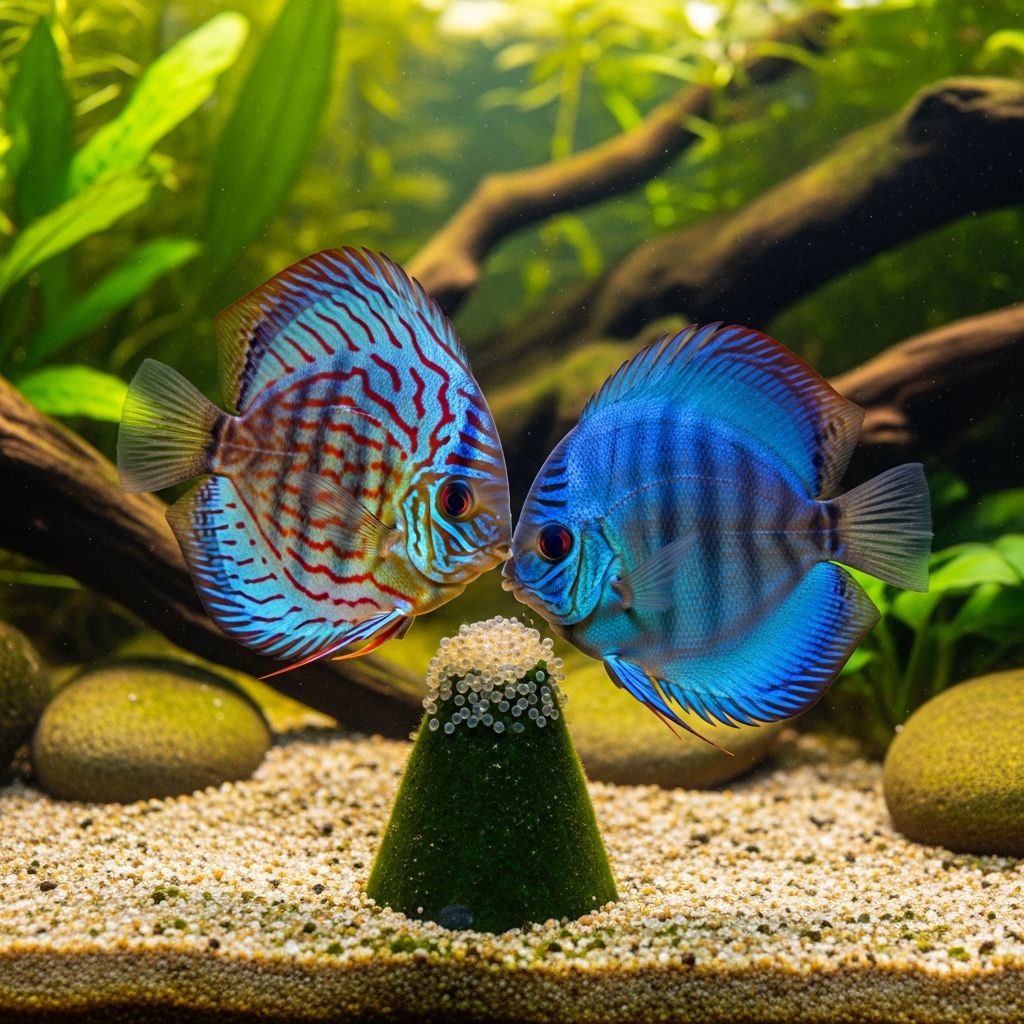
- Substrate and Decor: Bare bottom for hygiene, with vertical spawning sites like PVC pipes (4-inch diameter, 12-18 inches long, positioned 1 inch below surface) or slate cones. Avoid gravel to prevent fry entrapment.
- Lighting: Dim, subdued lights (8-10 hours daily) to reduce stress; place tank in a quiet room.
| Parameter | Breeding Range | Rationale |
|---|---|---|
| pH | 6.0-6.5 | Mimics Amazon soft water; stability prevents spawning failure |
| Temperature | 82-86°F | Warmer end triggers spawning; cooler changes stimulate |
| Hardness | 100-200 µS | Low minerals support egg viability |
| Water Changes | 50% daily | Maintains quality amid parental slime |
Match source water pH and temperature gradually when transferring pairs. Use RO water mixed with peat for acidification.
Conditioning Pairs for Optimal Spawning
Conditioning builds reserves for egg production and stimulates hormones. Transition pairs to the breeding tank seamlessly.
- Diet: High-protein regimen: beef heart, shrimp, bloodworms, and discus-specific pellets. Feed 3-5 times daily, varying to mimic wild foraging. Fast 1-2 days weekly to trigger spawning.
- Water Manipulation: Daily 20-50% changes with 2°F cooler water; gradually drop pH. Increase frequency or volume to simulate rainy seasons.
- Behavioral Cues: Watch for cleaning spawning sites, shivering, bowing, and tube protrusion. Test runs precede egg-laying.
Stress from poor health or instability halts progress. Proven pairs may spawn in 1-2 weeks; new ones longer.
The Spawning Process Step-by-Step
Spawning unfolds dramatically over hours. The female glides up the cone, depositing 200-400 translucent eggs in a tight grid. The male follows, fertilizing with milt. Eggs hatch in 48-72 hours at 84°F; wiggle stage follows, where fry absorb yolk sacs.
Parents fan eggs, removing infertile ones. Infertile eggs turn white; healthy ones silver-gray. If parents eat eggs, artificial hatching with methylene blue (1 ppm) prevents fungus.
Rearing Discus Fry: From Hatching to Independence
Fry rely on parental mucus for 7-14 days post-free-swimming. Do not separate prematurely.
- Days 1-3 (Hatching): Maintain 86°F, high oxygenation. Frequent 25% changes siphon debris.
- Weaning (Days 10-14): Introduce baby brine shrimp (BBS). Hatch BBS in 2L bottles: 1 tsp eggs in aerated saltwater, light for 24 hours.
- Grow-Out: 75% daily changes critical due to slime, uneaten food fouling. Transition to crushed flakes, microworms by week 4.
At 4-6 weeks, size-sort fry to prevent cannibalism. Yield varies: 50-200 survivors common with diligent care.
Common Challenges and Troubleshooting
Breeding pitfalls include egg-eating, bacterial crashes, and pair rejection.
| Issue | Symptoms | Solution |
|---|---|---|
| Egg Eating | Parents consume spawn | Practice spawns in group tank; remove for artificial incubation |
| Fry Losses | High mortality post-wean | Strict water changes; live BBS only |
| No Spawning | No tubes or cleaning | Enhance conditioning, vary parameters |
| Water Clouding | Bacterial bloom | Increase filtration/changes |
Genetics influence patterns; selective breeding enhances traits like marbling.
Advanced Techniques for Prolific Breeders
Once proficient, scale up: multiple tanks, strain isolation for pure lines. Track spawns: proven pairs rebond in 48 hours post-removal. Hormone injections (rarely needed) boost reluctant pairs but risk health.
Economics: Fry sell at 1.5 inches for $20-50 each. Community tanks for grow-out optimize space.
FAQs
How long until discus pairs spawn?
Conditioned pairs spawn in 1-4 weeks; juveniles take 6-12 months to pair.
Can I breed discus in hard water?
No—soften to 100-200 µS with RO/peat; hard water causes egg failure.
What if fry won’t eat BBS?
Try microworms or vinegar eels; ensure parents present for mucus feeding.
How often do pairs spawn?
Weekly post-first success, with proper management.
Best tank size for fry rearing?
30-55 gallons for first batches; overcrowd risks stunting.
References
- Different Strategies for Breeding Discus Fish — discus.com. Accessed 2026. https://www.discus.com/breeding/different-strategies-for-breeding-discus-fish/
- HOW TO: Breed Discus fish — YouTube (kGBKo9yy6Uk). Accessed 2026. https://www.youtube.com/watch?v=kGBKo9yy6Uk
- DISCUS BREEDING BASICS – a beginners guide — discusforums.com. Accessed 2026. https://www.discusforums.com/forum/showthread.php?2910-DISCUS-BREEDING-BASICS-a-beginners-guide
- Breeding Basics — North American Discus Association (discusnada.org). Accessed 2026. https://discusnada.org/breeding-discus/
- Breeding Discus Fish – Part One! — YouTube (1tdg-Xwx8SM). Accessed 2026. https://www.youtube.com/watch?v=1tdg-Xwx8SM
- Discus Genetics and Breeding Info and Discussion — simplydiscus.com. Accessed 2026. https://forum.simplydiscus.com/forum/main-discus-topics/breeding-discus/41161-discus-genetics-and-breeding-info-and-discussion
Similar Articles





Read full bio of medha deb