

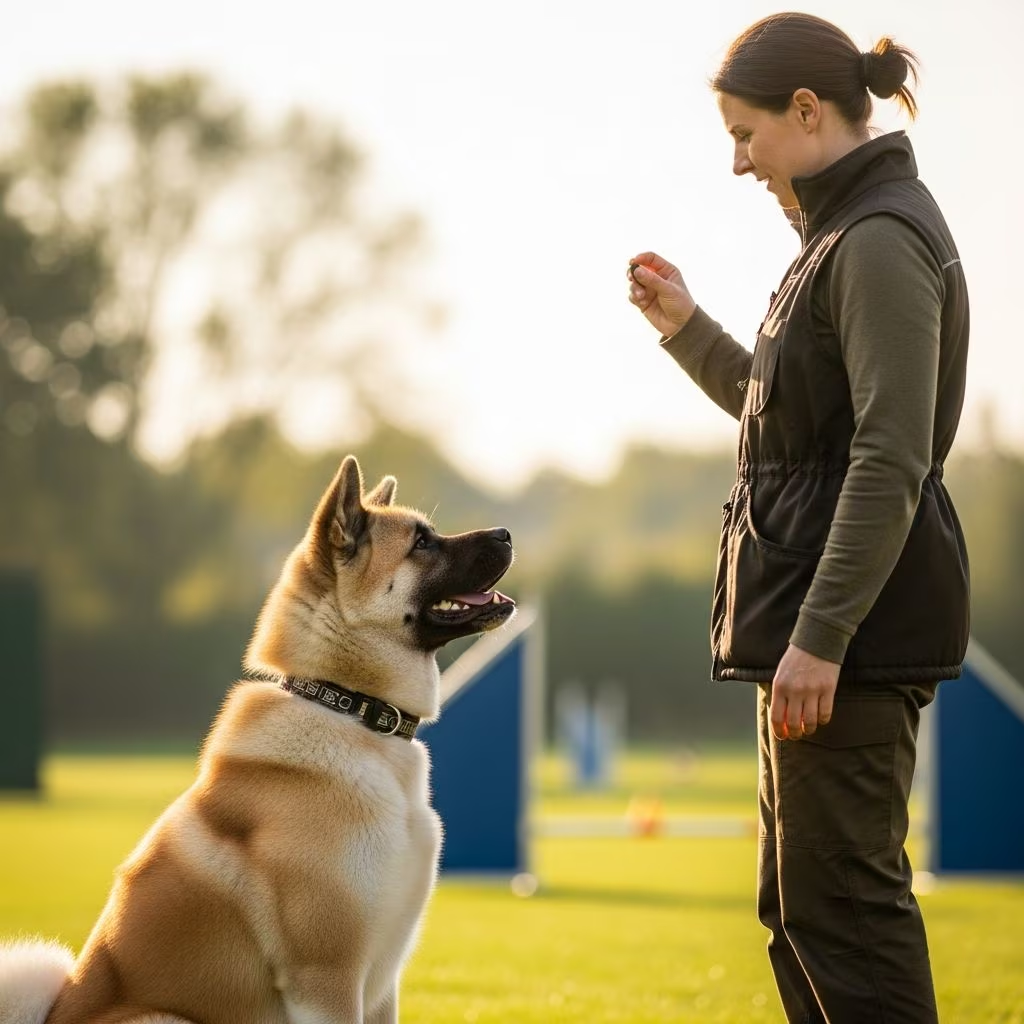
Akitas are intelligent, strong-willed dogs that require consistent, patient training to become well-behaved companions. These powerful breeds respond best to positive reinforcement combined with firm leadership, making training methodology critical for success. Understanding how to work with an Akita’s independent nature rather than against it will establish the foundation for a lifetime of obedience and mutual respect.
Understanding the Akita Temperament Before Training Begins
Before implementing any training protocol, owners must recognize that Akitas possess distinct personality characteristics that influence learning outcomes. These dogs are naturally confident and maintain strong opinions about their environment and social hierarchy. Unlike breeds that aim to please their handlers instinctively, Akitas evaluate commands and decide whether compliance aligns with their preferences.
Akitas demonstrate territorial instincts and can display dominance if not properly guided during their formative months. Early intervention with consistent boundaries prevents behavioral issues from becoming entrenched habits. The breed’s intelligence means they learn quickly—both desired and undesired behaviors—so training must remain vigilant and purposeful from the moment a puppy arrives home.
Establishing Leadership and Building Trust
Effective Akita training fundamentally requires establishing yourself as a calm, confident leader rather than an angry or frustrated authority figure. Dogs perceive human emotional states and respond accordingly; maintaining composure during training sessions directly impacts learning effectiveness. An owner who displays anxiety or frustration communicates uncertainty, which an Akita may interpret as an invitation to assume leadership.
Leadership manifests through consistent rules, predictable routines, and balanced corrections coupled with abundant praise. Owners should demonstrate that they control resources—food, toys, outdoor access—and that compliance leads to positive outcomes. This creates a hierarchical structure where the Akita understands its role within the family unit and respects the owner’s position.
Trust develops when dogs experience reliability from their handlers. Following through on commands, maintaining consistent standards, and avoiding arbitrary punishments build confidence that the owner knows what they’re doing. An Akita that trusts its owner will follow instructions even when distracted or uncertain.
Foundational Skills: The Building Blocks of Obedience
Training progression matters significantly with Akitas. Attempting advanced commands before mastering basics creates confusion and frustration. The following sequence represents an optimal progression:
- Collar and Leash Acclimation: Before any formal training, an Akita must become comfortable wearing a collar and leash. Allow the dog to wear these items during casual activities until they no longer provoke resistance or anxiety.
- Sit Command: This foundational command teaches the dog to respond to verbal cues paired with body language. Hold a treat above the dog’s head, allowing natural physics to guide the rear toward the ground. Immediately reward and praise when the desired position occurs.
- Drop or Down Command: After mastering “sit,” teach the dog to assume a prone position. This command proves particularly valuable for impulse control and safety management.
- Stay Command: Develop the dog’s ability to remain in position despite distractions or the owner’s movement. This skill builds impulse control and focus.
- Recall Command: Teaching a reliable “come” or “here” response provides essential safety management, particularly important for strong breeds like Akitas.
Each foundational skill builds upon previous accomplishments. Attempting to teach “stay” before the dog consistently responds to “sit” creates unnecessary confusion. Sequential mastery ensures the dog has the neurological and behavioral foundation for increasingly complex tasks.
Effective Training Frequency and Session Structure
Akitas respond poorly to rigid, repetitive routines that feel monotonous or forced. Rather than training twice weekly at the same time, concentrate training into more frequent but shorter sessions. A schedule of twice daily fifteen-minute sessions, for example, proves more effective than one thirty-minute weekly session.
Each training session should follow this structure: Begin with a warm-up exercise the dog already knows well, progress to new or challenging material, and conclude with a simple, easily completed exercise. Ending on a positive, successful note creates anticipation for the next session and prevents the dog from associating training with frustration.
Session location should vary throughout training progression. Initial instruction might occur indoors with minimal distractions, but successful dogs must demonstrate obedience in real-world environments. Progressively introduce busier locations—parks, city streets, unfamiliar terrain—so the dog generalizes commands across contexts rather than perceiving training as location-specific.
Positive Reinforcement and Operant Conditioning
Modern dog training science emphasizes operant conditioning, a learning principle where behavior followed by positive consequences becomes more likely to repeat. High-value treats, enthusiastic praise, physical affection, and play opportunities serve as effective reinforcers for Akitas.
The mechanics of operant conditioning with Akitas function as follows: The owner provides a cue (verbal command or hand signal), the dog performs the desired action, and immediately upon completion, the owner delivers a reward. This A-B-C sequence becomes hardwired through repetition, creating muscle memory and an emotional response that compensates for dogs’ relatively poor short-term memory.
Clicker training represents an advanced application of operant conditioning. A small handheld device producing a distinct sharp sound marks the exact moment of desired behavior, bridging the gap between action and reward. For example, when teaching “sit,” the owner clicks the moment the dog’s rear touches the ground, then immediately provides a treat. This precision timing accelerates learning and clarifies what specific behavior earned the reward.
Leash Training and Walking Management
Leash training encompasses multiple distinct skills rather than a single behavior. Understanding these variations helps owners address specific challenges effectively.
Loose Leash Walking: In this context, the dog maintains a slack leash while walking at the owner’s pace. The dog may sniff, explore, and move naturally within the leash’s constraints. This style provides mental stimulation and allows the dog autonomy within boundaries. Loose leash walking requires the dog to check in with the owner periodically but prioritizes the dog’s interest in exploring.
Heel or “With Me” Command: This more formal walking style requires the dog to remain immediately adjacent to the handler, matching pace and direction precisely. Training begins indoors with food lures that keep the dog’s attention forward. A continuous stream of kibble rewards the dog for maintaining position. Once established indoors, this command transitions to outdoor environments and eventually operates without food rewards.
Recall on Leash: Teaching the dog to approach quickly when called proves essential for safety. Begin by calling the dog with an excited tone while simultaneously pulling the leash gently and stepping backward. The dog’s natural response to follow movement, combined with the verbal command and leash pressure, creates a multi-sensory association. Immediate rewards reinforce this behavior.
Patience and persistence constitute the most critical elements of leash training success. Dogs learn physical skills through practice, and frustration on the handler’s part transfers to the dog, creating tension that sabotages training. Avoiding shortcuts during early training prevents compounded problems later.
Socialization: Exposure During Critical Periods
Socialization differs fundamentally from training, though both prove essential for Akita development. Socialization exposes dogs to varied stimuli—people, animals, environments, sounds, textures—during sensitive developmental windows when the brain remains neurologically plastic.
Puppies under sixteen weeks benefit from gentle exposure to other young dogs, varied sights, sounds, and sensory experiences. Responsible breeders often begin this process before puppies leave their litters through deliberate handling, touching different body parts, and exposing puppies to household stimuli. Well-structured puppy kindergarten classes provide controlled environments for age-appropriate peer interaction.
As puppies mature beyond sixteen weeks, controlled exposure to busier environments proves increasingly valuable. Walking an Akita past crowds of people, across unfamiliar terrain, over grates, and up and down stairs builds confidence and teaches the dog that novel situations pose no threat when the owner remains calm and confident.
Advanced Training: Search Games and Differentiation
Once foundational skills are established, advanced exercises engage the Akita’s problem-solving abilities and strengthen the human-dog bond. Search games, for instance, teach the dog to find specific hidden objects upon command. The owner shows the dog a target object, secretly hides it, and directs the dog to locate it. Upon successful retrieval, immediate praise and rewards reinforce the behavior.
Object differentiation represents another advanced skill where the dog learns to identify specific items from groups of similar objects and retrieve the correct one upon command. These exercises provide mental enrichment that prevents boredom-related behavioral problems while deepening the interactive relationship between owner and dog.
Housetraining Fundamentals
Housetraining should commence immediately upon the puppy’s arrival home, even before formal obedience training begins. Establishing designated areas for sleeping, eating, drinking, and elimination creates a mental map that persists throughout the dog’s life. The dog will instinctively return to the same locations for the same functions indefinitely, making initial choice critical.
Consistency regarding outdoor elimination schedules, combined with immediate praise and treats upon successful outdoor elimination, accelerates housetraining. Accidents indoors should never receive punishment; instead, owners should simply clean the area thoroughly to eliminate scent markers that might encourage repeat incidents in the same location.
Professional Training Considerations
While owner-directed training builds relationship and understanding, professional dog trainers offer expertise that accelerates progress. Enrollment in dog training schools provides Akitas exposure to different handlers, varied environments, and professional instruction that many owners cannot replicate independently.
When selecting a trainer, seek individuals with specific Akita experience who utilize positive reinforcement methods and emphasize clear communication. The breeder who raised the initial litter can sometimes provide valuable guidance and training continuation, ensuring consistency as the puppy transitions to new ownership.
Managing Common Behavioral Challenges
Akitas occasionally develop undesirable behaviors despite conscientious training efforts. Understanding appropriate intervention strategies proves essential. Firm corrections paired with immediate redirection to appropriate behavior provide clear feedback without creating fear or anxiety. For example, if an Akita begins jumping on guests, a firm “no” combined with redirection to a sitting position establishes the boundary and provides an alternative acceptable behavior.
Allowing a puppy to repeatedly engage in undesirable behaviors—pulling on leash, jumping, stealing food—communicates that these actions remain acceptable. The puppy will not respect or trust an owner perceived as ineffective, ultimately rendering all training ineffective.
Balancing Firmness with Affection
Successful Akita training requires a calibrated balance between loving encouragement and firm boundaries. Dogs learn to distinguish between a normal conversational tone, an encouraging praise tone, and a firm corrective tone. Varying vocal delivery communicates different messages and prevents the dog from becoming desensitized to commands.
Consistent positive reinforcement for desired behaviors—treats, belly rubs, enthusiastic praise, favorite toys—creates emotional associations between compliance and reward. Simultaneously, occasional firm corrections using a commanding voice and tone communicate that certain behaviors will not be tolerated. This combination establishes the well-rounded, well-behaved Akita that respects authority while trusting and enjoying its owner.
Frequently Asked Questions
At what age should Akita training begin?
Training should commence immediately upon bringing a puppy home, typically around eight weeks of age. Initial focus includes housetraining, collar and leash acclimation, and foundational obedience commands. Early intervention establishes patterns and prevents behavioral problems from developing.
How long should individual training sessions last?
For puppies and young Akitas, fifteen-minute sessions twice daily prove optimal. These thirty-minute daily commitments maintain focus without overwhelming the dog’s attention span or creating fatigue that undermines learning effectiveness.
Do Akitas respond better to male or female trainers?
Akita response depends more on the trainer’s confidence, consistency, and understanding of the breed than gender. Both male and female trainers can succeed with Akitas through establishing clear leadership and employing appropriate training methodologies.
Can adult Akitas be trained as effectively as puppies?
Adult dogs can absolutely learn new behaviors and modify existing patterns. The timeline may extend slightly compared to puppy training, but consistent methodology, patience, and positive reinforcement work regardless of the dog’s age.
Should punishment be used in Akita training?
Modern training science emphasizes reward-based methods over punishment. Positive reinforcement proves more effective, creates stronger human-dog bonds, and avoids the fear or anxiety that punishment can generate. Firm corrections paired with redirection accomplish discipline without psychological harm.
References
- Akita Inu Training: Obedience and Socialization Tips — The Akita Inu. Accessed 2026-01-30. https://theakitainu.com/the-akita-inu-training/
- Akita Leash Training: How to Stop Your Akita From Pulling — The Akita Life. Accessed 2026-01-30. https://theakitalife.com/akita-leash-training-how-to-stop-your-akita-from-pulling/
- Training and Care: Your Akita — Akitas.org. Accessed 2026-01-30. https://akitas.org/your-akita/training-and-care/



