

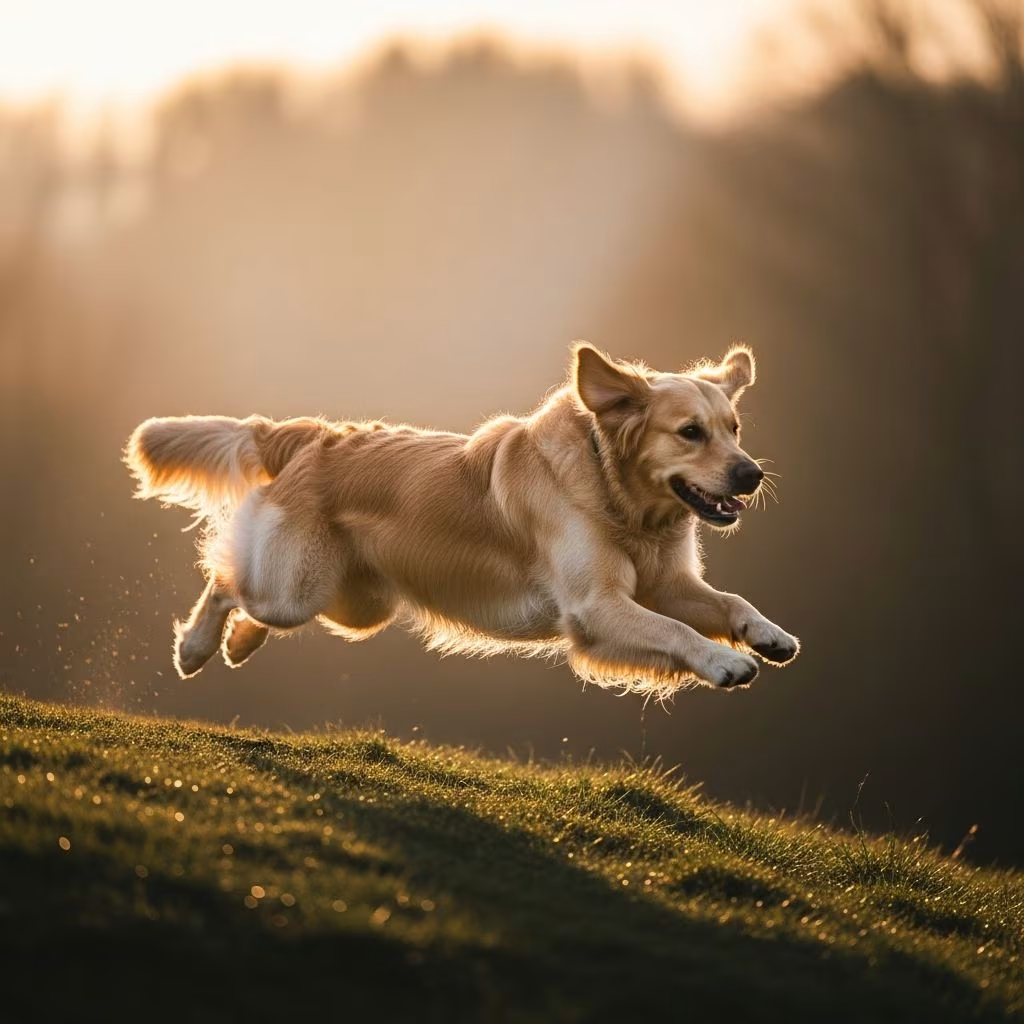
Capturing the essence of your dog through photography transforms everyday moments into timeless memories. Professional-quality dog photos highlight their unique personality, expressive eyes, and dynamic energy without requiring expensive gear. This guide draws from established photography principles to equip you with actionable strategies for composition, technical settings, lighting control, and behavioral handling.
Building Strong Foundations in Composition
Effective composition directs the viewer’s eye to your dog’s most captivating features. Start by considering the environment as a storytelling element that complements rather than overwhelms your subject.
- Position your dog using the rule of thirds: Imagine a grid dividing the frame into nine equal parts and place key elements like the eyes at intersections for balanced, engaging shots.
- Incorporate leading lines, such as paths or fences, to guide attention naturally toward your dog’s face.
- Frame with natural surroundings: A park bench or window can add context, revealing your dog’s adventurous spirit or cozy home life.
For indoor sessions, use household items like blankets or toys to create intimate setups that reflect your dog’s comfort zone. These choices ensure photos feel personal and authentic.
Perfecting Focus on Expressive Eyes
The eyes are the soul of any dog portrait, conveying emotion and forging an instant connection with viewers. Achieving razor-sharp focus here is non-negotiable.
Modern cameras and smartphones often feature eye-detection autofocus, which locks onto pupils automatically. For manual control, select a single-point autofocus mode and position it precisely over the nearest eye. This technique prevents distractions from pulling focus elsewhere.
| Focus Challenge | Solution | Benefit |
|---|---|---|
| Fast-moving dog | AI Servo or continuous tracking mode | Maintains sharpness as subject moves |
| Low light | Small focus area on eye | Precise lock-in despite dim conditions |
| Shallow depth of field | Wide aperture (f/1.8-f/2.8) | Isolates eyes with creamy blur |
Practice by half-pressing the shutter to engage tracking, then fully press to capture. This yields compelling images where the gaze draws viewers in emotionally.
Essential Camera Settings for Sharp Action Shots
Dogs rarely pose still, so prioritize settings that freeze motion while maintaining image quality. Aim for shutter speeds of 1/1000 to 1/2000 second to halt even bounding leaps.
Aperture choice balances depth of field and light intake. Lower settings like f/1.8 create bokeh effects, blurring distractions and spotlighting your dog, but demand precise focusing. Beginners may prefer f/4-f/5.6 for more forgiving sharpness across the frame.
- Shutter Priority Mode: Set minimum 1/400 sec for subtle movements; crank to 1/2000 for full runs.
- ISO Management: Keep under 3200 outdoors to avoid noise; boost indoors with good light.
- Burst Mode: Fire continuous shots to select the peak moment from a sequence.
Experiment in various conditions: Outdoor natural light allows lower ISOs, while indoors may require adjustments.
Harnessing Light for Flattering Portraits
Lighting defines texture, mood, and detail in dog photos. Soft, diffused natural light produces the most appealing results, avoiding harsh shadows or shiny coats.
Position the sun or primary light source behind you for even illumination. Golden hour—shortly after sunrise or before sunset—delivers warm, flattering tones. For overcast days, embrace the soft diffusion that minimizes contrasts.
Challenges with dark-coated dogs demand extra care. Direct sunlight often silvers black fur unflatteringly; instead, seek shade and supplement with fill flash positioned off-camera or just behind for subtle lift. Continuous lights prevent startling flashes, maintaining calm.
Quick Fix for Dark Dogs: Lower flash power, raise ISO, or edit shadows post-capture to reveal hidden details.
Adapting to Your Dog’s Perspective
Shooting from above imposes a dominant angle that diminishes your dog’s stature. Drop to their level—or lower—to enter their world and amplify presence.
- Lie on the ground for knee-level views, filling the frame with majesty and expansive backgrounds.
- Avoid chopping off legs; ensure space around for ‘breathing room,’ especially when dogs look aside.
- This low vantage enhances environmental context, like vast fields or urban adventures.
Result: Supersized, heroic portraits that celebrate your dog’s scale and personality.
Behavior Management for Natural Poses
Cooperation hinges on patience and positive vibes. Let your dog approach at their pace, avoiding pressure that tenses them up.
High-value treats (cheese, hot dogs) redirect attention skyward for alert expressions. Toss gently to capture mid-air joy, timing throws to match your dog’s speed. Squeaky toys or play prompts elicit genuine reactions over stiff poses.
- Know routines: Shoot during peak energy or post-nap calm.
- Use verbal cues paired with rewards for reliable responses.
- Take breaks to prevent fatigue-induced disinterest.
Sensitivity to flashes? Switch to continuous LED panels for steady, non-jarring light.
Enhancing Challenging Scenarios
Not every shoot is ideal. For macro details like whiskers or paws, engage portrait mode’s shallow depth for artistic blur. Dirty fur from play adds texture—embrace it, then boost shadows in editing.
Black dog woes? Side lighting with grids narrows beams for coat definition without blowouts. Funky edits like hue shifts can creatively isolate dark subjects.
Post-Production Polish
Raw captures rarely shine alone. Adjust exposure, sharpen eyes, and tweak saturation subtly. Tools like shadow sliders reveal fur details; avoid over-editing to preserve authenticity.
Crop tightly to rule-of-thirds alignments, straightening horizons for polish.
Common Pitfalls and Fixes
| Pitfall | Fix |
|---|---|
| Centered, static subject | Off-center placement with negative space |
| Blurry motion | 1/1000+ shutter, burst shooting |
| Harsh highlights | Backlit soft light, diffusers |
| Lifeless eyes | Treat toss, eye-level focus |
FAQs
What shutter speed for active dogs?
Minimum 1/400 sec; 1/1000-1/2000 for runs.
Best lens for creamy bokeh?
85-200mm with f/1.2-f/2.8 apertures.
How to light black dogs?
Shade + fill flash; avoid direct sun.
Phone vs. DSLR for pets?
Phones excel with eye AF; DSLRs offer manual control.
Ideal time for outdoor shoots?
Golden hour for soft, warm light.
References
- Pet photography tips: 5 steps to amazing pet photos — Derek Nielsen. 2023. https://www.dereknielsen.com/news/pet-photography-tips-5-steps-to-amazing-pet-photos/
- Taking Better Pet Photos in 2024 — Inspawration Photography. 2024. https://inspawrationphotography.com/taking-better-pet-photos-in-2024/
- Dog Photography Blog, Tips & Tricks — Rhian White Photography. 2023. https://www.rhianwhitephotography.co.uk/blog
- 6 Pro Pet Photography Tips — V-Flat World. 2023. https://vflatworld.com/blogs/behind-the-scenes/6-pro-pet-photography-tips
- Your Guide to Picture-Perfect Pet Photography — ASPCA Pet Insurance. 2024. https://www.aspcapetinsurance.com/resources/how-to-photograph-pets/
- My Camera Settings For Outdoor Pet Photography — Five Freedoms Photography. 2023. https://www.fivefreedomsphotography.com/blog/camera-settings-for-natural-light-pet-photography
- Pet Photography Tips & Posing Tricks — YouTube (Adam Goldberg). 2023. https://www.youtube.com/watch?v=h_IOAkXdf-A



