

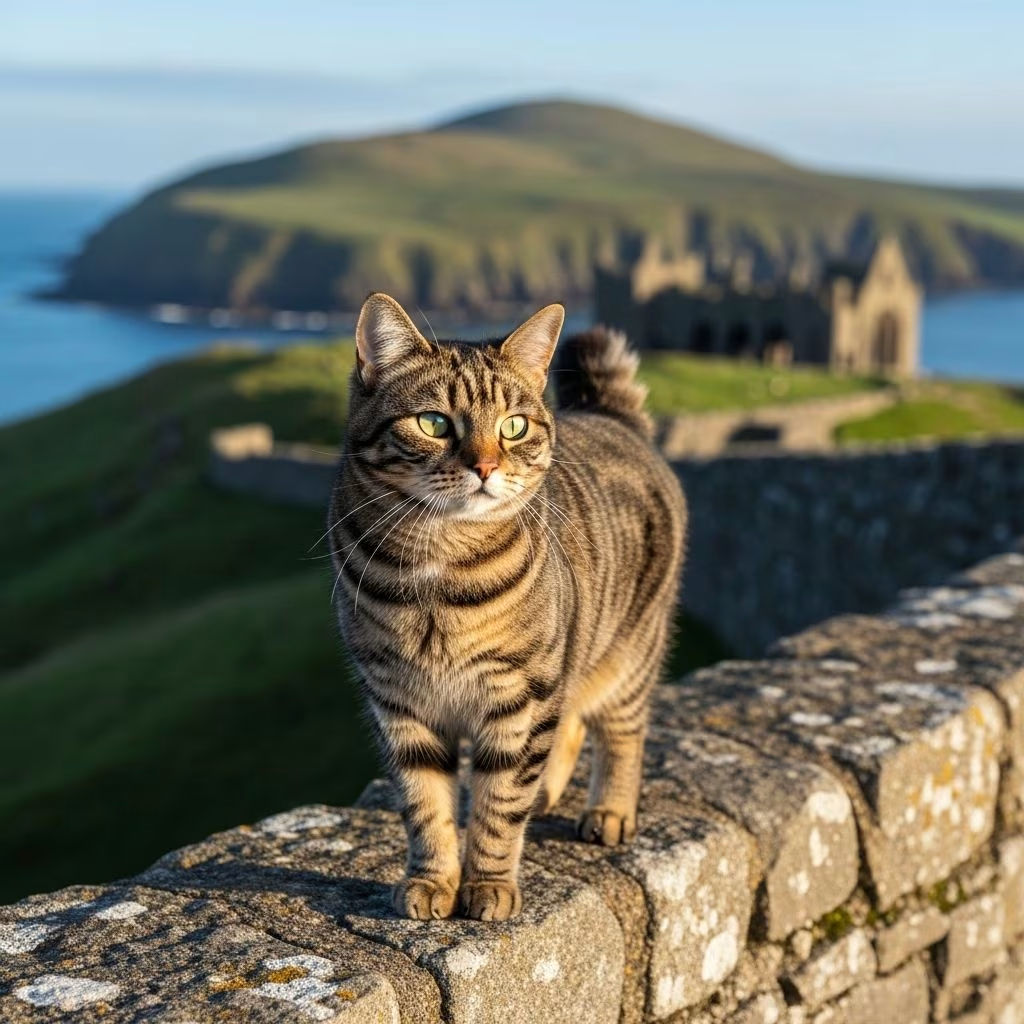
The Manx cat stands as one of the most distinctive and intriguing domestic cat breeds, recognized instantly by its most striking physical characteristic: the absence of a tail. Yet beyond this unusual feature lies a captivating historical narrative spanning centuries, filled with maritime legends, genetic anomalies, and the fascinating story of how island isolation shaped an entirely unique feline population. Understanding the Manx cat requires diving into the complex interplay between natural selection, human breeding practices, and the mythological traditions that have grown around this remarkable breed.
The Geographic Foundation: Isle of Man’s Role in Feline Evolution
Located in the Irish Sea between England and Ireland, the Isle of Man has served as the birthplace and primary breeding ground for the Manx cat breed. The island’s isolated geography created an ideal environment for the development and concentration of specific genetic traits. With a documented history of habitation extending back approximately 11,000 years, the Isle of Man possessed its own indigenous cat population that would undergo significant transformation over centuries.
The earliest cats arriving on the island were likely descended from African wildcats that had been domesticated and spread throughout Europe via ancient trade routes. Greek and Phoenician traders approximately 3,000 years ago introduced domesticated felines to European populations, establishing the foundational stock from which later European cat breeds, including the Manx, would develop. However, the island’s geographic isolation meant that the cats living there would experience reproductive patterns distinctly different from mainland populations.
The Genetic Mystery: Understanding Taillessness
The defining characteristic of the Manx breed—the absence of a tail or presence of only a small stub—originates from a spontaneous genetic mutation. This mutation did not develop through deliberate selective breeding by humans; rather, it arose naturally within the island’s feline population. The mutation manifests as a dominant gene, meaning that even a single copy inherited from one parent can result in tailless or short-tailed offspring.
The prevalence of this trait on the Isle of Man can be attributed directly to the island’s isolated ecosystem and limited genetic diversity. When a spontaneous mutation occurs in a small, isolated population with restricted breeding opportunities—a phenomenon known as the founder effect—that trait can become increasingly common over successive generations. Because island cats had limited access to mainland cats and could only interbreed with other island-based felines, the taillessness gene spread rapidly through the population.
Early in the breed’s development, inbreeding among the island’s cat population likely accelerated this process. With a constrained gene pool and no influx of new genetic material from external sources, the taillessness mutation became established as a defining breed characteristic. This natural process of genetic drift, combined with environmental isolation, created a situation where what began as a rare anomaly became the breed’s most recognizable feature.
Coat Variations: From Short to Long Hair
While taillessness defines the Manx breed, the cats’ coat characteristics tell another story of external influence and genetic blending. The original Manx population on the Isle of Man possessed short hair, similar to other native cat populations across the British Isles. However, the arrival of Norwegian seafarers introduced a new element to the island’s feline genetics.
Norse explorers traveling aboard Viking vessels brought their own cats—likely ancestors of the modern Norwegian Forest Cat—to the Isle of Man, possibly as early as the 8th century. When these long-haired cats interbred with the native tailless population, offspring began appearing with longer coats. This genetic contribution resulted in the modern Manx breed existing in two distinct coat length varieties: shorthaired and longhaired versions, both equally recognized within breed standards.
The interaction between Norwegian and local island cats demonstrates how maritime trade and exploration inadvertently shaped breeding outcomes. Rather than planned selective breeding, the natural intermingling of distinct cat populations created genetic diversity that would eventually become institutionalized in modern breed classifications.
Legendary Origins and Folklore
The true origins of the Manx cat remain partially shrouded in mystery, and this uncertainty has given rise to numerous cultural narratives and legends. The island’s rich folklore tradition embraced the tailless cat as a subject worthy of mythological explanation, generating several competing origin stories.
One prominent legend attributes the Manx’s taillessness to an event during Noah’s Ark—the cat allegedly arrived late to board the vessel, and the closing doors severed its tail in the process. Another narrative suggests that invading forces, either Vikings or Irish soldiers, deliberately mutilated cats’ tails, believing them to possess lucky properties. According to this version, protective mother cats responded by biting off their kittens’ tails to prevent theft.
A maritime-based legend claims that cats from the Spanish Armada swam ashore after their ship sank near Spanish Rock off the island’s coast, establishing the tailless population. Yet another tale describes a solitary tailless cat swimming from a shipwreck to the island, becoming the progenitor of the entire breed.
Despite these colorful narratives, no archaeological or historical evidence supports any of these origin stories. Instead, modern genetic and historical research points to the spontaneous mutation occurring naturally within the island’s isolated cat population as the actual explanation. Nevertheless, these legends persist in cultural memory, reflecting the human inclination to construct meaningful narratives around natural phenomena.
Documentation and Early Recognition
Written documentation of the Manx breed’s existence emerged relatively recently in historical terms. The earliest formal references to tailless cats on the Isle of Man appear in the early 18th century. By the early 1800s, the breed had gained sufficient recognition that painter J.M.W. Turner, a London resident, possessed seven Manx cats that he showed to visiting acquaintances, demonstrating their presence in mainland England by 1810.
The breed’s introduction to organized cat showing occurred during the late Victorian era. The first recorded exhibit of Manx cats at a formal cat show took place at Olympia in 1885. This event marked a transition point, moving the Manx from folk curiosity to recognized show breed. The formalization continued when breeding expert Charles Henry Lane published the first documented breed standard in 1903, establishing criteria by which judges could evaluate breed quality and distinguish genuine Manx specimens from other tailless cat varieties.
The Cat Fanciers’ Association recognized the Manx as an official breed when the organization was founded in 1906, making it one of the earliest breeds to receive such formal recognition. This institutional acknowledgment solidified the breed’s status within the developing framework of organized cat breeding and showing.
Physical Characteristics Beyond the Missing Tail
While the absence of a tail represents the Manx breed’s most famous characteristic, selective breeding and natural development produced several other distinctive physical features. Manx cats developed elongated hind legs, creating a distinctive body posture that some observers noted resembles rabbit-like hopping movements. Combined with their rounded head shape and sturdy build, these features create a recognizable silhouette distinct from other domestic cat breeds.
The breed exhibits a double coat structure in both short and long-haired varieties, providing insulation suited to the maritime climate of their native island. Body proportions and movement patterns became sufficiently distinctive that experienced judges could identify Manx cats among other tailless feline varieties by the early 20th century.
Practical History: Working Cats and Maritime Spread
Beyond their aesthetic uniqueness, Manx cats served practical functions in island and maritime economies. The breed’s hunting prowess made them valuable for pest control on farms and rural properties. Their effectiveness as working cats, combined with their unusual appearance, made them desirable additions to ships’ crews as both functional pest controllers and curiosities worth trading.
The maritime dimension of Manx history accelerated the breed’s geographic expansion. As ships traveled internationally, Manx cats aboard vessels established populations in distant ports. This seafaring exposure introduced the breed to North America, where documented records of Manx cats in breeding programs date to the 1920s. Without deliberate international breeding initiatives, maritime commerce inadvertently distributed the breed globally.
Popularity Timeline and Modern Development
Despite their early Victorian-era prominence in cat shows and their official recognition by major breeding associations in the early 20th century, widespread popularity eluded the Manx breed for many decades. The breed remained relatively uncommon until the 1960s, when interest surged significantly. This delayed popularity suggests that despite their distinctive appearance and show-ring success, Manx cats faced competition from more conventionally appearing breeds.
The modern Manx breed represents a culmination of centuries of natural genetic selection, international maritime distribution, deliberate breeding practices, and cultural mythmaking. Contemporary Manx cats maintain the genetic legacy of their island origins while incorporating selective breeding refinements developed over the past century.
Breeding Variations and Nomenclature
Modern Manx breeding has produced recognized variations distinguished by tail length. The terminology reflects these distinctions, with cats classified as “rumpies” (completely tailless), “stumpies” (with a short tail stub), “longies” (with a nearly normal tail), or intermediate categories. Longhaired Manx cats are sometimes designated as “Cymric,” particularly in certain breeding programs, though breed standard organizations maintain varying classification systems.
Tasman breeding programs, developed in certain regions, have created additional nomenclature variations reflecting coat length and tail characteristics, though these remain expressions of the single Manx breed rather than distinct breeds.
Frequently Asked Questions About Manx Cat History
Where do Manx cats originally come from?
Manx cats originated on the Isle of Man, located in the Irish Sea between England and Ireland. The breed developed there naturally, descended from domesticated cats brought by early traders and explorers.
Why don’t Manx cats have tails?
Manx cats lack tails due to a spontaneous genetic mutation that became prevalent in the island’s isolated cat population. The mutation spread through successive generations because of limited genetic diversity and the dominant nature of the taillessness gene.
Are all the origin stories about Manx cats true?
No, the various legends explaining Manx taillessness—including stories about Noah’s Ark, invading forces, and Spanish shipwrecks—lack historical evidence. These represent cultural folklore rather than documented fact.
When were Manx cats first shown as a breed?
The first recorded exhibit of Manx cats at a formal cat show occurred in 1885 at Olympia in London. The breed standard was formally published in 1903, and the Cat Fanciers’ Association recognized the breed in 1906.
Do all Manx cats come from the Isle of Man?
Modern Manx cats descended from Isle of Man populations, but the breed has been distributed globally through maritime trade and selective breeding programs since the 19th century. However, all Manx cats trace their ancestry to the island population.
How did Manx cats reach North America?
Manx cats spread through maritime commerce and deliberate breeding efforts. Documented breeding records in North America date to the 1920s, indicating the breed had established populations by that period.
Historical Significance and Legacy
The Manx cat’s history illuminates broader themes in animal domestication, genetic development, and human cultural response to biological anomalies. The breed demonstrates how geographic isolation can concentrate unusual traits, how maritime commerce distributed animals globally before modern transportation networks, and how folklore and mythmaking accompany natural phenomena.
Understanding the Manx requires synthesizing scientific explanation with cultural history. The taillessness reflects genetic reality; the legends reflect human creativity. Both dimensions contribute to the breed’s complete story, making the Manx cat historically significant beyond its distinctive appearance.
References
- History of the Manx Cat: Taking a Look at Their Past (Vet-Verified) — Catster. Retrieved from https://www.catster.com/lifestyle/manx-cat-history/
- The Manx Cat — Cat in the Box LLC. Retrieved from https://thecatisinthebox.com/blogs/kitty-contemplations/the-manx-cat
- The history and ‘tails’ of the Manx Breed — Manx Cat Cafe. Retrieved from https://www.manxcatcafe.co.uk/about-manx-cats/
- Manx cat — Wikipedia. Retrieved from https://en.wikipedia.org/wiki/Manx_cat
- Manx — The Governing Council of the Cat Fancy. Retrieved from https://www.gccfcats.org/getting-a-cat/choosing/cat-breeds/manx/
- All about Manx cat breed — Animalia. Retrieved from https://animalia.bio/pets/manx-cat
- Manx — The Cat Fanciers’ Association. Retrieved from https://cfa.org/breed/manx/



