

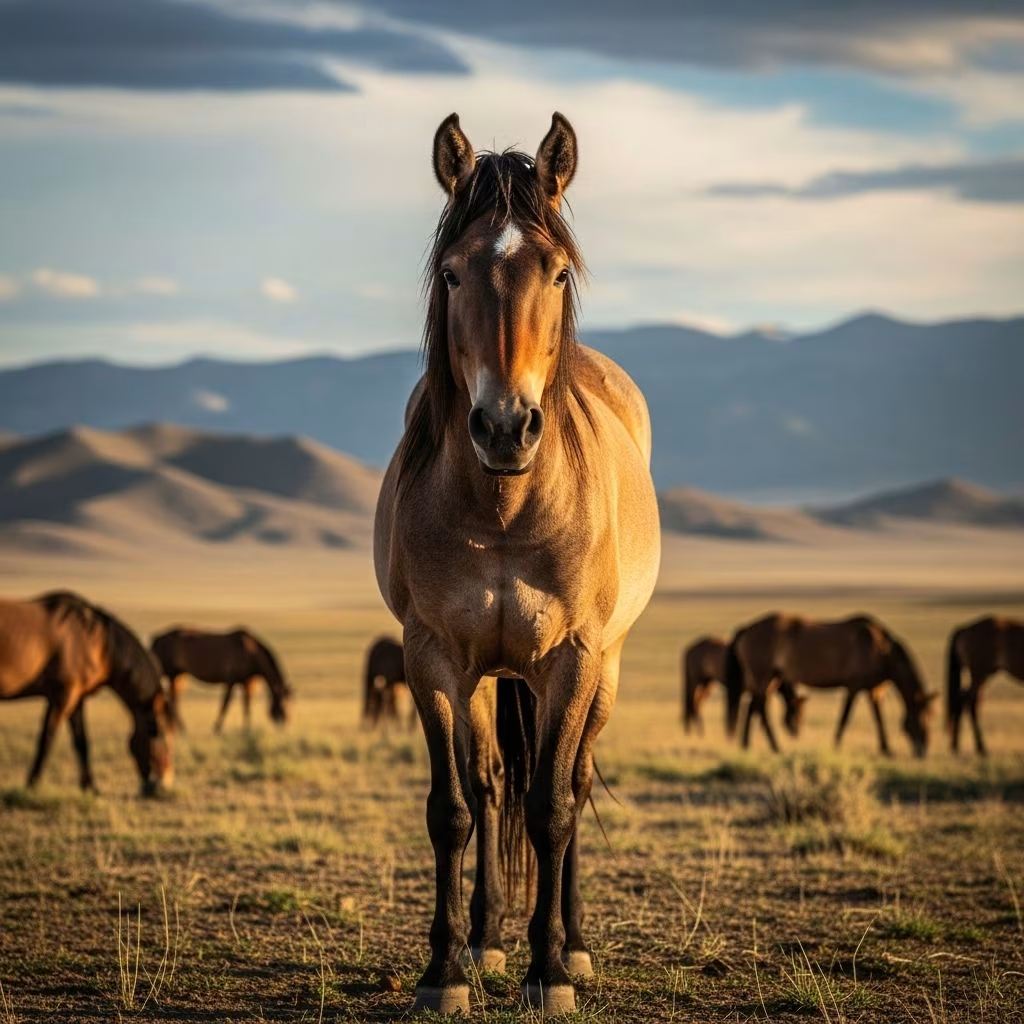
Wild horse populations in the United States face significant challenges due to rapid growth rates that exceed the carrying capacity of public lands. Traditional management approaches like roundups and adoptions have proven costly and controversial. Immunocontraception offers a promising, non-lethal alternative by temporarily suppressing reproduction while allowing horses to maintain natural behaviors.
The Challenge of Overabundant Wild Equid Populations
Free-roaming horses and burros, protected under the 1971 Wild Free-Roaming Horses and Burros Act, inhabit over 177 Herd Management Areas managed primarily by the Bureau of Land Management (BLM). Without intervention, their numbers can double every four to five years, leading to habitat degradation, competition with livestock, and risks of starvation during droughts.
Current strategies include physical removals via helicopter drives or bait traps, which stress animals and incur high costs for holding facilities. Fertility control emerges as a sustainable complement, reducing foal births to stabilize herds at ecologically viable levels, typically 150-200 breeding-age individuals per area.
Why Fertility Control Matters for Ecosystem Health
Balancing horse populations prevents overgrazing, preserves native vegetation, and supports biodiversity. Organizations advocate for slowing growth rather than halting it entirely, preserving family bands essential for social structure. Effective fertility management allows horses to roam freely, reducing the need for repeated gathers estimated at millions annually.
- Ecological Benefits: Stabilizes forage and water resources.
- Humane Advantages: Avoids permanent sterilization’s behavioral disruptions.
- Economic Savings: Lowers long-term holding and removal expenses.
Key Immunocontraceptive Vaccines in Use
Immunocontraceptives stimulate the mare’s immune system to block fertilization or ovulation without hormones, minimizing side effects. Leading options include Porcine Zona Pellucida (PZP) and GonaCon, each with distinct profiles.
| Vaccine | Mechanism | Duration | Efficacy | Delivery |
|---|---|---|---|---|
| PZP (Native or Processed) | Antibodies coat egg’s zona pellucida, preventing sperm binding | 1-2 years (boosters extend) | 85-98% | Dart or hand-injection |
| GonaCon | Induces antibodies against GnRH, suppressing ovulation | 1-4 years with boosters | 85-100% post-booster | Remote dart |
| SpayVac | Enhanced PZP formulation for longer effect | Potentially multi-year | Under evaluation | Dart or injection |
PZP, derived from pig eggs, has been refined into native forms for higher efficacy, achieving 91-98% at sanctuaries like Return to Freedom. GonaCon, studied extensively at Colorado State University, showed initial 50% efficacy rising to near 100% with boosters in free-roaming mares.
Comparing Fertility Control to Other Methods
Alternatives like surgical sterilization (spaying mares or vasectomies) are permanent but invasive, altering behavior and requiring individual captures. Hormone treatments or IUDs face practicality issues in field conditions.
- Permanent Sterilization: Ends reproduction but disrupts bands; high risk during surgery.
- Removals: Effective short-term but expensive; skews sex ratios, potentially increasing aggression.
- No Intervention: Leads to unchecked growth and welfare crises.
Fertility vaccines stand out for reversibility, preserving natural hormone cycles and social dynamics.
Administration Techniques for Field Application
Delivering vaccines to >80% of females is crucial for population decline. Methods balance reach with animal welfare.
Remote Darting
Biodegradable darts fired from air rifles or ground allow treatment without full capture. Ideal for GonaCon in open ranges, though accuracy depends on terrain.
Helicopter or Bait Trap Gathers
For broad coverage, targeted gathers using helicopters or baited traps facilitate hand-injection of PZP. While helicopters stress herds, improvements minimize risks; baiting shows promise in studies.
Sanctuary and Pasture Models
In controlled settings, annual boosters maintain near-100% efficacy, informing range applications.
Effects on Horse Behavior and Health
Unlike sterilants, PZP-treated mares retain estrous cycles, supporting stallion bonding and band stability. GonaCon suppresses cycles longer but without major health impacts in trials. No evidence of foal abnormalities from treated mares exists, affirming safety.
Challenges include booster timing and weather effects on efficacy, addressed via adaptive monitoring.
Real-World Success Stories and Data
At Theodore Roosevelt National Park, GonaCon boosters yielded 85-100% infertility for four years. Return to Freedom’s PZP program stabilized herds at 98% efficacy, enabling natural lifestyles. BLM trials combine vaccines with removals for optimal results.

Research Frontiers and Future Directions
Ongoing trials test SpayVac for extended duration and combination therapies. Adaptive management integrates vaccines, sex-ratio adjustments, and genetic infusions to sustain viable herds. Collaborative efforts between agencies, NGOs, and researchers accelerate scalable solutions.
Frequently Asked Questions
What is the most effective wild horse contraceptive?
PZP variants show 85-98% efficacy, with GonaCon excelling in multi-year suppression post-booster.
Does immunocontraception harm horses?
No significant side effects reported; vaccines are non-hormonal and reversible.
How often must mares be treated?
Annually for standard PZP; boosters extend GonaCon to 4+ years.
Can fertility control replace roundups?
It complements removals for stabilization, reducing future gathers.
Is PZP approved for wild horses?
Yes, via BLM special permits; native PZP enhances safety.
Policy Recommendations for Sustainable Management
Policymakers should prioritize vaccine R&D funding, streamline approvals, and incentivize partnerships. Comprehensive plans targeting high-density areas with 80%+ treatment rates promise balanced rangelands.
References
- Population Management — Return to Freedom. 2023. https://returntofreedom.org/learn/wild-horse-issue/population-management/
- Wild horse and burro management — Humane World for Animals. 2023. https://www.humaneworld.org/en/wild-horse-and-burro-management
- Novel study shows promise for managing wild horse populations — Colorado State University. 2022-10-12. https://cvmbs.source.colostate.edu/novel-study-shows-promise-for-managing-wild-horse-populations/
- Methods and Effects of Fertility Management — National Academies Press. 2013. https://www.nationalacademies.org/read/13511/chapter/6
- Population Control — Wild Horse Education. 2023. https://wildhorseeducation.org/population-control/
- Fertility Control Options for Management of Free-roaming Horse — Utah State University Digital Commons. 2015. https://digitalcommons.usu.edu/hwi/vol16/iss2/5/



