

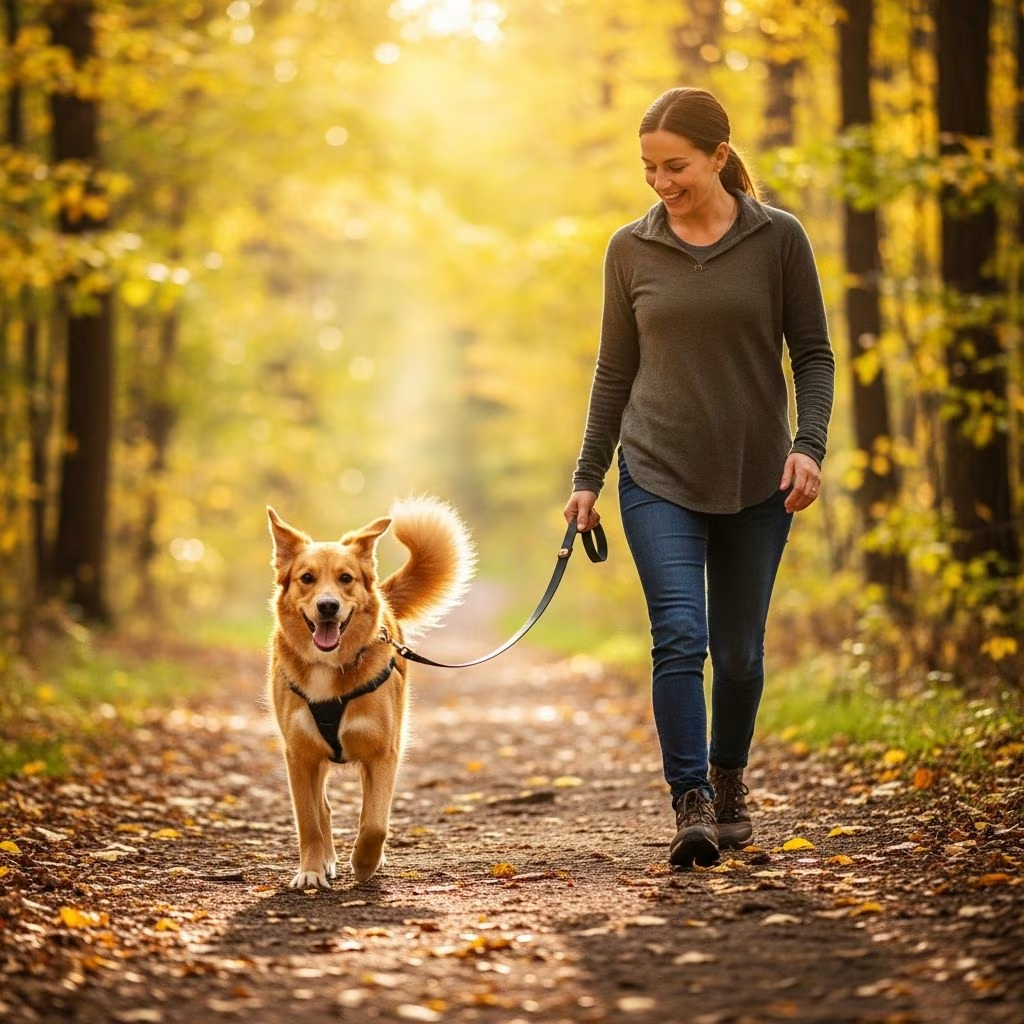
Many dog owners believe that on-lead walks are inherently boring for their dogs, and that only off-lead running can provide genuine enjoyment and exercise. This common misconception often leads owners to feel guilty about keeping their dogs on a leash. However, the reality is far different. On-lead walks can be just as engaging, mentally stimulating, and physically rewarding as off-lead adventures when approached with creativity and the right mindset. By understanding what truly motivates and enriches our dogs, we can transform routine leashed walks into exciting experiences that strengthen our bond while keeping everyone safe.
Can On-Lead Walks Ever Be Exciting for Dogs?
The short answer is an unequivocal yes. The perception that dogs require off-lead freedom to enjoy walks is largely a human construct rather than a canine reality. Many experienced dog owners and behaviorists have discovered that on-lead walks can be profoundly rewarding for dogs when they are structured with the dog’s natural instincts in mind. The key lies in shifting our perspective from viewing the lead as a restriction to seeing it as a tool for shared exploration and connection.
The mindset change required is significant. Instead of measuring success by how far or fast a dog runs, owners should focus on how mentally engaged and satisfied their dog becomes during the walk. Research and practical experience demonstrate that dogs have diverse needs and preferences, and not all dogs thrive on constant running. Some dogs become over-stimulated by excessive off-lead activity, which can actually lead to behavioral issues like nipping, biting, and jumping up rather than a calm, content companion. On-lead walks, when done intentionally, provide structure, safety, and the opportunity for deeper mental enrichment.
The Power of the Sniffari: Unleashing Your Dog’s Natural Instincts
One of the most transformative concepts for on-lead walking is embracing what many call a “sniffari”—essentially a walk focused on following your dog’s nose and allowing them to explore scents at their own pace. This approach directly taps into one of your dog’s most fundamental and rewarding instincts: olfactory exploration. A dog’s sense of smell is estimated to be between 10,000 and 100,000 times more sensitive than humans, making scent exploration an incredibly rich and satisfying experience for them.
The statistics are compelling. Approximately 20 minutes of focused sniffing can provide your dog with as much mental stimulation and physical exhaustion as 90 minutes of running around. This means that even a short walk can be completely satisfying for your dog if they’re allowed to follow their nose. During a sniffari, if your dog wants to spend five minutes investigating a lamppost, let them. If they want to explore one small patch of grass for half the walk, allow it. This behavior isn’t random; your dog is reading a complex olfactory landscape, identifying which other dogs have passed by recently, and learning about their neighborhood in ways we cannot fully comprehend.
The beauty of sniffing-focused walks is that they require no special equipment or advanced training. Simply adjust your pace to your dog’s preferences and allow them to dictate the route based on interesting scents. This approach works particularly well during evening walks when scent markers are fresher and your dog’s natural investigative instincts are heightened.
Varying Routes and Environments for Fresh Experiences
Dogs, like humans, appreciate novelty. Walking the same route every day can become monotonous, even with sniffing opportunities. Varying your walking routes introduces new scents, sights, and challenges that keep your dog’s mind engaged and curious. Different environments offer different sensory experiences and mental stimulation.
Consider implementing these strategies for varied walks:
- Urban exploration: Different streets and neighborhoods offer new scent profiles and environmental stimuli
- Natural settings: Parks, woodlands, and gardens provide varied terrain and wildlife scents
- Time-based variation: Walking at different times of day exposes your dog to different scent layers and activity levels
- Seasonal changes: The same route offers dramatically different olfactory experiences across seasons
- Weather variations: Walking in different weather conditions provides unique sensory input
By rotating between different locations and times, you ensure that each walk presents novel challenges and experiences. This variety keeps your dog mentally alert and engaged, preventing the boredom that repetition can create.
Interactive Games and Training During Leashed Walks
On-lead walks offer excellent opportunities to incorporate training games and interactive activities that strengthen your bond while providing mental stimulation. These activities transform a simple walk into an engaging partnership where your dog is actively thinking and responding to you.
Effective games for leashed walks include:
- Engaging check-ins: Frequently reward your dog for making eye contact or checking in with you without being prompted
- Direction changes: Randomly change direction and reward your dog for staying engaged and following
- Sit-and-observe: Stop periodically to sit with your dog and watch the world go by together
- Recall practice: Use the lead as a safety net while practicing recall skills in controlled environments
- Scent games: Hide treats along your walking route for your dog to discover
- Obstacle navigation: Guide your dog through different obstacles and terrain variations
These interactive elements serve multiple purposes: they provide mental stimulation, strengthen your communication with your dog, build trust, and make the walk feel like quality time together rather than a chore. The lead becomes a communication tool rather than a restriction, allowing you to guide, reward, and support your dog throughout the experience.
Adjusting Speed and Intensity for Your Dog’s Needs
Not all dogs have the same energy levels or physical capabilities. A responsible approach to on-lead walking considers your individual dog’s age, fitness level, breed characteristics, and personality. What works for a young Border Collie may be completely inappropriate for a senior Bulldog or a small breed dog.
Consider these factors when planning walks:
- Age: Puppies and senior dogs have different requirements and limitations
- Breed characteristics: Some breeds are naturally less energetic and more content with shorter, slower-paced walks
- Individual personality: Some dogs are naturally more excitable while others are calm by temperament
- Health status: Any physical limitations or health concerns should influence walk planning
- Weather conditions: Extreme heat, cold, or wet conditions may require adjusted expectations
The key principle is matching the walk to your dog rather than forcing your dog to match a predetermined walking plan. A well-matched walk leaves your dog satisfied and relaxed, not frustrated or exhausted.
Using Long Lines for Extended Exploration
For dogs who benefit from more distance while still maintaining safety and control, long lines offer an excellent compromise between on-lead and off-lead walking. A long line, typically ranging from 15 to 30 feet, allows your dog significantly more freedom while keeping them under your control.
Long lines are particularly valuable for:
- Dogs with inconsistent recall in the presence of distractions
- Dogs with high prey drive who might chase small animals
- Dogs in training who are learning to respond at greater distances
- Dogs who need freedom but in controlled environments
- Building gradually toward off-lead reliability
When using a long line, watch for signs that your dog’s attention and communication breaks down at specific distances. If your dog is ignoring you or not responding reliably at 20 feet, reduce the working distance back to 15 feet where communication remains strong. Gradually extend distance over time as your dog becomes more reliable. Always reward generously when your dog chooses to return to you, making the return a positive choice rather than a forced action.
Environmental Enrichment and Mental Stimulation
The most underutilized aspect of on-lead walks is their potential for environmental enrichment. Mental stimulation often matters more than physical exercise in determining whether a dog feels satisfied after a walk. A dog who has spent 30 minutes solving problems, exploring scents, and engaging mentally may be more satisfied than one who has run for an hour.
Ways to build mental enrichment into walks include:
- Puzzle walks: Create mental challenges by pointing out specific objects for your dog to investigate
- Scent tracking: Let your dog follow specific scent trails or marked routes
- Environmental exploration: Allow time for detailed investigation of interesting areas
- Social observation: Stop periodically and allow your dog to observe other dogs and people from a safe distance
- Sensory variety: Expose your dog to different textures, sounds, and environmental conditions
Building a Stronger Bond Through On-Lead Walking
On-lead walks provide unique opportunities to deepen your relationship with your dog. When a dog is on-lead, they are directly connected to you, and this physical connection can translate into emotional bonding. The lead becomes a way to be present with your dog, to support them through challenging situations, and to communicate your partnership.
Walking on-lead creates moments of true connection that off-lead walking sometimes lacks. When your dog is nearby exploring independently, there’s less active interaction. On-lead, you’re constantly communicating through the lead, your body language, and your presence. This ongoing engagement builds trust and strengthens your bond in meaningful ways.
Safety Considerations and Lead Etiquette
Beyond enrichment, on-lead walks offer significant safety advantages. A dog on-lead cannot chase wildlife unpredictably, cannot run into traffic, and cannot engage in unwanted interactions with other dogs or people. For dogs with reactive tendencies, high prey drive, or recall challenges, on-lead walking is the humane and responsible choice.
Practicing good lead etiquette also contributes to pleasant experiences for everyone: when you see other on-lead dogs, recall your dog and put them on lead as you pass. Give wide berth to dogs that are being trained or whose owners are clearly managing a challenging situation. Remember that just because your dog is friendly doesn’t mean every dog they encounter is comfortable with that friendliness.
Frequently Asked Questions
Q: How long should an on-lead walk be to properly exercise my dog?
A: Duration varies by individual dog, but 20-30 minutes of engaged sniffing or interactive walking can provide equivalent stimulation to much longer off-lead sessions. Quality matters more than quantity; a mentally engaged dog tires faster than one simply wandering.
Q: Can on-lead walks provide enough exercise for high-energy dogs?
A: For exceptionally high-energy dogs, supplement on-lead walks with activities like Canicross (running with dogs), Bikejoring (off-road cycling with dogs), or mantrailing (scent trail work) to appropriately match their exercise exertion. These activities build bonds while meeting intense energy needs.
Q: My dog pulls constantly on the lead. How can I make walks enjoyable?
A: Consider using a longer lead that reduces pulling tension. Dogs who pull on six-foot leads often don’t pull on eight, ten, or longer leashes. Additionally, focus on rewarding engagement with you rather than punishing pulling behavior.
Q: Is there a difference between sniffing walks and regular walks?
A: Yes. Regular walks often prioritize forward movement and distance, while sniffing walks prioritize your dog’s olfactory exploration. Allowing your dog to dictate the pace and route creates a fundamentally different, often more rewarding experience.
Q: How do I transition my dog from off-lead to on-lead walks?
A: Introduce on-lead walks gradually alongside off-lead time. Make on-lead walks rewarding through treats, games, and sniffing opportunities. Many dogs adapt quickly when they realize on-lead walks offer their own unique rewards.
References
- Leadership and Path Characteristics During Walks Are Linked to Dominance Order and Individual Traits in Dogs — National Center for Biotechnology Information (NCBI). 2013. https://pmc.ncbi.nlm.nih.gov/articles/PMC3900374/
- Why Keeping Your Dog On The Lead Isn’t ‘Bad Pet Parenting’ — Kinship. https://www.kinship.com/uk/dog-behaviour/dog-lead-walking-benefits
- How to Make On-Lead Dog Walks More Exciting — Kinship. https://www.kinship.com/uk/dog-behaviour/how-to-make-on-lead-dog-walks-more-exciting



