Premier Birding Destination in Arizona’s Santa Rita Mountains
Discover why over 250 bird species call this scenic canyon home
Exploring Madera Canyon: Arizona’s Premier Avian Sanctuary
Nestled within the sprawling Santa Rita Mountains of southeastern Arizona, Madera Canyon stands as one of the most significant birding destinations in the entire United States. This deep, densely wooded canyon, situated on the north slope of the Santa Ritas and managed as part of the Coronado National Forest, attracts bird enthusiasts from around the globe. With more than 250 documented bird species recorded throughout the region, the canyon represents an extraordinary concentration of avian diversity that rivals few other locations across North America.
Understanding the Canyon’s Unique Geographic and Ecological Position
The canyon’s prominence as a birding hotspot stems largely from its remarkable elevation gradient and the resulting diversity of ecological zones. Beginning at lower elevations with desert grassland habitats, the canyon transitions progressively through multiple distinct plant communities. As elevation increases, visitors encounter Arizona Sycamores and Fremont Cottonwoods around 4,500 feet, followed by Alligator Junipers mixed with various oak species at mid-elevation zones. At higher elevations, maples, box elders, and coniferous forests create rich woodland environments that support specialized bird communities.
This vertical stratification creates what ecologists recognize as an “avian utopia.” The combination of year-round water sources, including active springs and a seasonal creek running through the canyon bottom, provides essential resources that concentrate bird populations. The proximity to Tucson, situated approximately 50 miles to the south, further enhances the canyon’s accessibility for both casual visitors and serious birders conducting research or pursuing personal sightings.
Seasonal Patterns and Prime Viewing Periods
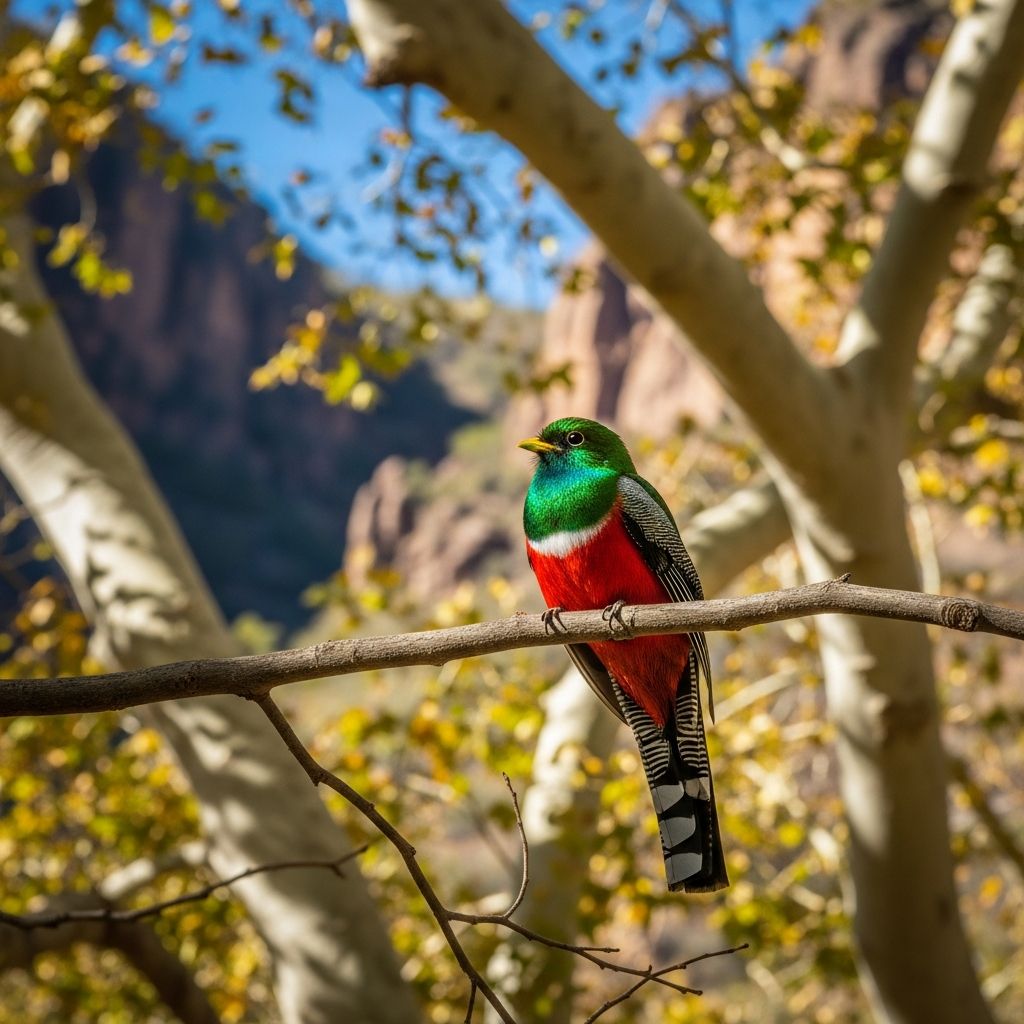
The birding experience in Madera Canyon varies considerably across different seasons, with each period offering distinct advantages for observers. Spring represents the most celebrated season, particularly May, when migratory species return and breeding activity reaches its peak. This period brings the spectacular Elegant Trogon, arguably the canyon’s most famous resident and a species that draws international visitors specifically seeking this iconic sighting.
Summer months continue the abundance, with hummingbird activity reaching remarkable levels as breeding populations establish territories. Fall migration brings additional diversity as species move southward, while winter supports a stable population of year-round residents adapted to the canyon’s seasonal climate variations. The canyon remains accessible throughout the year, operating 24 hours daily with relatively minimal disruption to wildlife.
Signature Species and Specialty Sightings
Certain bird species have achieved legendary status among the Madera Canyon birding community, drawing visitors with specific objectives. The Elegant Trogon, with its iridescent plumage and characteristic behaviors, remains the most celebrated species. This tropical resident typically appears during spring and early summer months and demonstrates relatively little wariness around parking areas and trailheads, making it accessible to photographers and casual observers alike.
Beyond the trogon, several additional specialty species define the birding experience:
- Red-faced Warbler – A striking summer resident with distinctive facial patterning and forest canopy preference
- Painted Redstart – An acrobatic insectivore known for dramatic aerial displays and striking coloration
- Bridled Titmouse – A charismatic resident of oak-juniper woodlands with distinctive vocalizations
- Gray Hawk – A rare raptor species that has expanded its range northward in recent decades
- Sulphur-bellied Flycatcher – A tropical migrant that breeds in the canyon’s riparian corridors
- Elf Owl – A diminutive nocturnal resident that inhabits sycamore cavities along the creek
The canyon also supports exceptional hummingbird diversity, with the Santa Rita Lodge area serving as a concentrated viewing location for up to 15 different species. Broad-billed, Anna’s, Black-chinned, Rufous, Broad-tailed, and Magnificent Hummingbirds represent only a portion of the nectar-feeding species attracted to strategically positioned feeders.
Mid-Elevation Habitats and Common Species Assemblages
The central portions of the canyon, including the Madera Picnic Area, Santa Rita Lodge, and Bog Springs Campground at approximately 5,000 feet elevation, represent the most intensively birded zones. The oak-juniper woodland composition at these elevations supports predictable communities of year-round residents and seasonal visitors.
Among the most frequently encountered species at mid-elevations are White-winged Doves, Mexican Jays, House Finches, Lesser Goldfinches, and Acorn Woodpeckers. The Mexican Jay, in particular, serves as a regional equivalent to California’s Scrub Jay, providing familiar yet distinctly regional birding experiences. White-winged Doves, while superficially similar to Mourning Doves, exhibit different behavioral and ecological preferences, occupying specific habitat niches within the canyon system.
Additional notable species frequently observed at mid-elevations include Ladder-backed Woodpeckers, Phainopeplas, Black-headed Grosbeaks, and Canyon Towhees. Year-round residents such as Common Ravens exhibit particularly vocal and visually conspicuous behaviors, while Turkey Vultures appear seasonally during summer months, employing characteristic V-shaped wing postures during their soaring flights above the canyon.
Riparian Corridor Excellence and Lower Canyon Opportunities
The creek-side trail system following Madera Creek provides exceptional opportunities for observing species dependent upon riparian vegetation and aquatic resources. These productive zones, bordered by stately Arizona Sycamores with their distinctive white bark, create concentrated feeding and nesting habitat for numerous species.
The lower canyon sections, characterized by mesquite woodland and transitional desert scrub, introduce additional species not readily encountered at higher elevations. This ecotonal habitat—the transition zone between distinct ecological communities—often produces unexpected sightings and vagrant species records, adding an element of unpredictability and excitement to lower canyon explorations.
Strategic Visitor Amenities and Observation Infrastructure
The Santa Rita Lodge represents the most developed birding observation facility within the canyon, offering strategically positioned feeders and comfortable viewing areas. Multiple feeder stations dispense different food resources: nectar supplies for hummingbirds, seeds for finches and grosbeaks, and suet or peanut butter for woodpeckers and nuthatches. The lodge’s shaded seating areas provide comfortable observation platforms, while the on-site gift shop and refreshment options extend visitor comfort during extended stays.
Beyond the lodge, several additional infrastructure elements support birding activities. The Proctor Trailhead offers a well-maintained entry point with accessible parking and restroom facilities. The Madera Canyon Picnic Area provides day-use infrastructure, while the Old Baldy Trailhead serves hikers combining birding with more ambitious trekking objectives. Bog Springs Campground and additional camping facilities enable multi-day visits for comprehensive canyon exploration.
Visitor Access and Operational Considerations
Madera Canyon maintains accessibility throughout the year, operating continuously on a 24-hour basis. A modest day-use fee of $8 provides funding for ongoing maintenance and resource management. Camping facilities operate on a first-come, first-served basis at no charge, making extended visits economically accessible to budget-conscious birders.
Multiple access routes serve the canyon, with approaches available via Interstate 19 near Green Valley and via Highway 83 through the scenic Greaterville Road option. The Greaterville route, stretching approximately 11 miles over unpaved roads, offers its own birding opportunities and scenic vistas despite requiring additional travel time.
Professional Guidance and Specialized Services
For visitors seeking enhanced experiences or targeting particular species, professional birding guides provide expertise cultivated through years of field experience. Local guides possess intimate knowledge of seasonal distributions, behavior patterns, optimal viewing times, and current sighting information that maximizes encounter probabilities. Customized tours accommodate various experience levels, from introductory birding to specialized objectives focused on particular species or comprehensive canyon surveys.
Planning Your Madera Canyon Birding Adventure
Optimal timing: Spring (March-May) offers peak diversity and activity levels, with May particularly productive for specialty species. Summer provides excellent hummingbird viewing, while fall migration delivers additional diversity. Winter presents quieter conditions suitable for concentrated observation.
Physical preparation: The canyon’s elevation range and varied terrain require appropriate footwear and conditioning levels. Multiple difficulty options accommodate various fitness levels, from leisurely creek-side walks to challenging ridgeline hikes.
Equipment essentials: Binoculars, field guides, camera equipment, water supplies, and sun protection prove essential. The canyon’s exposure and elevation create intense sunlight and rapid temperature changes requiring appropriate clothing layers.
Logistical planning: Multi-day visits enable comprehensive coverage of diverse habitats. Day visits focus strategically on specific elevations or trail systems based on target species and seasonal expectations.
Frequently Asked Questions
When is the best time to see the Elegant Trogon?
The Elegant Trogon typically appears in May through early July, with peak activity in May. These birds often remain relatively approachable near parking areas and trailheads, though early morning hours generally provide optimal viewing opportunities.
How many species can I reasonably expect to observe during a single visit?
A single day visit may yield 15-25 species depending on season, specific habitats visited, observer experience, and weather conditions. Multi-day visits exploring various elevations and habitats often produce 40-60 species.
What is the entrance fee and camping cost?
A $8 day-use fee applies to vehicle entry. Camping facilities operate free on a first-come, first-served basis, with no advance reservations required.
Are guided tours available for beginning birders?
Professional guides regularly conduct tours accommodating all experience levels. Services range from single-day outings to comprehensive multi-day experiences, with customization available based on specific interests and objectives.
What should I bring for a full day of canyon birding?
Essential items include binoculars, field guides, water bottles, sun protection (hat and sunscreen), appropriate footwear, weather-appropriate clothing layers, and camera equipment if desired. A small daypack accommodates these items comfortably.
References
- Madera Canyon – Arizona Birding Trail — Arizona Birding Trail. Accessed January 2026. https://arizonabirdingtrail.com/site/madera-canyon/
- The Santa Rita Mountains and Santa Cruz County — Southeastern Arizona Bird Observatory. Accessed January 2026. https://sabo.org/birding-guide/birding-hotspots/the-santa-rita-mountains-and-santa-cruz-county/
- Madera Canyon — Coronado National Forest. U.S. Department of Agriculture Forest Service. Accessed January 2026. https://www.fs.usda.gov/recarea/coronado/recreation/scenicdrivinginfo/recarea/?recid=25666&actid=105
- Proctor Trail Birds — Friends of Madera Canyon. 2024. https://friendsofmaderacanyon.org/
- Birds & Wildlife — Santa Rita Lodge in Madera Canyon, AZ. Accessed January 2026. https://www.santaritalodge.com/things-to-do/birding-and-wildlife.html
- Birding in Southeastern Arizona: Madera Canyon — Natural History Journal. June 2019. http://natural-history-journal.blogspot.com/2019/06/birding-in-southeastern-arizonia-madera.html
Similar Articles








Read full bio of medha deb