
Liver Fluke Disease in Ruminants: Pathology and Management
Understanding Fasciola hepatica infection, transmission, and treatment strategies in livestock.
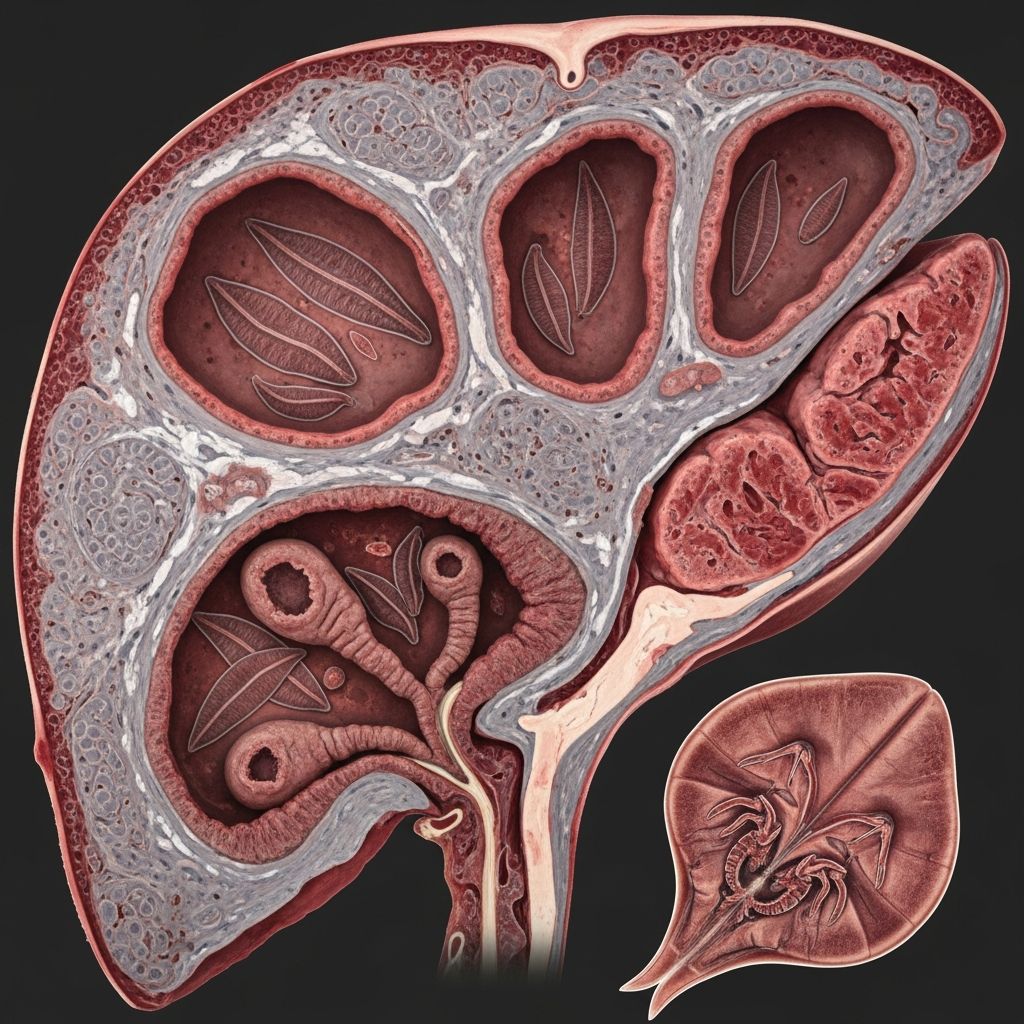
Liver fluke disease, scientifically termed fascioliasis or hepatic fasciolosis, represents one of the most economically significant parasitic infections affecting cattle, sheep, and other ruminant livestock worldwide. This condition is caused by the trematode parasite Fasciola hepatica, commonly known as the common liver fluke or sheep liver fluke. Understanding the biological characteristics, transmission dynamics, and clinical manifestations of this infection is essential for veterinarians and livestock producers managing grazing animals.
The Parasitic Agent: Morphological Characteristics
Fasciola hepatica belongs to the class of flatworms known as trematodes and exhibits distinctive physical features that facilitate its identification in diagnostic examinations. Adult flukes are large, broadly flattened organisms measuring approximately 30 millimeters in length and 15 millimeters in width. The anterior extremity displays a characteristic cone-shaped appearance, distinguishing it from other parasitic flukes encountered in veterinary parasitology.
The tegumental surface of the parasite is noteworthy for its coverage with sharp, cutaneous spines that serve both protective and pathogenic functions. These microscopic projections enable the parasite to anchor itself within the host’s bile ducts and contribute to mechanical damage of tissue during infection. The internal anatomy of F. hepatica includes well-developed oral and ventral suckers, complex alimentary systems, and elaborate reproductive organs that enable the parasite to persist within the definitive host for extended periods.
Epidemiology and Host Range in Livestock
Fasciola hepatica demonstrates a broad host range among ruminants, with cattle and sheep serving as the primary definitive hosts. Goats and various wild ruminant species, including camelids, cervids, and buffalo, can also sustain mature infections. The parasite occasionally establishes infections in aberrant host species such as equines, rabbits, kangaroos, and rodents, though these infections typically do not reach full pathogenic potential.
The geographic distribution of liver fluke infections extends across more than 70 countries globally, with prevalence varying according to climatic conditions and ecological factors that support intermediate host populations. The parasite exhibits particular affinity for wetland environments and regions with adequate moisture to support populations of the snail intermediate hosts essential for completion of its life cycle.
Developmental Biology and Life Cycle Progression
The life cycle of F. hepatica follows a complex indirect pattern involving both aquatic snail intermediate hosts and terrestrial or semi-aquatic grazing animals as definitive hosts. Adult hermaphroditic flukes reside permanently within the bile ducts and biliary system of infected ruminants, where they maintain reproductive activity and produce substantial quantities of eggs.
Egg Development and Release: Adult flukes discharge immature eggs directly into the biliary system, from which they are conveyed through the hepatic ducts to the intestinal lumen and subsequently eliminated in the host’s feces. These eggs require approximately two weeks for embryonation in aquatic or semi-aquatic environments, during which time a motile miracidial larva develops within each egg. Upon completion of embryonic development, the miracidium hatches and actively seeks suitable snail intermediate hosts, most commonly species belonging to the genus Lymnaea.
Intramolluscan Development: Following penetration of the susceptible snail host, the miracidium undergoes a series of asexual developmental stages within the snail’s tissues. These stages include sporocyst formation, redia development, and ultimately the production of free-swimming cercariae. The intramolluscan developmental period typically spans several weeks, dependent upon environmental temperature and snail species compatibility. The cercariae eventually emerge from the infected snail and encyst on aquatic vegetation as metacercariae, the infective stage for definitive hosts.
Transmission and Infection in Livestock: Ruminants acquire infections through ingestion of herbage contaminated with metacercariae, typically during grazing in pastures with snail populations. Metacercariae survive on vegetation and retain infectivity for extended periods under appropriate environmental conditions. Upon ingestion, metacercariae excyst in the duodenal segment of the small intestine, whereupon the juvenile flukes penetrate the intestinal mucosa and traverse the peritoneal cavity en route to the liver.
The prepatent period—the interval between initial infection and detection of eggs in feces—typically extends 8 to 12 weeks, though delays in fluke development can extend this period to 3 months or longer. The complete life cycle requires approximately 17 weeks under optimal conditions. An important distinction exists between cattle and sheep regarding fluke longevity: adult flukes persist in sheep bile ducts for years, whereas cattle typically shed infections within 5 to 6 months, indicating species-specific differences in parasitic establishment.
Pathogenesis: Tissue Damage and Clinical Disease Mechanisms
The pathological manifestations of liver fluke infection evolve dynamically as the parasites progress through different developmental stages within the host. Disease severity correlates directly with the number of metacercariae ingested, the developmental stage of migrating flukes, and the susceptibility of the specific host species.
Acute Phase Pathology
The acute phase of fasciolosis, spanning approximately 3 to 4 months from infection onset, represents the most destructive period of parasitic development. During this migratory phase, immature flukes actively burrow through hepatic parenchyma, creating tunneling tracts and causing hemorrhagic necrosis of liver tissue. This destructive migration damages hepatocytes, disrupts vascular structures, and compromises hepatic perfusion.
Grossly, acutely affected livers demonstrate enlargement, friability of tissue consistency, fibrinous deposits on the hepatic capsule surface, and an irregular, mottled appearance reflecting extensive hemorrhage and necrosis. Migratory tracts visible on the liver surface or within the parenchyma provide direct evidence of fluke penetration and migration. These pathological changes result in acute hepatic inflammation, impaired synthetic function, and substantial blood loss, manifesting clinically as acute fascioliasis with potential mortality in heavily infected hosts.
Chronic Phase Pathology
As surviving flukes mature and establish residence within the bile ducts, the disease transitions to a chronic phase characterized by persistent inflammation and progressive hepatic degeneration. The spiny tegumental surface of mature flukes continuously traumatizes the biliary mucosa, causing ulceration, bleeding, and secondary infection. Chronic blood loss from damaged bile ducts leads to anemia, while inflammatory responses to parasitic antigens and tissue injury promote progressive fibrosis.
Chronically infected livers exhibit cystic dilatation of bile ducts, marked wall thickening, fibrotic infiltration of surrounding hepatic tissue, and varying degrees of cirrhotic changes. These anatomical alterations compromise bile flow and hepatic perfusion, ultimately interfering with synthetic and metabolic functions of the liver. The chronic inflammatory milieu predisposes to secondary bacterial infections of damaged biliary epithelium.
Clinical Expression and Host-Specific Manifestations
The clinical presentation of fasciolosis varies considerably between cattle and sheep, reflecting differences in innate susceptibility and parasitic burden tolerance. In cattle, disease manifestations are predominantly associated with chronic infections established by adult flukes within the biliary system, where they cause progressive hepatic inflammation and functional impairment. Cattle demonstrate greater tolerance to fluke infection compared to sheep, though chronic infections still result in production losses, reduced growth rates, and impaired milk yields in dairy cattle.
In sheep, acute fasciolosis caused by migrating immature flukes represents the primary clinical concern and may result in substantial morbidity and mortality, particularly in heavily contaminated pasture environments. Young sheep are especially susceptible to acute fluke disease complications. Additionally, fluke infections in sheep are sometimes complicated by concurrent bacterial infections such as Clostridium species, which can exacerbate disease severity.
Diagnostic Approaches and Laboratory Methods
Diagnosis of liver fluke infection depends upon demonstration of parasitic elements in clinical specimens or identification of pathological changes consistent with hepatic fasciolosis. Fecal examination remains the primary diagnostic tool, utilizing flotation or sedimentation techniques to recover fluke eggs from fecal samples. However, the prepatent period of 8 to 12 weeks means early infections prior to egg production may yield false-negative results despite active parasitic infection and ongoing tissue damage.
Serological testing offers diagnostic utility during the acute prepatent phase when parasites are migrating through hepatic tissue but have not yet established in bile ducts. Specific antibodies against fluke antigens can be detected before eggs appear in feces, enabling earlier confirmation of infection. Post-mortem examination of livers remains the most definitive diagnostic method, revealing characteristic lesions, adult flukes in bile ducts, and migratory tracts indicative of parasitic activity.
Management and Treatment Considerations
Effective management of liver fluke infections requires integrated approaches combining chemotherapy, pasture management, and intermediate host control. Anthelmintic agents targeting F. hepatica demonstrate variable efficacy depending on developmental stage at treatment time. Many antiparasitic compounds effectively eliminate adult flukes and late-stage immature parasites but show reduced efficacy against early migratory flukes, necessitating strategic treatment timing based on infection history and expected development stage.
Delaying treatment protocols by 8 to 12 weeks after pasture exposure allows migrating flukes to reach the bile ducts, ensuring susceptibility to commonly employed anthelminthics. However, this approach permits substantial tissue damage during the acute migratory phase. Alternative strategies involving earlier treatment targeting immature fluke stages may be necessary in high-risk situations despite reduced efficacy of available compounds against wandering flukes.
Pasture management to reduce intermediate snail host populations involves drainage of marshy areas, modification of water sources, and rotational grazing systems that interrupt transmission cycles. Limiting access of susceptible livestock to heavily contaminated pastures during peak transmission seasons provides practical disease prevention.
Impact on Production and Economic Significance
Liver fluke disease substantially impacts livestock productivity through multiple mechanisms: direct effects of parasitic tissue destruction, secondary inflammatory responses, anemia from chronic blood loss, and impaired hepatic function. Infected animals exhibit reduced feed efficiency, diminished growth rates, decreased milk production in dairy cattle, and poor reproductive performance. Chronic infections necessitate extended treatment protocols and management modifications, increasing production costs.
The economic burden of fasciolosis extends beyond direct treatment costs to include production losses, reduced marketability of affected animals, and expenses associated with pasture management for disease control. In endemic regions, liver fluke disease represents a significant constraint to sustainable ruminant production.
References
- Fasciola hepatica – Learn About Parasites — Western College of Veterinary Medicine, University of Saskatchewan. https://wcvm.usask.ca/learnaboutparasites/parasites/fasciola-hepatica.php
- DPDx – Fascioliasis — Centers for Disease Control and Prevention, U.S. Department of Health and Human Services. https://www.cdc.gov/dpdx/fascioliasis/index.html
- Fasciola hepatica in Ruminants – Digestive System — Merck Manual Veterinary Edition. https://www.merckvetmanual.com/digestive-system/fluke-infections-in-ruminants/fasciola-hepatica-in-ruminants
- Clinical Overview of Fasciola | Liver Flukes — Centers for Disease Control and Prevention, U.S. Department of Health and Human Services. https://www.cdc.gov/liver-flukes/hcp/clinical-overview-fasciola/index.html
Similar Articles








Read full bio of Sneha Tete


