

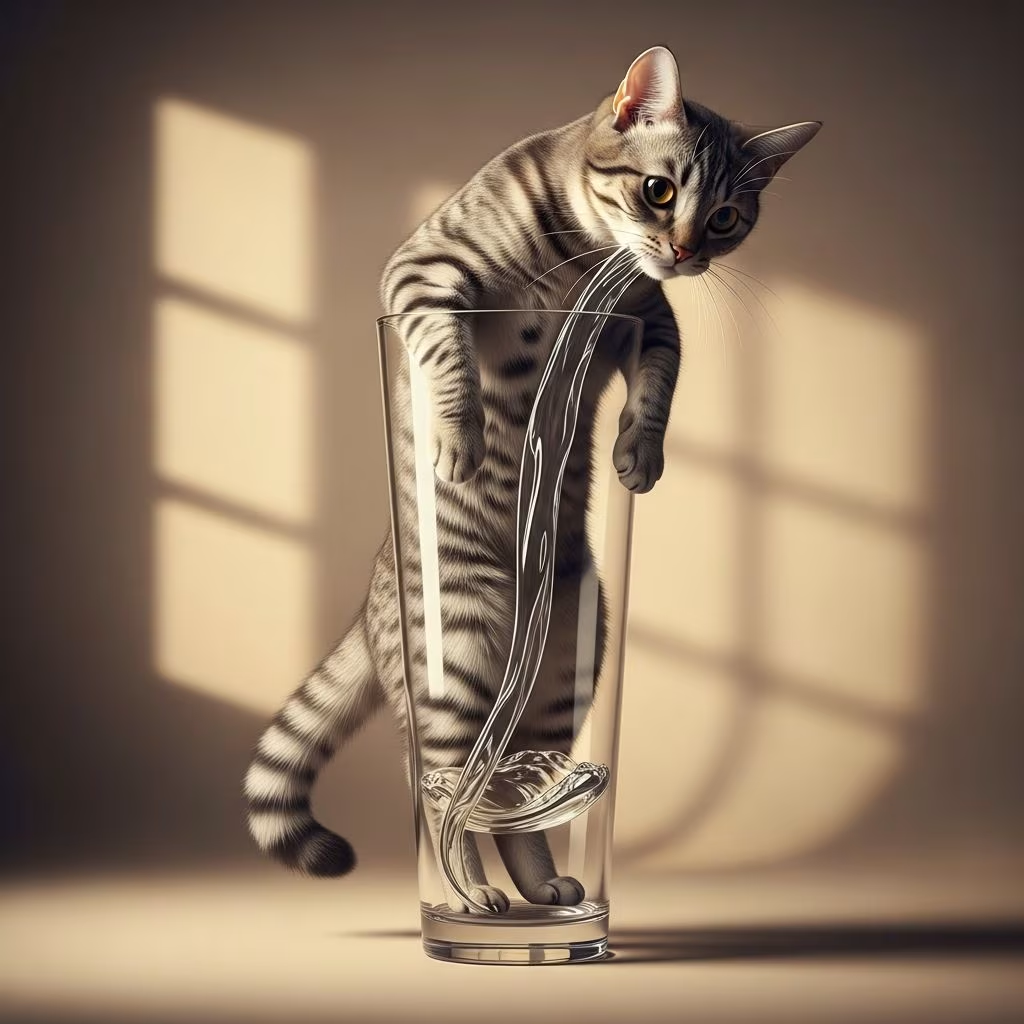
Liquid Cats: Why Are Cats So Flexible?
Cats have earned the nickname “liquid cats” for their seemingly impossible ability to contort their bodies and squeeze into spaces that appear far too small for their size. This remarkable flexibility isn’t magic—it’s the result of millions of years of evolutionary adaptation that has shaped feline anatomy into a marvel of biomechanical engineering. Understanding the science behind cat flexibility reveals why these animals are such efficient hunters and survivors in the wild.
The Marvel of the Feline Spine
The foundation of a cat’s extraordinary flexibility lies in their spine. Cats possess 53 vertebrae throughout their entire body, significantly more than the 33 vertebrae found in humans. Roughly 20 of these vertebrae are located in the cat’s tail alone, contributing to that flexible appendage’s remarkable range of motion. Beyond the sheer number of vertebrae, the structure and composition of these bones set cats apart from other mammals.
The vertebrae in a cat’s spine are notably lighter, shorter, and positioned differently than those in humans and other animals. These bones are connected by elastic cushioning discs that allow for extraordinary flexibility along multiple axes. This unique arrangement enables cats to twist, bend, and rotate their spines in ways that would be impossible for humans without causing serious injury. The cat’s spine functions almost like a slinky, capable of expanding and compressing at different points, which allows for increased agility during hunting and rapid movement.
Research on the biomechanical properties of cat spines has revealed additional insights into their flexibility. The compressive stiffness of a cat’s spine is approximately 53.62±4.68 N/mm, which is remarkably close to that of the human spine. This similarity provides cats with the ability to prevent impact damage while maintaining exceptional flexibility. During dorsiflexion motion—when the spine bends downward—stress is evenly distributed across the vertebrae without significant concentration in any single area. This distribution mechanism is crucial for protecting the spine during jumps and falls.
Another critical distinction is that cat vertebrae are held together primarily by muscles rather than ligaments, as is the case in humans. This muscular attachment system contributes significantly to the cat’s elasticity and ability to elongate and contract their back. Cats can curve their spines upward or oscillate them along their vertebral line with precision, making movements that appear physically impossible.
The Unique Skeletal Structure
While the spine is the primary factor in feline flexibility, other skeletal features work in concert to create the “liquid cat” phenomenon. These adaptations work together to give cats unparalleled agility and the ability to fit into confined spaces.
The Loose Clavicle (Collarbone)
One of the most distinctive features of feline anatomy is the clavicle, or collarbone, which doesn’t attach to other bones in cats. In humans, the clavicle anchors to our arms and provides structural support. Cats, however, have free-floating clavicle bones that allow them to twist in any direction and adjust their body width. This adaptation means that if a cat’s head can fit through an opening, the rest of their body can follow, as they can manipulate their clavicles to narrow their shoulder width as needed.
Shoulder Blade Attachment
The cat’s shoulder blades are attached only by muscle rather than bone, unlike in dogs and humans where shoulder blades are anchored more rigidly. This muscular attachment system allows cats to lengthen their body and manipulate their shoulders far more than humans. This feature enables cats to produce extra-long strides, increasing their hunting speed and allowing them to stretch their bodies into unusual positions without strain.
The Absence of the Nuchal Ligament
Dogs, horses, and humans all possess a nuchal ligament—a thick, tough piece of tissue that supports the head on the neck. Cats lack this nuchal ligament, which means their head can be more agile and maneuverable. However, this anatomical difference comes with a trade-off: while cats have superior head mobility for hunting and quick directional changes, they can only sustain short bursts of sprinting activity, unlike dogs which can maintain lower speeds for extended periods.
The Role of the Pelvis
Beyond the spine and shoulder girdle, a cat’s pelvis plays an important role in overall flexibility. The cat’s pelvis is more loosely connected to the spine than in other mammals, providing additional flexibility in the lower back and hind legs. This loose connection allows cats to rotate and bend their hindquarters independently from their front half, enabling complex twisting motions that are essential for their hunting and defensive behaviors.
The Remarkable Tail
The cat’s tail is far more than a decorative appendage—it’s a sophisticated instrument of balance and communication. Cat tails consist of 22 to 23 vertebrae with fairly loose attachments and cushioning between them. This structure allows for exceptional flexibility and rotation. The tail serves as a counterbalance during quick movements, helping cats maintain stability during rapid directional changes. During mid-air jumps, cats use their tails to adjust their body orientation and facilitate their famous ability to land on their feet.
How Flexibility Serves Survival
The extreme flexibility of cats isn’t simply a novelty—it’s a crucial evolutionary adaptation that directly impacts their survival and hunting success. Understanding the practical applications of feline flexibility demonstrates why these anatomical features were selected through evolution.
Hunting and Predation
Cats are apex predators, and their flexibility is fundamental to their hunting prowess. The ability to twist and bend their spines enables rapid directional changes while pursuing prey. This agility is essential when hunting small, quick rodents and birds that make sudden evasive maneuvers. The extra-long strides enabled by spinal flexibility allow cats to cover ground efficiently during the hunt.
Escaping Predators
While modern house cats rarely face predators, their wild ancestors relied on flexibility to escape threats. The ability to change direction instantaneously and contort their bodies allows cats to slip away from larger predators and reach safety in confined spaces.
Grooming and Self-Care
Cats are fastidious groomers, and their flexibility allows them to reach nearly every part of their bodies with their tongues and teeth. The ability to groom hard-to-reach places is important for maintaining healthy fur and skin. This self-grooming capability also allows cats to clean wounds and maintain their overall health.
Landing and Balance
Perhaps most famously, cats can land on their feet even when falling from height. This ability, known as the righting reflex, involves the cat using its remarkable flexibility to twist its body midair, orienting one part of the body while allowing the rest to follow. The cat engages this reflex instinctively, using its inner ear and flexible spine to determine its orientation and rotate accordingly. Combined with their well-developed sense of balance, this ability allows cats to land gracefully and with minimal injury even from significant heights.
Sleeping Like a Liquid
One of the most endearing—and sometimes bewildering—aspects of cat behavior is their ability to sleep in seemingly impossible positions. A cat might curl up in a tiny box, drape themselves over furniture at odd angles, or contort themselves to fit into a corner. This isn’t just cute; it reflects the true range of motion available to cats thanks to their flexible spines and loose skeletal attachments. Cats can achieve these unusual sleeping positions without discomfort or risk of injury because their anatomy simply allows for it.
The “Liquid Cat” Myth
While the phrase “liquid cats” is popular among cat lovers, it’s important to understand that cats aren’t actually liquid—they’re just extraordinarily flexible solid creatures. Their flexibility creates the illusion of a liquid-like quality, especially when they flow through small openings or squeeze into confined spaces. The key to this seemingly impossible behavior is their unique shoulder girdle and the absence of rigid bone attachments that restrict movement in other animals. Once a cat’s head passes through an opening, their entire body can follow because they can adjust their clavicles and shoulder blades to compress their body width.
Evolutionary Insights and Future Applications
The biomechanical characteristics of the cat’s spine have attracted attention from researchers and engineers beyond traditional veterinary science. The flexibility principles evident in feline spines could potentially inspire the development of robots designed for rescue operations in confined environments. Understanding how cats manage impact forces while maintaining flexibility has implications for biomimetic engineering and the design of flexible robotic systems.
Frequently Asked Questions
Q: Why are cats more flexible than humans?
A: Cats have cushioned spines with significantly more vertebrae (53 compared to our 33), small loose clavicles, and shoulder blades attached only by muscle rather than bone. These adaptations collectively allow cats to achieve extraordinary flexibility that humans cannot match.
Q: Why are cats so much more flexible than dogs?
A: Cats have longer spines with extra cushioning between vertebrae to allow rotation and flexibility. Their clavicles are free-floating and not anchored to other bones, and their shoulder blades are attached only by muscle. Dogs, in contrast, have more rigid skeletal attachments designed for sustained running rather than extreme flexibility.
Q: How does a cat’s tail contribute to its flexibility?
A: The cat’s tail contains 22 to 23 vertebrae with loose attachments and cushioning between them. This allows the tail to be highly flexible and to serve as a counterbalance during quick movements and as a tool for adjusting body orientation during falls.
Q: Can cats actually hurt themselves with their flexibility?
A: Due to the cushioning in their spines and the way stress is distributed evenly across their vertebrae, cats are well-protected against injury from their own flexible movements. However, extremely high falls or trauma can still cause injury despite their adaptability.
Q: Why do cats sleep in such odd positions?
A: Cats can sleep in unusual positions without discomfort because their flexible spines and loose skeletal attachments allow for a much greater range of motion than in humans. These positions cause them no pain or risk of injury due to their unique anatomical structure.
Q: How do cats land on their feet when they fall?
A: Cats use their righting reflex, which is enabled by their remarkable spinal flexibility and an inner ear that helps them sense orientation. They twist their flexible body midair to orient themselves correctly and land safely, using their flexibility as a crucial component of this remarkable ability.
References
- Comprehensive Biomechanical Characterization of the Flexible Cat Spine — SSRN (Social Science Research Network). 2024. https://papers.ssrn.com/sol3/papers.cfm?abstract_id=4805568
- Why Are Cats So Flexible? A Vet Explains — Cats.com. 2024. https://cats.com/why-are-cats-so-flexible
- Why Are Cats So Flexible? This Body Part Is Key — Inverse. 2024. https://www.inverse.com/science/cats-so-flexible-vertebrae
- Cat Anatomy — Wikimedia Foundation (Wikipedia). 2024. https://en.wikipedia.org/wiki/Cat_anatomy
- Ever Wonder Why Cats Are So Flexible? Ask Our Cat Veterinarian — Catonsville Cat Clinic. 2024. https://www.catonsvillecatclinic.com/holmes-corner/why-cats-are-so-flexible-ask-cat-veterinarian/
- How do cats squeeze through small spaces? — Live Science. 2024. https://www.livescience.com/how-cats-squeeze-through-small-spaces



