

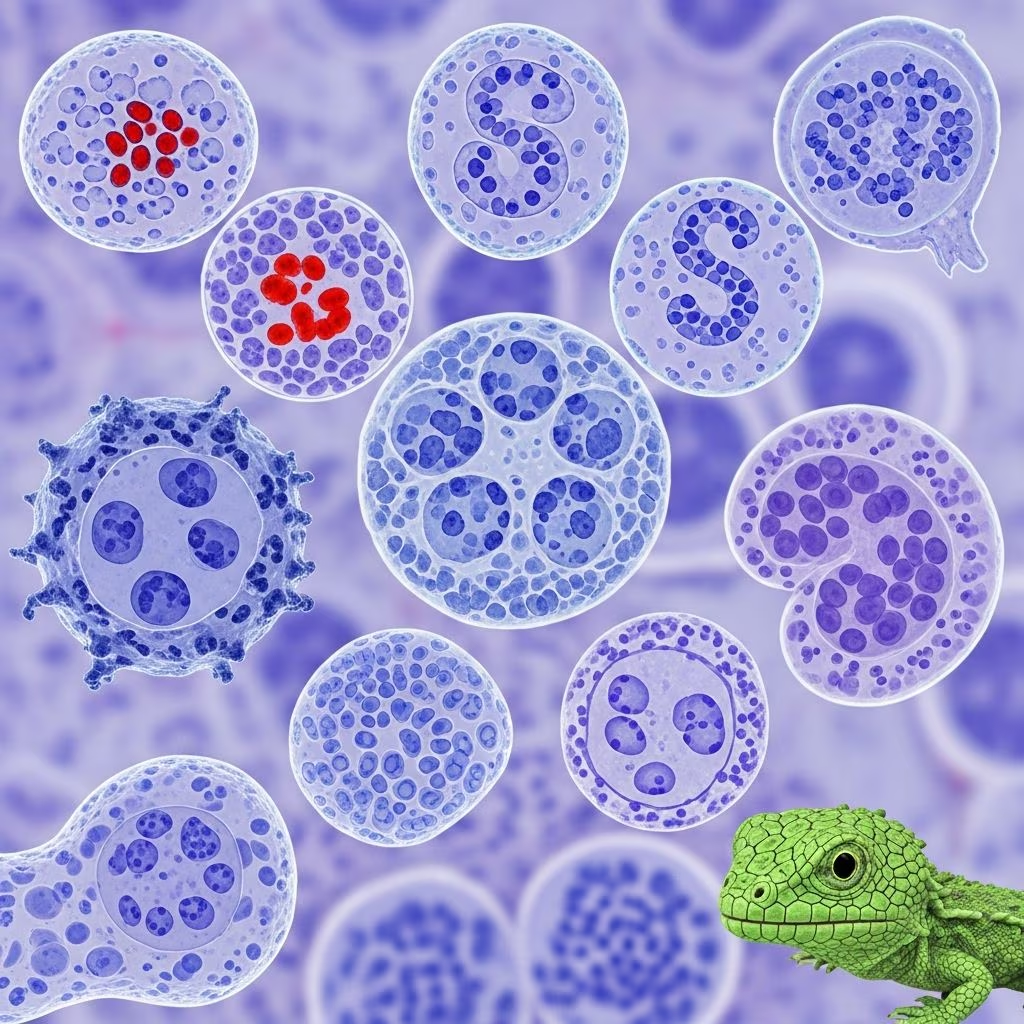
Leukocytes, or white blood cells, form the cornerstone of an animal’s immune system, actively defending against pathogens, damaged cells, and foreign invaders. These cells circulate through the bloodstream and migrate into tissues, adapting to threats with remarkable versatility. Understanding their physiology reveals how animals maintain health amid constant environmental challenges.
The Origin and Development of Leukocytes
Leukocyte production begins in the bone marrow, where hematopoietic stem cells differentiate into various lineages under the influence of colony-stimulating factors (CSFs) and interleukins. Granulocytes, including neutrophils, eosinophils, and basophils, arise from myeloid progenitors, while monocytes and lymphocytes follow distinct pathways.
Lymphocytes undergo further maturation: T cells develop in the thymus, gaining capabilities for cellular immunity, whereas B cells mature in bone marrow or bursa equivalents, preparing for antibody production. This process ensures a steady supply of mature cells ready for circulation or tissue deployment.
- Bone marrow as primary site: Generates most leukocytes, with reserves for rapid response.
- Secondary sites: Lymph nodes and spleen support lymphocyte maturation and cloning.
- Regulation: Cytokines like interleukins fine-tune production based on demand.
Distribution Dynamics: Circulating and Marginal Pools
Leukocytes exist in two main blood compartments: the circulating pool, freely flowing through vessels, and the marginal pool, adhering to endothelial walls. Factors like blood flow rate, fluid shifts, and endothelial adhesion influence distribution, maintaining equilibrium with extravascular spaces.
In most animals, these pools are roughly equal, though cats show a larger marginal pool. Disruptions, such as inflammation, shift cells rapidly, altering total counts without changing overall numbers.
| Species | Circulating Pool (%) | Marginal Pool (%) |
|---|---|---|
| Dogs, Horses | ~50 | ~50 |
| Cats | ~40 | ~60 |
| Ruminants | ~45 | ~55 |
This table illustrates typical distributions, aiding in interpreting leukograms during clinical assessments.
Neutrophils: Frontline Defenders Against Infection
Neutrophils, the most abundant granulocytes, excel in phagocytosis, engulfing and destroying microbes. Their multi-lobed nuclei and granule-filled cytoplasm enable swift responses to bacterial invasions.
Their functions extend beyond killing: they increase vascular permeability to facilitate immune cell recruitment, modulate T and B cell activities, and influence inflammation phases. Emerging research highlights their role in tumor cell destruction via tissue-damaging mechanisms.
- Chemotaxis: Attracted to infection sites by chemical signals.
- Phagocytosis stages: Attachment, engulfment, lysosomal fusion, and digestion.
- Reserve pool: Bone marrow storage ensures quick mobilization during acute needs.
Eosinophils: Specialists in Parasite Combat and Allergy Modulation
Eosinophils target larger threats like metazoan parasites, releasing enzymes to disrupt invaders. They also counteract mast cell products, such as histamine via histaminase, tempering allergic responses.
Chemotactic to histamine and immune complexes, eosinophils accumulate in parasitic infestations or hypersensitivity reactions, where elevated counts signal underlying issues.
Basophils and Mast Cells: Amplifiers of Inflammation
Basophils release histamine and heparin, intensifying inflammation and preventing clotting. Though once thought related to circulating mast cells, they derive from separate lineages.
High basophil levels link to allergies, parasites, or endocrine imbalances like hypothyroidism, while lows occur in stress or hyperthyroidism.
Monocytes and Macrophages: Versatile Clean-Up Crew
Monocytes circulate briefly before differentiating into macrophages in tissues. These cells phagocytose debris, pathogens, and apoptotic bodies, forming giant cells against foreign bodies.
They bridge innate and adaptive immunity by presenting antigens to lymphocytes and secreting IL-1, which triggers fever and progenitor growth.
Lymphocytes: Architects of Adaptive Immunity
Lymphocytes drive long-term protection: T cells handle cellular threats via cytotoxicity and helper functions, producing lymphokines to activate other effectors. B cells generate antibodies for humoral defense.
Long-lived and capable of cloning, lymphocytes recirculate through blood, lymph, and tissues, mounting amplified responses upon re-exposure to antigens.
Migration and Tissue Deployment
Unlike erythrocytes, leukocytes exit vessels via diapedesis, squeezing through endothelial gaps guided by chemotaxis. In tissues, they become macrophages, microglia, or other forms, patrolling for threats.
This mobility allows targeted responses, with positive chemotaxis drawing cells to damaged sites emitting attractant signals.
Leukocyte Lifespan and Turnover
Most leukocytes live hours to days, except long-lived lymphocytes. Continuous bone marrow production, boosted by demand, replenishes them. Thrombopoiesis, platelet formation from megakaryocytes, parallels this, with platelets aiding repair.
Platelets release growth factors for tissue healing, extending leukocyte roles in recovery.
Clinical Relevance: Interpreting Leukocyte Changes
Leukograms reflect inflammation: neutrophilia indicates bacterial fights, eosinophilia parasites or allergies. Leukopenia rarely occurs in dogs and cats due to marrow reserves.
Stress alters profiles, useful in conservation physiology for assessing vertebrate health.
FAQs
What are the main types of leukocytes in animals?
The five major categories are neutrophils, eosinophils, basophils, lymphocytes, and monocytes.
How do leukocytes leave blood vessels?
Through diapedesis, they migrate into tissues responding to chemotactic signals.
What triggers eosinophilia in animals?
Allergic reactions and parasitic infections primarily induce elevated eosinophil counts.
Why are neutrophils crucial during infections?
They rapidly phagocytose bacteria, with marrow reserves preventing leukopenia.
Do lymphocytes recirculate?
Yes, many return to blood from tissues, enabling sustained immunity.
Key Takeaways
- Leukocytes originate in bone marrow and specialize for immune tasks.
- Migration via chemotaxis targets threats precisely.
- Each type—neutrophils for bacteria, eosinophils for parasites—has unique roles.
- Clinical leukograms guide disease diagnosis.
References
- Neutrophilic leukocyte structure and function in domestic animals — PubMed. 1985-01-01. https://madbarn.com/research/neutrophilic-leukocyte-structure-and-function-in-domestic-animals/
- Leukocytes and Platelets – The organised life of animals — CSU Open Text. N/A. https://opentext.csu.edu.au/organisedlifeofanimals/chapter/leukocytes-and-platelets/
- White Blood Cells in Animals – Circulatory System — Merck Veterinary Manual. N/A. https://www.merckvetmanual.com/circulatory-system/hematopoietic-system-introduction/white-blood-cells-in-animals
- Physiology of Leukocytes in Animals – Circulatory System — Merck Veterinary Manual. N/A. https://www.merckvetmanual.com/circulatory-system/leukocyte-disorders/physiology-of-leukocytes-in-animals
- Leukocyte Disorders — Veterian Key. N/A. https://veteriankey.com/leukocyte-disorders/
- Normal leukocytes — eClinpath. N/A. https://eclinpath.com/hematology/morphologic-features/white-blood-cells/normal-leukocytes/



