

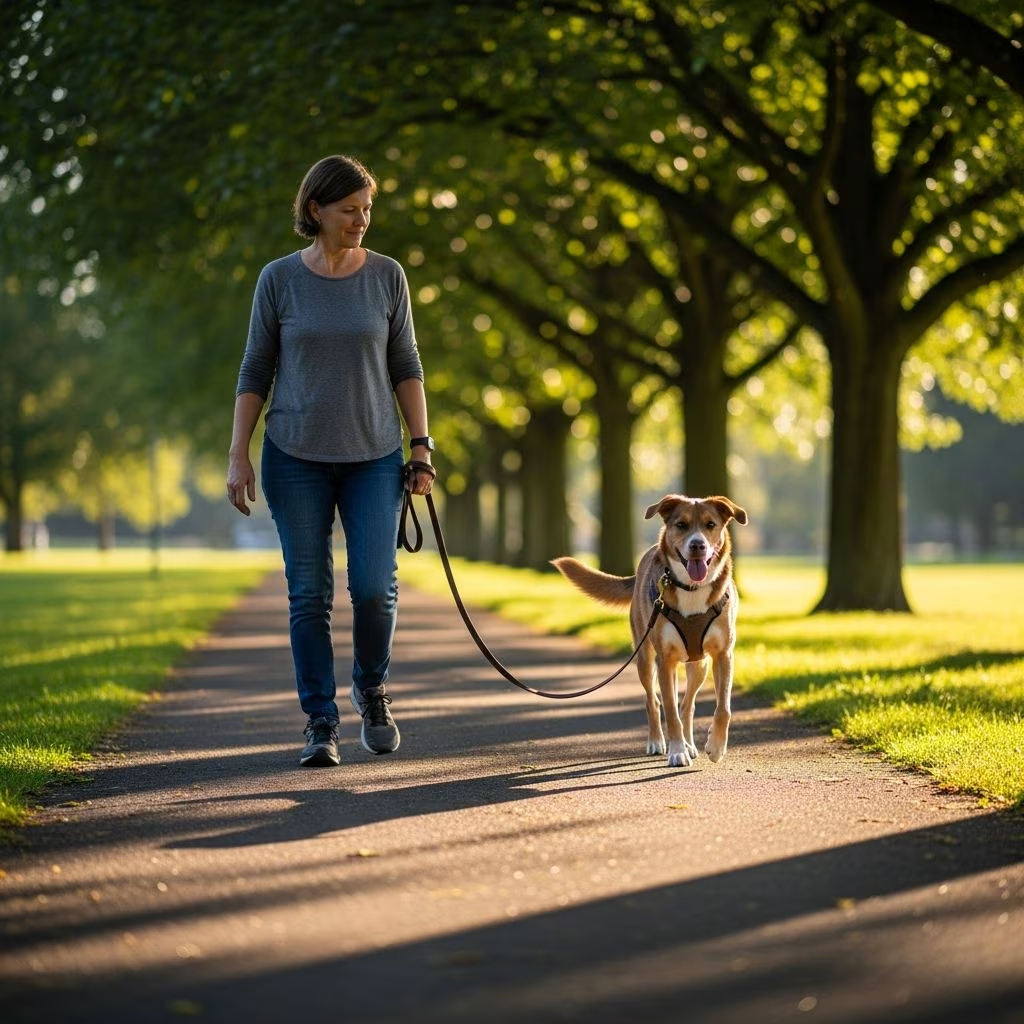
Leash belay is a simple handling technique that helps you manage pulling and lunging without yanking your dog or getting dragged, while also supporting better training and calmer walks over time.
Instead of battling the leash, you use your body position, a stable stance, and the environment to keep both of you safer and more comfortable as your dog learns loose-leash skills.
What Is Leash Belay?
Leash belay borrows its name from climbing, where a belayer protects the climber by taking or giving slack in a rope in a controlled way. On a walk, you act as the belayer and your dog is the climber: you control the leash in a way that:
- Prevents you from being physically pulled off balance
- Stops the dog from gaining speed and momentum toward triggers
- Reduces the risk of sudden jerks to the dog’s neck or shoulders when using a collar
- Creates a more steady, predictable connection for sensitive or reactive dogs
Leash belay is not a substitute for training; it is a management tool that supports positive reinforcement training such as loose-leash walking and behavior modification for reactivity.
Why Dogs Pull and How Leash Belay Helps
Most dogs are not trying to be stubborn when they pull; they are simply moving toward something they want faster than we can walk. According to humane training organizations, dogs pull because:
- The environment is full of exciting scents, sights, and sounds
- They have learned that pulling often gets them where they want to go
- They are anxious or over-aroused around people, other dogs, or traffic
- They have never been taught an alternative, such as loose-leash walking
Leash belay helps you handle that pulling more safely while you work on training, by:
- Making it easier to stay upright and in control when your dog lunges
- Preventing your dog from rehearsing big, self-rewarding pulls
- Reducing the need for harsh corrections and keeping training positive
The Core Mechanics of the Leash Belay Game
The leash belay technique focuses on how you hold and manage the leash and your own body posture. You practice it before you need it in real life, so it becomes automatic when your dog suddenly pulls.
1. Your Stance and Body Position
Think like a climber securing a rope. You want a grounded, balanced stance that lets you absorb force without falling:
- Stand with your feet about shoulder-width apart
- Keep one foot slightly in front of the other for stability
- Bend your knees softly rather than locking them
- Engage your core and keep your shoulders relaxed, not tense
This athletic stance spreads out the force of a sudden pull, protecting your back, elbows, and shoulders, which is especially important with medium or large dogs.
2. How to Hold the Leash Safely
Many people instinctively wrap the leash around their wrist or hand, which can cause injuries if the dog lunges. Animal welfare groups recommend holding the leash in a way that allows you to release or adjust it quickly while keeping good control.
For leash belay, a safe and effective hold usually includes:
- One hand as the main anchor, held close to your body at about waist level
- The other hand to manage slack and guide the leash
- No wrapping the leash tightly around fingers or wrists
- Keeping a short, safe amount of slack (forming a gentle “J” shape to the collar or harness)
| Unsafe Leash Habits | Belay-Friendly Alternatives |
|---|---|
| Wrapping leash around wrist or hand | Holding leash with thumbs over the top, no wraps |
| Arm fully extended and locked | Elbows bent, hands close to body for strength |
| Leash so tight the dog feels constant pressure | Soft “J” shaped slack, with tension only when needed |
| Letting dog drag you in any direction | Turning your body and feet to reorient the team |
3. Using the Environment as a “Belay Anchor”
A key part of leash belay is learning to use the world around you to your advantage. Instead of trying to overpower your dog with strength, you can:
- Step behind a parked car, tree, or bench to block your dog’s path
- Shift sideways into a driveway or onto a patch of grass to create distance from a trigger
- Stand with your hip or shoulder gently blocking forward movement
By adding these small environmental barriers, you transform a straight pulling contest into a controlled pause, giving your dog the chance to refocus on you and calm down.
Step-by-Step: Teaching the Leash Belay Game
Before practicing in a busy area, start in a low-distraction space like a quiet sidewalk or yard. Use high-value treats and keep sessions short, as recommended in many loose-leash training programs.
Step 1: Set Up and Introduce the Game
- Clip the leash to a comfortable harness or flat collar
- Stand in your belay stance with your main hand at your waist
- Let your dog move a small distance forward until there is light tension on the leash
- Before the dog reaches full pulling force, hold your position and avoid stepping forward
When your dog notices the change and glances back or shifts weight toward you, mark this (with a clicker or a “yes”) and reward by delivering a treat near your leg.
Step 2: Build the “Pressure On, Pressure Off” Pattern
The goal is to teach your dog that:
- Leash tight = nothing good happens (no progress, no access)
- Leash loosens and dog looks back = treats and forward movement
To build that association:
- Allow a small, safe amount of forward motion
- As pressure rises, stop moving and stabilize the leash using your stance
- Wait silently for your dog to ease off, even a little
- Mark and reward the instant you feel the leash slacken, then move forward a few steps as an extra reward
Step 3: Add Mild Distractions
Once the pattern is clear in a quiet area, practice near mild distractions like:
- Parked cars, bushes, or mailboxes
- Light street noise
- Occasional people at a distance
Use the same rules: if the dog hits the end of the leash, stabilize your stance and wait. When they check in with you or soften the leash, mark, reward, and move. Short, frequent sessions are more effective than long, frustrating walks.
Step 4: Practice Around Triggers at a Safe Distance
For dogs that react to other dogs, bikes, or people, experts recommend working at a distance where your dog can still eat and think while you train. At that distance:
- Use your belay stance and environmental barriers to stop sudden lunges
- Reward any voluntary check-ins or moments of calm when the trigger appears
- Gradually reduce distance over multiple sessions only if your dog remains relaxed
If your dog remains highly reactive even at a distance, consult a qualified reward-based trainer or behavior professional for a tailored plan.
Integrating Leash Belay with Loose-Leash Training
Leash belay works best alongside a structured loose-leash walking program that teaches your dog where you want them to walk and how to earn reinforcement for staying near you.
Key Loose-Leash Skills to Pair with Belay
- Check-ins: Reward your dog for voluntarily looking at you during walks
- Walking at your side: Reinforce when your dog stays beside your leg
- Change of direction: Practice smooth turns with treats to teach your dog to follow you
- Stop-and-go: If the leash tightens, you stop; when it loosens, you go
Leash belay supports all of these skills by giving you a stable, consistent way to enforce the “stop” part of the rule, without jerking or dragging.
Benefits of the Leash Belay Technique
When practiced consistently and paired with rewards-based training, leash belay offers several benefits:
- Greater safety for the handler, especially with strong or large dogs
- Less physical strain on your dog compared with repeated leash yanks
- Fewer rehearsed pulling behaviors, because pulling no longer “works”
- Better emotional regulation for reactive or excitable dogs
- Compatibility with positive reinforcement and humane guidelines from major welfare organizations
Common Mistakes to Avoid
Even with a solid technique, a few common errors can undermine your progress:
- Turning belay into a constant restraint: The goal is intermittent support, not a permanent tight leash.
- Moving forward while the leash is tight: This accidentally teaches your dog that pulling still works.
- Practicing only in big, overwhelming environments: Start somewhere quiet and build up.
- Skipping rewards: Management alone will not teach new behavior; reinforcement is essential.
- Using pain-based equipment: Tools that cause pain or fear can increase reactivity and reduce welfare.
When to Seek Professional Help
Leash belay is appropriate for many dogs, but some situations call for expert guidance. You should consult a certified trainer or veterinary behaviorist if:
- Your dog has bitten or attempted to bite people or other dogs on leash
- Your dog is too strong for you to control safely, even with improved technique
- Your dog panics, freezes, or shows extreme fear on walks
- You suspect underlying pain or medical issues that make walks uncomfortable
Professionals can help design a plan that combines safe handling (including leash belay), appropriate equipment, and evidence-based behavior modification.
Frequently Asked Questions (FAQs)
Q: Is leash belay the same as loose-leash walking?
A: No. Leash belay is a handling and safety technique that helps you manage pulling and lunging. Loose-leash walking is a trained behavior that teaches your dog to walk on a slack leash. They work best when used together.
Q: Do I need special equipment to use leash belay?
A: You do not need special gear, but many humane training organizations recommend a well-fitted harness and a sturdy, non-retractable leash for better control and safety. Avoid choke, prong, or shock collars, which can increase fear and reactivity.
Q: Can leash belay help with a reactive dog?
A: Leash belay can make it easier to hold your ground and create distance when your dog reacts, which supports behavior programs for leash reactivity. However, reactivity usually requires a structured training plan using counterconditioning and desensitization with professional guidance.
Q: How long does it take for my dog to improve using this technique?
A: Timing varies by dog, history, and environment. Many dogs show small improvements within a few weeks of consistent, reward-based practice in low-distraction areas, with more solid behavior taking longer as you add real-world challenges.
Q: Is leash belay okay for small dogs?
A: Yes. In fact, stabilizing the leash and avoiding sudden jerks can be especially important for small dogs, whose necks and spines are more vulnerable. A comfortable harness and gentle belay handling help keep them safer.
References
- Teach your dog to walk on a loose leash — Animal Humane Society. 2023-03-10. https://www.animalhumanesociety.org/resource/teach-your-dog-walk-loose-leash
- How to Leash Train a Dog: A Step-by-Step Guide — Pets Best. 2022-08-15. https://www.petsbest.com/blog/how-to-leash-train-your-dog
- Managing and Training Leash-Reactive Dogs — ASPCApro. 2021-07-01. https://www.aspcapro.org/resource/managing-and-training-leash-reactive-dogs
- Reward-based training of dogs and cats: Is it necessary? — American Veterinary Society of Animal Behavior (AVSAB Position Statement). 2021-07-28. https://avsab.org/wp-content/uploads/2021/08/Reward_Based_Training_Position_Statement_Download.pdf
- Welfare Implications of Leash Walking and Training Aids for Dogs — American Veterinary Medical Association. 2020-06-16. https://www.avma.org/resources-tools/avma-policies/welfare-implications-leash-walking-and-training-aids-dogs



