

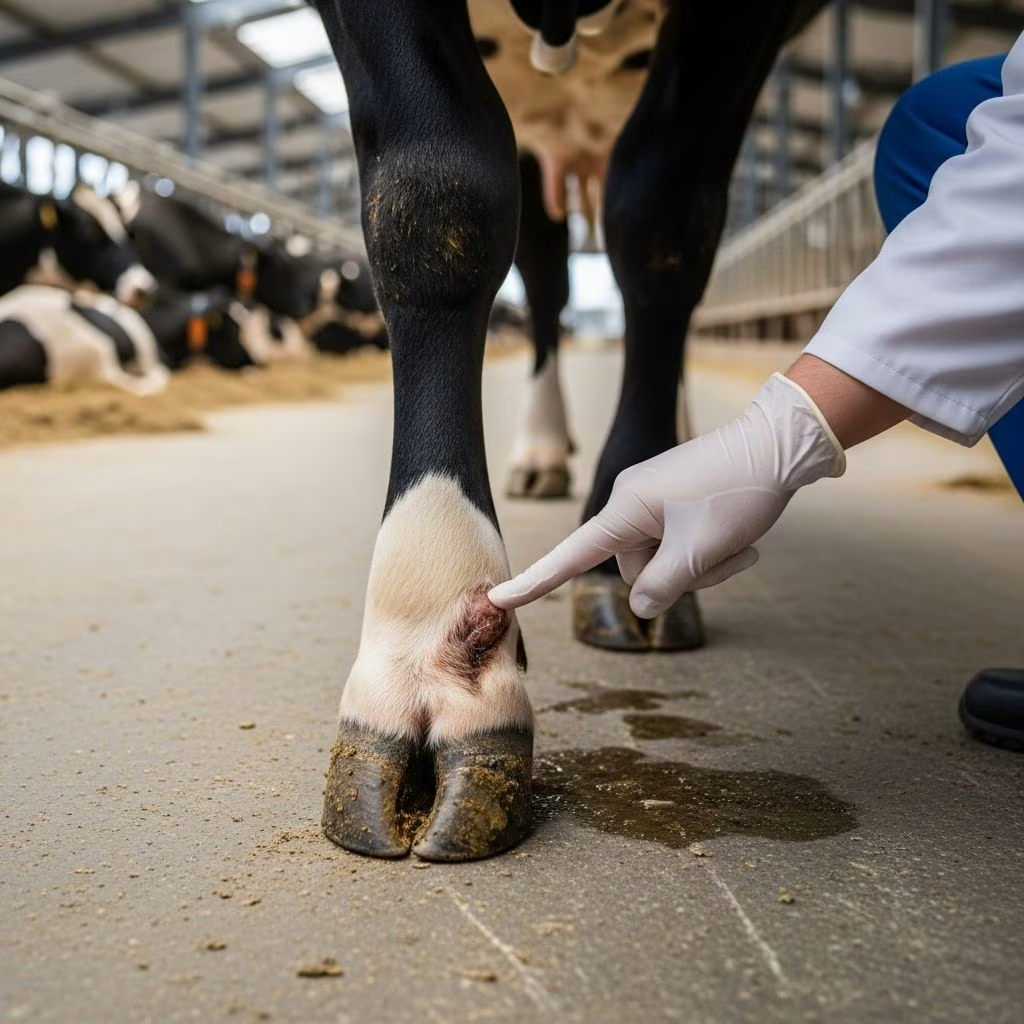
Lameness represents a major welfare and economic challenge in cattle production, affecting mobility and productivity across dairy and beef sectors worldwide. Prevalence rates vary significantly by region, housing system, and management practices, often ranging from under 5% in low-intensity systems to over 30% in intensive confinement setups.
Global Overview of Lameness Incidence
Worldwide, lameness prevalence in dairy cattle averages around 22.8%, with herd-level variations from 0% to 88% depending on assessment methods and locations. In pasture-based systems, rates are typically lower at about 8%, while confinement housing sees 15-30% or higher, up to 55% in some indoor facilities. These differences underscore the influence of environment on hoof health.
In beef cattle, particularly in North American feedlots, prevalence estimates fall between 5% and 17%, with 70-75% of cases linked to hoof issues and the rest to upper limb injuries or joint problems. Cow-calf operations show scarcer data, ranging from 0% to 43%, with incidence around 1 case per 100 animal-years.
Prevalence Variations by Production System
Dairy farms exhibit stark contrasts between commercial and smallholder operations. One study in India reported 21.9% prevalence in commercial dairy farms versus 4.6% in smallholder setups, highlighting scale-related management impacts. In Ethiopia, overall animal-level prevalence was 5.77%, with herd-level at 32.4% and within-herd averages of 5.20% (range 0-25%).
| System Type | Prevalence Range | Key Notes |
|---|---|---|
| Pasture-based dairy | 8% | Lower due to natural footing |
| Confinement dairy | 15-55% | Higher in indoor housing |
| Commercial dairy farms | 21.9% | India study |
| Smallholder dairy | 4.6% | India study |
| Feedlot beef | 5-17% | 70-75% hoof-related |
Severe lameness (scores ≥4/5) occurs at about 7-8.2% globally, with within-herd ranges up to 65%. Hock injuries, a related issue, affect 12-81% of cows in housed systems.
Key Risk Factors Influencing Lameness
Multiple interconnected factors contribute to lameness, categorized into animal, environmental, and management groups.
Animal-Level Risks
- Age and Parity: Higher prevalence in multiparous cows (9.17%) and those over 6 years (12.3%). Early lactation and late-stage cows face elevated risks.
- Body Condition and Weight: Poor body condition scores correlate with increased lameness, alongside heavier body weights straining hooves.
- Lactation Stage: Middle and late lactation show 15.2% prevalence, linked to physiological stress.
Environmental and Housing Factors
- Floor Type: Concrete or slatted floors in confinement increase injury risk compared to pasture.
- Housing Style: Closed houses (33.3%) exceed semi-open (25%). Unwashed animals in 40% lame herds vs. 31.2% washed.
- Overcrowding and Hygiene: Poor hygiene and injuries to hocks/knees significantly associate with lameness.
Management Practices
- Hoof Trimming: Lack of regular trimming heightens lesion risks.
- Farm History: Herds with prior lameness history show 69.2% prevalence vs. 12.5% without (OR=10.0).
- Lesion Distribution: Hindlimbs account for 92% of lesions, 65% in outer claws.
In beef feedlots, lameness contributes 16-40% to health issues and 3-11% to mortality, often detected in 5-30% at slaughter.
Economic and Welfare Implications
Lameness reduces milk yield by 10-30% in dairy cows, shortens productive lifespans, and elevates culling rates. Treatment costs, labor, and lost performance compound losses, estimated at hundreds per case annually. Welfare concerns include pain from lesions like digital dermatitis or sole ulcers, prompting calls for better monitoring.
Prevention and Management Strategies
Effective control requires integrated approaches:
- Regular locomotion scoring (e.g., Sprecher scale) to detect early cases.
- Improved flooring with rubber mats or grooving to enhance traction.
- Routine hoof trimming, targeting high-risk periods like early lactation.
- Hygiene protocols, including frequent washing and bedding changes.
- Balanced nutrition to maintain optimal body condition and reduce metabolic stress.
Transitioning to pasture access can lower prevalence; one study noted median 29.4% in limited-access farms. Farmer education on risk factors, especially in regions like Ethiopia and India, is crucial.
Regional Case Studies
India: Commercial vs. Smallholder Disparities
HF crossbreds showed 13.69% farm-level and 13.29% animal-level prevalence, with commercial farms far exceeding smallholders due to intensive management.
Ethiopia: Urban and Peri-Urban Insights
Prevalence aligned with lactation stage and farm history, emphasizing monitoring in expanding dairy sectors.
Challenges in Data Collection and Assessment
Prevalence varies due to scoring inconsistencies (e.g., ≥3/5 vs. clinical observation). Incidence data is rare owing to recording costs. Standardized protocols are needed for reliable benchmarking.
Future Directions in Lameness Research
Emerging tech like automated sensors promises real-time detection. Genomic selection for hoof health traits and climate-adapted housing could further mitigate risks. Collaborative studies across production systems will refine global strategies.
Frequently Asked Questions (FAQs)
What causes most lameness cases in cattle?
About 80-90% stem from common hoof lesions like sole ulcers and digital dermatitis, exacerbated by housing and hygiene.
How can farmers detect lameness early?
Use 5-point locomotion scoring: 1=normal, 5=severe. Score weekly in high-risk herds.
Does housing type affect lameness rates?
Yes, confinement boosts rates to 15-55% vs. 8% on pasture.
What is the global average lameness prevalence?
Around 22.8% in dairy, varying widely by region and system.
Can nutrition prevent lameness?
Optimal body condition reduces risks; deficiencies worsen hoof integrity.
References
- Assessing lameness prevalence and associated risk factors … – PMC — PMC. 2024. https://pmc.ncbi.nlm.nih.gov/articles/PMC11127402/
- Prevalence and risk factors for lameness in dairy cattle on selected … — Frontiers in Veterinary Science. 2025. https://www.frontiersin.org/journals/veterinary-science/articles/10.3389/fvets.2025.1456527/full
- Epidemiology of Lameness in Cattle – Musculoskeletal System — Merck Veterinary Manual. Accessed 2026. https://www.merckvetmanual.com/musculoskeletal-system/lameness-in-cattle/epidemiology-of-lameness-in-cattle
- The relationship between lameness prevalence and pasture access … — PMC. 2024. https://pmc.ncbi.nlm.nih.gov/articles/PMC11210846/
- Investigating Herds with Lameness Problems — Cornell University. Accessed 2026. https://www.vet.cornell.edu/animal-health-diagnostic-center/programs/nyschap/modules-documents/investigating-herds-lameness-problems
- Lameness in the US Cattle Industry — NC State Extension. Accessed 2026. https://beef.ces.ncsu.edu/lameness-in-the-US-Cattle-Industry/
- Lameness Risk Landscape – Dairy — University of Wisconsin Extension. Accessed 2026. https://dairy.extension.wisc.edu/articles/lameness-risk-landscape/



