

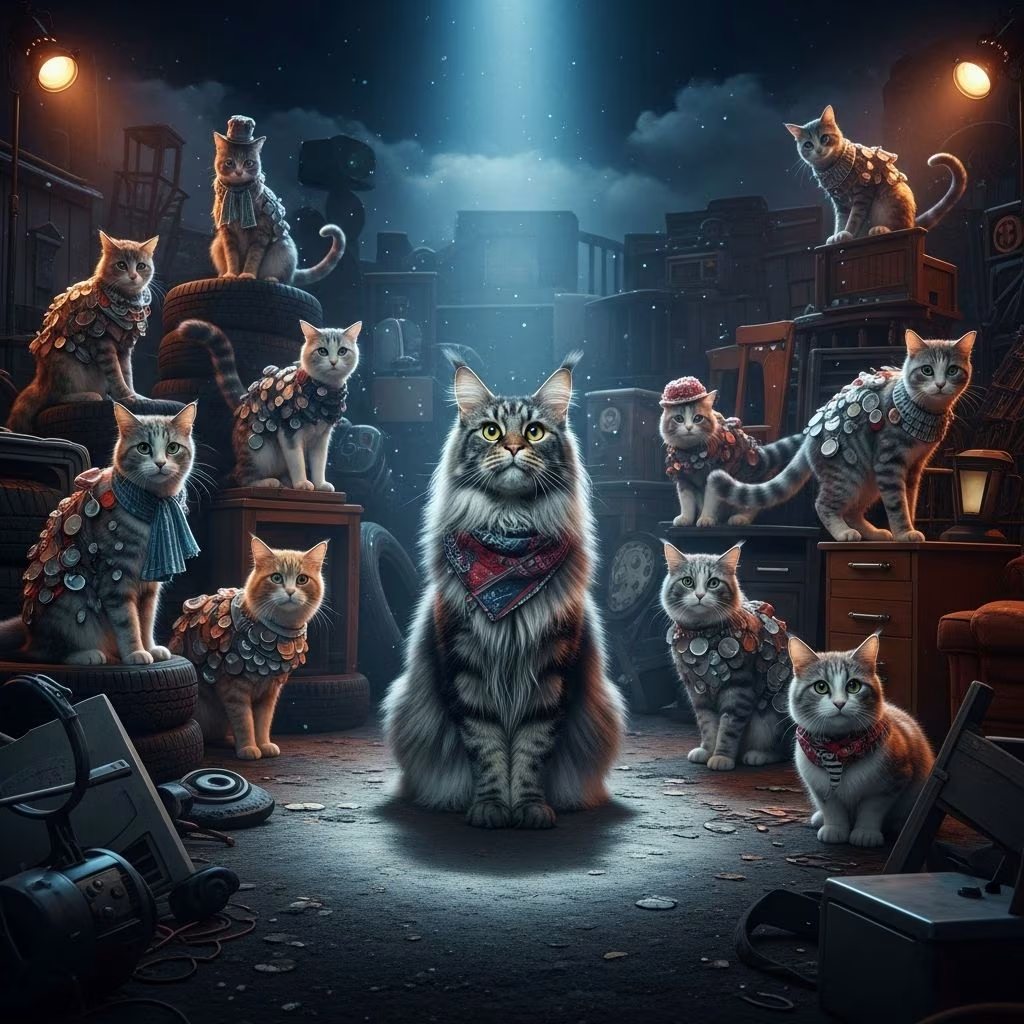
Jellicle Cats represent a whimsical creation from early 20th-century literature, evolving into cultural icons through theater and media. Originating in T.S. Eliot’s playful poetry, these fictional felines embody mystery, nocturnal revelry, and communal celebration, particularly at the annual Jellicle Ball where one cat receives a chance for renewal.
The Literary Birth of Jellicle Cats
The term “Jellicle Cat” first appeared in T.S. Eliot’s 1933 collection Five-Finger Exercises, within the poem “Lines to a Yorkshire Terrier.” Here, Eliot introduced Jellicle Cats alongside Pollicle Dogs, portraying them as scruffy, black-and-white creatures full of friendly energy. Scholars suggest “Jellicle” derives from a playful corruption of “dear little cat,” mirroring “Pollicle” for “poor little dog,” though Eliot’s secretary later linked it to his cat Jellylorum.
By 1939, Eliot expanded this concept in Old Possum’s Book of Practical Cats, dedicating the poem “The Song of the Jellicles” to these enigmatic felines. The verse paints them as moderate-sized, white-and-black cats with moonlit eyes that leap like jumping jacks. They remain subdued during daylight, conserving energy for terpsichorean displays under the Jellicle Moon, gathering for the Jellicle Ball—a nocturnal festivity of dance and song.
Jellicle Cats are white and black,
Jellicle Cats are of moderate size;
Jellicle Cats jump like a jumping-jack,
Jellicle Cats have moonlit eyes.
This imagery captures the essence of domestic cats’ secretive lives, anthropomorphized into a tribal society with rituals and hierarchy.
Traits and Behaviors of Jellicle Cats
In Eliot’s depiction, Jellicle Cats exhibit distinct nocturnal habits. They groom meticulously—washing behind ears and drying between toes—before repose, awakening for midnight adventures. Their affinity for the Jellicle Moon symbolizes a mystical rebirth cycle, central to their lore.
- Nocturnal dancers: Active primarily at night, showcasing acrobatic prowess.
- Communal gatherers: Unite at the Jellicle Ball under Old Deuteronomy’s leadership.
- Mystical selectors: One cat is chosen for ascension to the Heaviside Layer, granting a new life.
- Scruffy charm: Often black-and-white with a rugged, approachable appearance.
Fan interpretations vary: some view all cats as Jellicle, others see them as an elite tribe with supernatural intelligence amid ordinary felines.
From Page to Stage: The Musical Revolution
Andrew Lloyd Webber transformed Eliot’s poems into the 1981 musical Cats, premiering in London before Broadway dominance. The production expanded Jellicle lore, diversifying coat colors and personalities beyond Eliot’s monochrome vision. The Jellicle Ball became the narrative core, where cats perform for Old Deuteronomy, who selects one for rebirth.
Choreographer Gillian Lynne’s innovative dance sequences emphasized feline mimicry, blending ballet, modern, and tap. The show ran 21 years on Broadway, grossing over $3 billion globally and inspiring tours, films, and revivals like Cats: The Jellicle Ball (2024), reimagining the story in LGBTQ+ ballroom culture.
| Aspect | Eliot’s Poems | Musical Cats |
|---|---|---|
| Appearance | Black-and-white, scruffy | Varied colors, theatrical costumes |
| Key Event | Jellicle Ball (poetic) | Elaborate Jellicle Ball performance |
| Leadership | Implied | Old Deuteronomy |
| Rebirth | Moonlit renewal | Heaviside Layer ascension |
Cultural Ripples Beyond the Theater
Jellicle Cats permeated pop culture extensively. The 2019 Cats film, directed by Tom Hooper, featured hyper-realistic CGI felines, sparking debate but reinforcing the brand. Madame Tussauds New York unveiled wax figures of characters like Grizabella in 2019.
In 1986’s Logan’s Run, Jellicle Cats appeared as purchasable pets, blending sci-fi with Eliot’s whimsy. A 2017 Faber and Faber picture book revived “The Song of the Jellicles” standalone. Recent Broadway’s Cats: The Jellicle Ball fuses vogue ball traditions from 1960s Harlem, with emcees like those from House of LaBeija, honoring ballroom pioneers.
Jellicle-Inspired Real-World Initiatives
The Jellicle Cats Rescue Foundation, a 501(c)(3) nonprofit in Long Beach, California, channels the fictional tribe’s spirit into action. Focused on trap-neuter-release (TNR) programs, they curb stray populations, promote responsible ownership, and facilitate adoptions. Their efforts address feline homelessness, echoing the communal renewal theme.
- TNR operations to stabilize populations.
- Awareness campaigns on pet care.
- Adoption matching for homeless cats.
No Official Breed, But Endless Inspiration
Despite their fame, no cat breed bears the Jellicle name. Enthusiasts speculate future hybrid developments might claim it, honoring Eliot. For now, any spirited, tuxedo-patterned cat evokes the archetype—black-and-white coats reminiscent of moonlit dancers.
Modern Adaptations and Fan Legacy
Revivals keep Jellicle lore alive. Cats: The Jellicle Ball integrates vogue elements, where performers compete in categories mirroring ball culture’s categories, led by figures like emcee James Goode Jr. (father of ballroom legend Willie Ninja). This fusion highlights dance as survival and expression.
Online fandoms debate theories: Are Jellicles a universal cat identity or a magical elite? Wikis and forums preserve Eliot’s originals alongside musical expansions.
Why Jellicle Cats Endure
Jellicle Cats transcend literature, symbolizing joy, community, and transformation. From Eliot’s 1930s verses to 21st-century stages, they celebrate felinity’s playful enigma, inspiring art, rescue, and imagination worldwide.
Frequently Asked Questions
What defines a Jellicle Cat?
A Jellicle Cat, per T.S. Eliot, is a nocturnal, black-and-white feline that dances at the Jellicle Ball under the moon.
Where did Jellicle Cats originate?
First in Eliot’s 1933 Five-Finger Exercises, expanded in 1939’s Old Possum’s Book.
Is there a Jellicle Cat breed?
No recognized breed exists today.
What is the Jellicle Ball?
An annual gathering where cats perform, and one is chosen for a new life in the Heaviside Layer.
How did Jellicle Cats become famous?
Through Andrew Lloyd Webber’s 1981 musical Cats, a global theater sensation.
References
- Jellicle Cats – ‘Cats’ Musical Wiki – Fandom — Cats Musical Fandom. Accessed 2026. https://catsmusical.fandom.com/wiki/Jellicle_Cats
- What Is a Jellicle Cat? History & Explanation – Catster — Catster. Accessed 2026. https://www.catster.com/lifestyle/what-is-a-jellicle-cat/
- Jellicle – Sesquiotica — Sesquiotic. 2019-12-19. https://sesquiotic.com/2019/12/19/jellicle/
- The real history behind ‘Cats: The Jellicle Ball’ on Broadway — New York Theatre Guide. Accessed 2026. https://www.newyorktheatreguide.com/theatre-news/news/the-real-history-behind-cats-the-jellicle-ball-on-broadway
- What is a Jellicle Cat? – Behind the Scenes | Cats the Musical — YouTube (Andrew Lloyd Webber channel). Accessed 2026. https://www.youtube.com/watch?v=WPn2IcGNtW8
- The Origins of CATS — Andrew Lloyd Webber Official Site. Accessed 2026. https://www.andrewlloydwebber.com/news/the-origins-of-cats



