

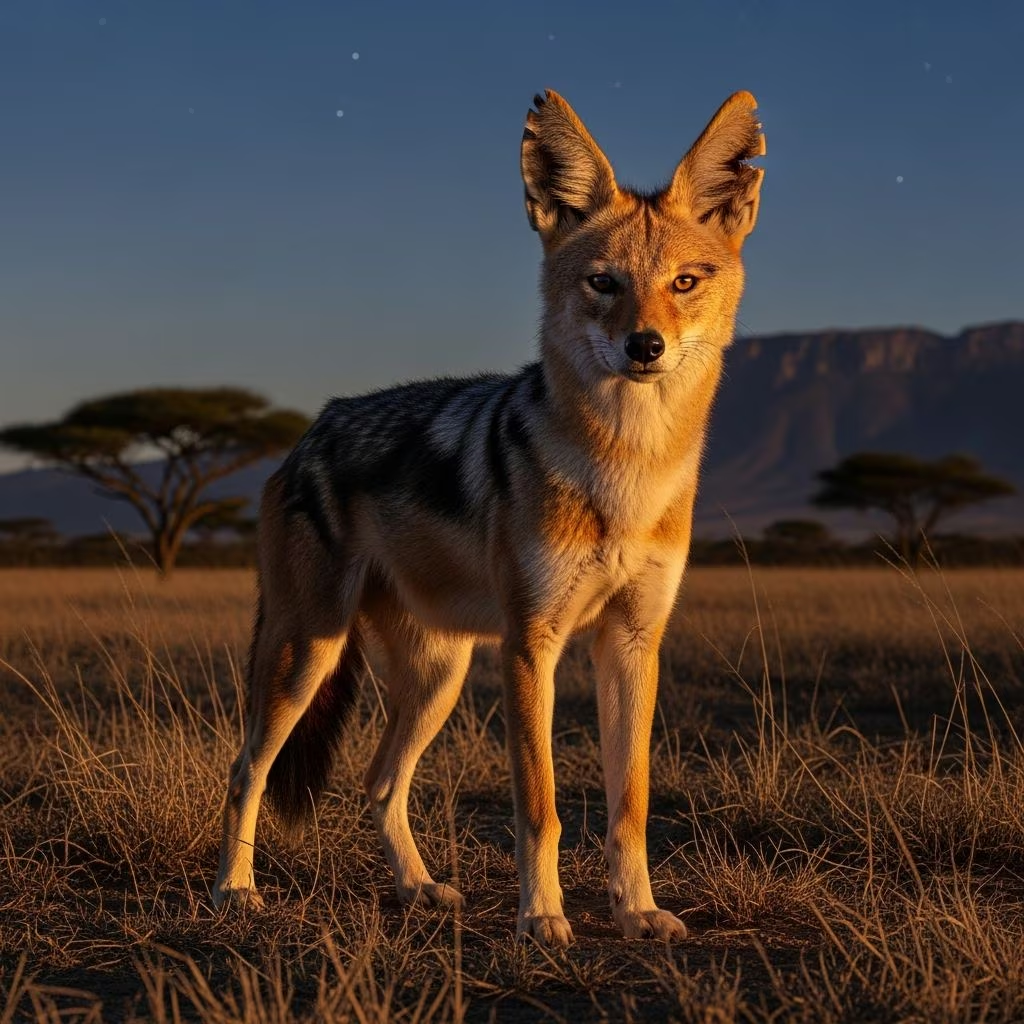
Hybrids between golden jackals and domestic dogs, while rare, have been scientifically documented, primarily through genetic analysis of wild specimens in regions like Croatia. These crossings challenge traditional views of species boundaries among canids and raise questions about wildlife preservation.
The Biological Feasibility of Canid Crossings
Canids, including dogs, wolves, coyotes, and jackals, share a close evolutionary lineage within the genus Canis, making interbreeding possible under certain conditions. Golden jackals (Canis aureus) diverged from domestic dogs (Canis familiaris) thousands of years ago but retain sufficient genetic compatibility for hybridization. This compatibility stems from overlapping chromosomes and similar reproductive cycles, though natural barriers like differing habitats and breeding seasons limit occurrences.
Historical accounts from the 19th century, including observations by naturalists like Charles Darwin, noted captive hybrids that were partially fertile. Modern science confirms that first-generation hybrids can produce offspring, with fertility persisting in backcrosses to either parent species. The cross is reversible, but success rates are higher when the jackal is the mother, as jackal females may accept roaming male dogs during their limited breeding window.
Groundbreaking Genetic Evidence from the Wild
The first confirmed wild jackal-dog hybrids were identified in Croatia in 2015, through a study analyzing tissue from three anomalous canids harvested by hunters. These animals displayed unusual traits: one female had a light coat, depigmented paws, and elongated ears with rounded tips, deviating from typical golden jackal morphology.
Researchers employed a multi-marker approach:
- Mitochondrial DNA (mtDNA) control region: All samples matched the golden jackal haplotype, indicating maternal jackal ancestry.
- Y-chromosome Zfy intron: Male hybrids showed dog-specific amplicons, confirming paternal dog origin.
- Autosomal microsatellites (15 loci): Principal coordinate analysis (PCoA) placed hybrids intermediately between jackal and dog reference clusters.
- Major Histocompatibility Complex (MHC) loci: Exclusive haplotypes further validated admixture.
One hybrid was a backcross to jackal, another to dog, proving fertility across generations. A melanistic 3bp deletion in the K locus (β-defensin CBD103 gene), absent in pure jackals but present in the black-coated backcross, indicated introgression from dogs.
| Genetic Marker | Hybrid Result | Implication |
|---|---|---|
| mtDNA CR (550 bp) | Golden jackal haplotype | Maternal jackal lineage |
| Y-linked Zfy | Dog amplicons (males) | Paternal dog lineage |
| 15 STR loci | Intermediate PCoA position | Autosomal admixture |
| MHC loci | Species-exclusive haplotypes | Hybrid detection utility |
| K locus deletion | Dog-derived melanism | Gene flow evidence |
This study, published in Royal Society Open Science, marked the inaugural documentation of wild golden jackal-dog hybrids, with all cases involving female jackals and male dogs—likely due to free-roaming dogs in rural Croatia.
Physical Traits and Identification Challenges
Jackal-dog hybrids often blend parental characteristics, with jackal traits like slender builds and pointed muzzles predominating in F1 generations. Variations include:
- Coat: Lighter or melanistic colors from dog genes, atypical for jackals’ tawny hues.
- Ears: Longer and rounded versus jackal’s short, triangular ones.
- Paws: Depigmented pads, a dog-like feature.
- Size: Intermediate between jackal (15-30 lbs) and small dogs.
- Tail: Occasionally curled upward, mimicking domesticated canids.
These traits complicate field identification, as environmental factors or individual variation can mimic hybridization. Genetic testing remains essential, as pure jackals occasionally show unusual fur mutations without dog admixture, as seen in Israeli studies where a colorful, tail-curled jackal proved 100% pure via multi-generational DNA analysis.
Historical Experiments and Captive Breeding
Captive jackal-dog hybrids date back centuries. French naturalist Georges Cuvier and others in the 1800s produced litters, noting partial fertility. Geoffroy Saint-Hilaire’s experiments yielded hybrids sterile by the fourth generation unless backcrossed. Darwin critiqued inbreeding in these trials but affirmed F1 fertility.
In India and Africa, where ranges overlap, natural hybrids occur sporadically. Buffon and Darwin referenced fertile crosses, with jackal mothers facilitating easier production. Captive F1s favor jackal morphology but carry dog behaviors like tameness.
Implications for Conservation and Species Integrity
Hybridization threatens golden jackal populations, classified as Least Concern by IUCN but expanding in Europe. Introgressed dog genes could alter adaptive traits, reducing fitness in wild environments. Free-roaming dogs in jackal habitats exacerbate risks, prompting calls for leashing and sterilization in overlap zones.
This phenomenon questions rigid species definitions under the Biological Species Concept, as fertile hybrids blur lines. Canid taxonomists propose a hybrid swarm model, viewing dogs, wolves, and jackals as a continuum rather than discrete entities.
Geographic Hotspots and Prevalence
Confirmed wild hybrids cluster in southeastern Europe (Croatia), India, and parts of Africa/Asia. In Croatia, hunters report increasing anomalous canids amid jackal range expansion. India’s rural areas see frequent contacts due to feral dogs. Prevalence remains low—estimated <1% of jackals—but rising dog populations may elevate rates.
Myths, Culture, and Modern Fascination
Folklore across Eurasia depicts jackal-dog crosses as mystical guardians or omens. Today, social media fuels myths of ‘exotic pets,’ but no recognized breeds exist. Ethical breeding is discouraged due to health issues like hybrid vigor loss and welfare concerns.
FAQ
Are jackal-dog hybrids real?
Yes, genetic studies confirm rare wild and captive hybrids, fertile in first generations.
Can jackal-dog hybrids reproduce?
Partially fertile; F1s and backcrosses produce viable offspring.
Where do jackal-dog hybrids occur naturally?
Primarily Croatia, India, and overlap zones in Africa/Asia.
Do hybrids make good pets?
No; they retain wild instincts, face health issues, and are illegal in many areas.
How are hybrids detected?
Via mtDNA, Y-chromosome, microsatellites, and morphological anomalies.
References
- First evidence of hybridization between golden jackal (Canis aureus) and domestic dog (Canis familiaris) as revealed by genetic markers — Royal Society Open Science / Gopalakrishnan et al. 2015-12-15. https://pmc.ncbi.nlm.nih.gov/articles/PMC4807452/
- First finding of crossbreeding between dogs and golden jackal confirmed — Phys.org / Bob Yirka. 2015-12-15. https://phys.org/news/2015-12-crossbreeding-dogs-golden-jackal.html
- Researchers find evidence of jackal domestication in Israel — Ynetnews / Environment Article. 2023-01-01. https://www.ynetnews.com/environment/article/h1ibmsxhh
- Jackal–dog hybrid — Wikipedia. 2024-01-01. https://en.wikipedia.org/wiki/Jackal%E2%80%93dog_hybrid
- Dog-jackal Hybrids — Macroevolution.net. 2023-01-01. http://www.macroevolution.net/dog-jackal-hybrids.html



