

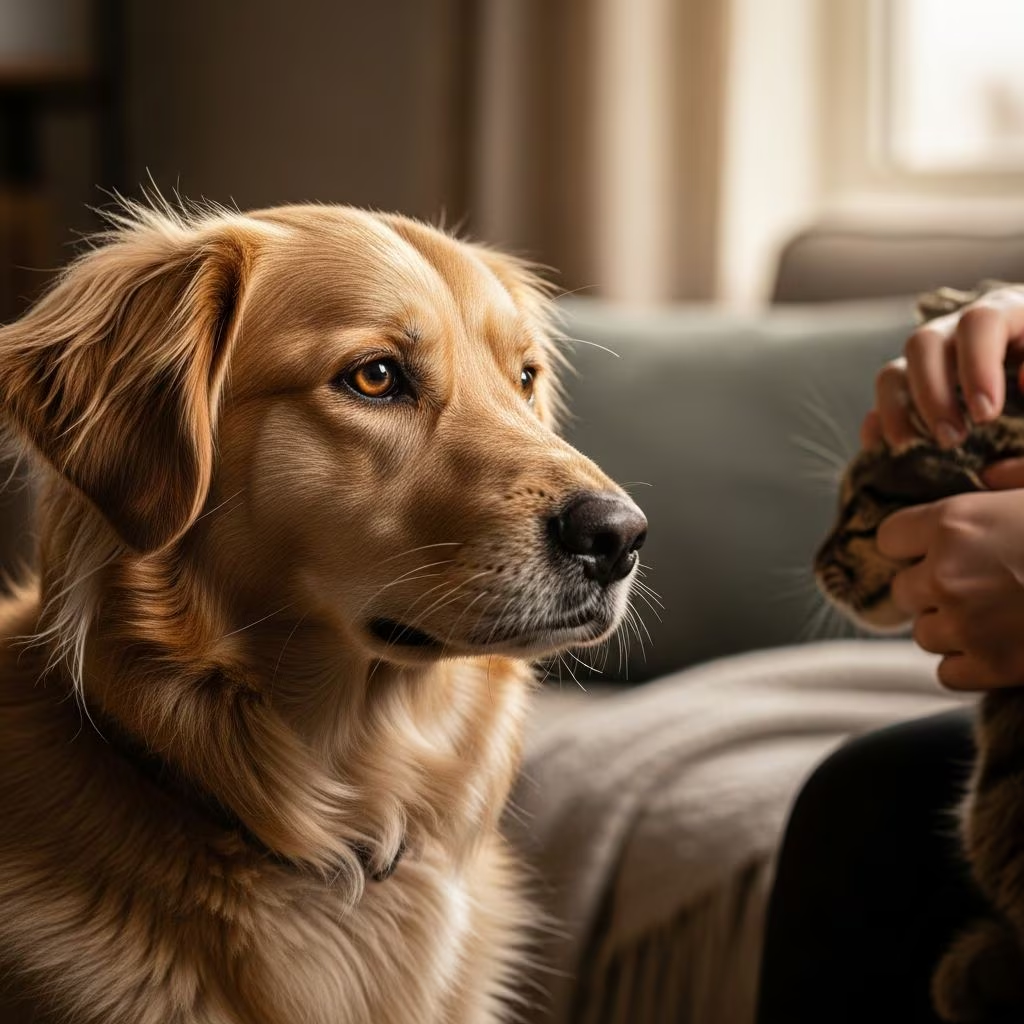
Dogs exhibit jealousy through behaviours like snapping, pushing between owners and rivals, and increased pulling force when owners give attention to other dogs, as demonstrated in controlled experiments using fake dog rivals. This emotional response protects social bonds, akin to primordial forms seen in human infants, with dogs showing stronger reactions to perceived social rivals than inanimate objects.
Do Dogs Get Jealous? The Science Says Yes
Scientific research confirms dogs experience jealousy, particularly when owners interact affectionately with another dog. A landmark study published in PLOS ONE adapted human infant paradigms, finding dogs displayed significantly more jealous behaviours—such as snapping, inserting themselves between owner and object, and pushing—when owners petted a realistic stuffed dog that barked and moved, compared to nonsocial objects like a fleece-covered rolling pin. In this experiment with 36 dogs, 83% showed at least one jealous behaviour towards the fake dog, versus 25% for the object.
Another study in Psychological Science tested 18 dogs’ reactions using a barrier to block views. Dogs pulled harder on leashes (over twice the force) when owners petted an audible fake dog behind the barrier, but not a fleece cylinder or silent dog, indicating jealousy persists without visual cues and targets social rivals specifically. Researchers measured pull force as in child jealousy studies, where effort to approach parents signals distress.
These findings counter earlier mixed results from a 2018 Animal Cognition study with small samples and high variability, which found no compelling evidence but noted limitations. Experts like animal behaviorist Patricia B. McConnell affirm jealousy in dogs mirrors tension seen in preverbal children, observed weekly in multi-dog homes. A UC San Diego study emphasized dogs’ motivation to disrupt owner-rival bonds, with snapping and pushing more frequent towards perceived dogs than books or objects.
Signs Your Dog Is Jealous
Jealousy manifests in observable actions protecting the owner-dog bond. Common signs include:
- Snapping or growling at rivals during owner petting, seen in 41.7% of dogs in one study.
- Pushing or crowding to insert between owner and competitor; 100% of aggressive dogs pushed owners, 86.7% pushed fakes.
- Barking, whining, or excited agitation when owners train or affection another dog.
- Resource guarding of toys, beds, or meal areas against newcomers.
- Potty accidents timed with rival proximity, signaling stress.
- Blocking access to owners physically.
Dogs attend more to threatening interactions and seek owner attention, with patterns matching human jealousy constellations. Aggressive jealous dogs still show multiple non-aggressive signs, spending more time engaging the scenario.
Why Do Dogs Get Jealous?
Jealousy evolved as a survival trait in pack animals. Dogs view owners as vital resources for food, safety, and affection, reacting to threats like new dogs or babies.
- Pack hierarchy instinct: Assertive behaviours mimic dominance manoeuvres to ‘dethrone’ rivals and secure top status.
- Alliance protection: Cooperation aids pack survival; perceived favoritism triggers rivalry to maintain bonds.
- Social cognition: Dogs read human cues like pointing better than chimps, detect inequity, and manipulate attention, enabling complex emotions.
In multi-dog homes, rivalry peaks as household dogs are prime competitors. Even invisible interactions provoke responses, suggesting auditory or contextual cues suffice.
Jealousy in Multi-Dog Households
New dogs amplify jealousy since owners represent ‘all good things’. Existing dogs guard resources and attention, showing aggression or blocking. Research proves stronger reactions to canine rivals than objects. Patience in introductions prevents escalation; dogs don’t feel jealousy identically to humans but respond evolutionarily.
| Scenario | Jealous Reaction | Evidence |
|---|---|---|
| Owner pets new dog | Hardest pulling, snapping | Avg. 2x force vs. cylinder |
| Owner near silent dog | Minimal pull | No social attention |
| Owner reads book | Least behaviours | No rival |
Dealing with a Jealous Dog
Ignore jealous displays to avoid rewarding with attention—scolding counts as engagement. Turn away, back up, or remove calmly. Reward calm behaviour separately.
- Train independently: Equal sessions prevent ‘me too!’ whining.
- Positive reinforcement: Praise non-jealous moments.
- Desensitize gradually: Short, supervised interactions building tolerance.
Consult behaviourists for persistent aggression; books like Doggie Language by Lili Chin aid body language reading.
Dogs and Babies: Managing Jealousy
New babies shift attention, prompting guarding or accidents. Jealousy roots in resource loss, but preparation mitigates: Acclimate scents pre-arrival, maintain routines, supervise eternally. Dogs protect bonds like with rivals, but training ensures safety.
Frequently Asked Questions (FAQs)
Q: Do dogs really feel jealousy like humans?
A: Dogs show a primordial form, with behaviours like pushing and snapping to protect owner bonds, supported by studies on fake rivals. Not identical to human complexity, but evolutionarily similar.
Q: How can I tell if my dog is jealous of a new puppy?
A: Watch for crowding, guarding, barking, or accidents when interacting with the puppy. Pulling harder towards you signals distress.
Q: Should I punish jealous behaviour?
A: No—ignore it completely, as any attention reinforces. Reward calm instead.
Q: Can only certain breeds get jealous?
A: All dogs can, varying by individual and environment; studies used mixed breeds.
Q: Does jealousy fade over time in multi-dog homes?
A: With patient management and equal attention, yes, but requires consistent training.
References
- Do Dogs Get Jealous? — Kinship. 2023. https://www.kinship.com/dog-behavior/do-dogs-get-jealous
- Do Dogs Get Jealous? Exploring Emotion in Your Four-Legged Friend — Richmond Family Magazine. 2023. https://richmondfamilymagazine.com/life/pets/dogs-get-jealous/
- Jealousy in Dogs — PMC / NIH (PLOS ONE). 2014-07-23. https://pmc.ncbi.nlm.nih.gov/articles/PMC4108309/
- Dog Jealousy Study Suggests Primordial Origins — UCSD Today. 2014-07-23. https://today.ucsd.edu/story/dog_jealousy_study_suggests_primordial_origins_for_the_green_eyed_monster
- Introducing a New Dog to a Jealous Dog — Whole Dog Journal. 2023. https://www.whole-dog-journal.com/behavior/introducing-a-new-dog-to-a-jealous-dog/
- How to Introduce a New Dog to a Jealous Dog — Kinship. 2023. https://www.kinship.com/dog-behavior/introducing-a-new-dog-to-a-jealous-dog



